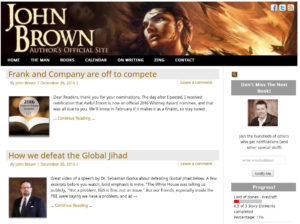
You vote: excerpt or full text?

Readers, for the last year or so I’ve set the blog to show a summary of each post which you then click into as shown below.

For the years before that I just showed the full text like you see now.

I personally engage more with full text displays because I read as I scroll, so even if I’m skipping, I do at least pick up the gist of the post.

Do you have a preference? Does one view “feel easier” to you?

Let me know.

Share

Similar Posts

  • I’m done being Amazon’s fool

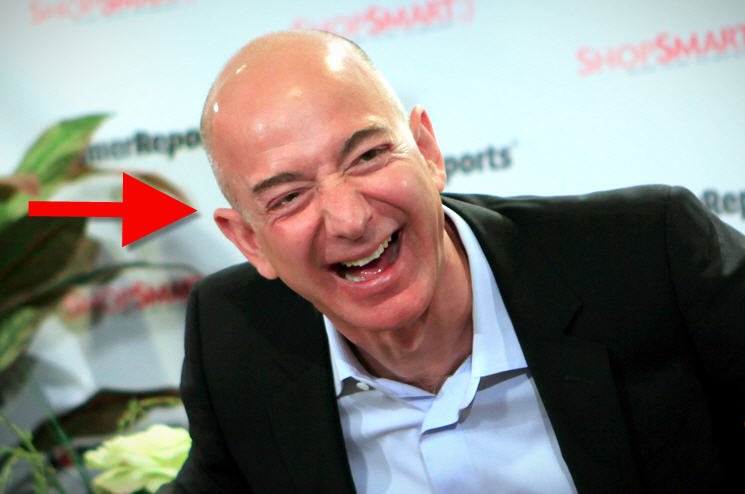
    Do you see this picture? This is Jeff Bezos laughing at John Brown. Because John Brown was a fool.

    Let me explain.

    When I sell my ebooks on Amazon for $2.99 to $9.99, Amazon charges me 30% of the price. I keep 70%. That’s a decent deal. I’m happy to do business with them as a partner with my ebooks.

    But Amazon’s got some alter ego going when dealing with folks selling used books. When I sell used books, Amazon somehow thinks it’s a swell deal for all of us little guys if they take a huge chunk of the pie. Look at the numbers below.

    Order date: 04/08/2017
    Price: $3.98
    Shipping: $3.99
    Amazon fees: -$3.99 (100% of sale price)
    Your earnings: $3.98

    Order date: 04/05/2017
    Price: $5.50
    Shipping: $3.99
    Amazon fees: -$4.21 (77% of sale price)
    Your earnings: $5.28

    Order date: 03/23/2017
    Price: $3.50
    Shipping: $3.99
    Amazon fees: -$3.91 (112% of sale price)
    Your earnings: $3.58

    Order date: 03/15/2017
    Price: $1.49
    Shipping: $3.99
    Amazon fees: -$3.61 (242% of sale price)
    Your earnings: $1.87

    You might think, hey, John, you’re making a few bucks on each. But no, what you see above is what I get from Amazon. I still have to ship the product. And if I purchased the book somewhere, I have to cover those costs as well.

    For example, look at the last one. Amazon feels that not only do they need to charge me the total sale price of the book, they also need more than half of the shipping costs. That book cost over three dollars to ship plus a little for a bubble mailer because I actually care that the book is in great shape when the buyer opens the package. So I lost money. But Amazon did just fine.

    And Bezos was laughing because John Brown, the fool, was paying Amazon for the pleasure of taking time to list the book, shelve the book at his house, package it, and then post it. It was as good as going to Disneyland!

    The fees used to be lower.

    Order date: 06/26/2014
    Price: $3.59
    Amazon fees: -$2.88 (a mere 80% of the sale price)
    Shipping: $3.99
    Your earnings: $4.70

    I hated the fees they were charging then, but after postage, we could still make a buck or so on books priced at this level. Not anymore.

    So adios Amazon. I’m done being your fool. And shame on me for taking so long to recognize it. I’m moving all my used book stock to Half.com because they actually have a good thing going. Look at what they charge for their services.

    $0.75 – $50.00: 25.0%
    $50.01 – $100.00: 22.5%
    $100.01 – $250.00: 20.0%
    $250.01 – $500.00: 17.5%
    > $500.00: 15.0%

    That means on that $1.49 book, they would have charged me a whopping 37 cents.

    Hey, profit for them AND me. And a great price for the buyer. Win-win-win.

    How nice.

    Share
  • Good Stuff! Two books, a movie, and a dinner

    Are you ready for a story that’s heroic and inspirational? And poignant. And action-packed. And all true.

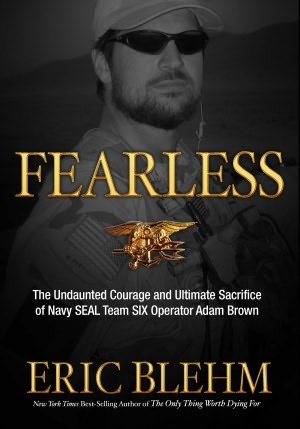
    I just finished Fearless: The Undaunted Courage and Ultimate Sacrifice of Navy SEAL Team SIX Operator Adam Brown by Eric Blehm. And wow. I can’t tell you how happy I am to have read this book.

    It tells the story of Adam Brown who was killed while on assignment in 2010. But this book isn’t about a special operations battle in Afghanistan, although the battle is detailed. It’s not a war book. Although it tells about many episodes in the life of a Navy SEAL operator. No, this book starts when Adam was a kid.

    It like the story of Louis Zamperini that’s told in Unbroken by Laurel Hillenbrand (and, yes,the film adaptation missed so much of the story, including the most important part,that if you haven’t read that book, you are missing out on an absolute treat). In this one, Brown starts out as a boy with bright promise, but after he graduates from high school, he makes a number of bad choices and drives his life right off a cliff.

    You’ll be flipping the pages to see what helps him turn it around and whether he can make the change permanent, or if he’ll lose everything, including the love of his wife and kids. You’ll also be amazed at his grit. It’s a tremendous read. If you can listen to it on audio, you’ll enjoy the narration by Paul Michael. Either way, if you like stories about redemption and triumph amidst struggle, if you like books about special operations forces and elite soldiers, then you’re going to love this book. Highly recommended.

    *

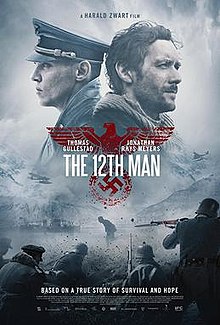
    The 12th Man is a 2017 World War 2 historical drama based on the true story of Jan Baalsrud. He and eleven other Norwegian resistance fighters set off from the UK on board a fishing boat with six to seven tons of TNT to sabotage some German military facilities.

    However, their mission falls apart soon after reaching Norway. A German warship attacks. The resistance fighters set fire to the TNT on their boat and jumped into the water just off shore. Eleven of the fighters are caught by the Germans. The twelfth, Jan Baalsrud, gets shot in the toe, but still runs across land and manages to elude immediate capture by swimming across the fjord, in the dark, in the freezing, winter water.

    Yeah, and that’s just the beginning. The story is about his attempt to get to the safety of Sweden, a neutral country. I watched this with my teenage daughter, and we were riveted with the suspense and action. And we were amazed at what this guy endured.

    You will have to read English subtitles during a large parts, but we found that after a few minutes, we really didn’t notice it. It was a great date night. If you like war movies and action, I think you’ll love this movie.

    *

    Tonight I ate a dish that instantly became one of my favorites. My oldest daughter and her husband found it. They love it and shared it with Nellie. And since it was her night to cook, she decided to give it a try. My first bite was wow.

    It’s a baked casserole, a cross between lasagna and spaghetti, called “MillionDollar Spaghetti” from tastesbetterfromscratch.com. Just click on the link the get the recipe.

    Now, here’s the thing: you can use spaghetti pasta, or you can make it totally low carb by replacing the pasta with cooked spaghetti squash like we did. The low carb version was awesome. I can’t wait to heat up the leftovers tomorrow.

    By the way, here’s a quick way to cook spaghetti squash.

    First, cut the squash in half lengthwise. The easiest and safest way I’ve found to do this is to place the uncooked squash on a cutting board. Next, get a big knife and set it along the line you want to cut. Finally, rap the spine of the blade smartly with a thick stick or long block of wood until the knife cuts through all the way. Using a knife this way is called batoning because you’re using a baton, a stick. It’s a slick and safe way to cut a hard squash.

    Once you have cut the squash in half, scrape out the seeds with a large spoon.

    Next, pour about a quarter cup of water into the hollow of the squash, and then turn the squash hollow-side down on a plate or microwave dish. Microwave the half on high for five to six minutes. It’s done when you can easily pierce the outside with a fork.

    Remove the plate with hot pads and use a fork to scrape out the cooked squash. Voila! Cooked spaghetti squash in less than 10 minutes.

    You can also just bake the halves in the oven for 40 minutes on 375 degrees. Baking gives the squash a slightly richer flavor. In this method, you brush the halves with olive oil and sprinkle with salt and pepper then put the sides face-down on a baking sheet. Again, it’s done when you can easily pierce the outside with a fork.

    *

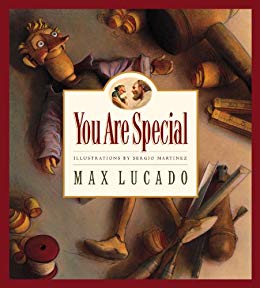
    And here’s one more because it’s Christmas. I attended a young women’s meeting for my local congregation not too long ago. As part of the program, one of the leaders read a picture book called You Are Special by Max Lucado.

    It’s about these small wooden people called Wemmicks who stick gold stars or gray dots on one another. The pretty or talented ones always get stars. The others, like Punchinello, get the ugly gray dots. And then one day Punchinello finds a happy Wemmick that has no dots at all. In fact, no dots stick to her. How does she manage it?

    It’s a great little tale with an important insight. After hearing it, I knew I needed a copy of the book to read to all my grown up kids. 

    Share
  • The secret of Mormonism

    If you want to understand the secret to Mormonism, something 99.9% of the world does not know, even though many think they do, read on.

    This last Tuesday I was at dinner with a number of wonderful coworkers. We were talking about religion and listening to the guy who helps set up our training environments talk about the interesting hunting ministry he’s involved with (it’s very cool—12,000 acres of woodland in Alabama all dedicated to hunting, outdoor survival, and God).

    At one point in the conversation, a delightful fellow trainer, who shared with us the night before the definition of diplomacy as being able to tell someone to go to hell and have them look forward to the trip, asked me, “Does your church believe in Christ. Or, no, is it some other fellow?”

    It’s a great question, and I realized that many people are confused. And so I wanted to take time to clear it up.

    So what the heck is a Mormon?

    It’s not what you think.

    And for those of you who think you know, nope, it’s not about that book.

    Let me explain. You’ll come away knowing more about us than anyone in any of your circles, and you can lord your superior knowledge over them at dinner parties, when playing games that require vast stores of smarts, or at random moments, just because you can.

    Here’s the deal. The first part of the name of the church is “The Church of Jesus Christ.” So, yes, we believe in Christ, that he died for us, was resurrected, is our Lord and god, etc.

    The last part of the name is “of latter-day saints.” We don’t use “saint” to mean super-holy people like the Catholic church does, but more as followers or disciples. So you could translate the last part of the name of our church as “of latter-day followers.”

    So the whole name would be The Church of Jesus Christ of Latter-day People who Follow Him.

    Okay, then what’s the deal with the name “Mormon”?

    Well, here’s where we get to the nub of it and the thing that 99.9% of the world doesn’t know. The key difference between the Mormon church and other Christian churches is that we believe that Jesus has called apostles again in our day, just like he did back in the good old days. And when I say apostles, I mean guys like Peter, James, John, Paul, etc.

    You might be wondering what an apostle is. What made those guys special?

    It wasn’t that they had great faith in Jesus. Lots of people had great faith. It was that they were called to bear special witness of him. And that special witness was not merely that they believed, but that they knew Jesus was the Messiah because they had seen and heard him after his resurrection.

    Peter himself said it best when he wrote in his letter, “For we have not followed cunningly devised fables, when we made known unto you the power and coming of our Lord Jesus Christ, but were eyewitnesses of his majesty.”

    When the apostles had to choose someone to replace Judas, Peter said, “Wherefore of these men which have accompanied us all the time that the Lord Jesus went in and out among us, beginning from the baptism of John unto that same day that he was taken up from us, one must be ordained to be a witness with us of his resurrection.”

    These guys didn’t simply believe. They knew. They were eyewitnesses to the fact that Jesus wasn’t just some preacher—he was the son of God and was resurrected.

    So Mormons believe that Jesus has called apostles again today who bear witness of an absolute certain knowledge of the reality of Jesus the Christ. We believe their purpose is also to be the Lord’s spokesmen when He wants to make general announcements or give general instructions. Finally, we also believe they’ve received the authority to offer the covenants the Lord wants to make with all of us.

    We believe the first apostle called in these latter days was a fellow by the name of Joseph Smith. We don’t worship Smith. He was just an apostle. Just like Matthew or John of old were. But we do believe the Lord called him to be an apostle and restore some truths that had gotten lost or confused over the years.

    We also believe the Lord asked him to bring forth other scriptures in addition to those in the Bible. One of these new scriptures was a translation of an ancient record called The Book of Mormon. It’s called that because Mormon is the name of the guy who wrote it. And Mormon was another apostle—one called by Jesus in ancient America.

    And guess what the purpose of The Book of Mormon is? It’s to testify of Jesus Christ and explain his gospel.

    So the name of the Mormon church is really The Church of Jesus Christ of Latter-day Saints. Mormons believe that Jesus has called and commissioned apostles in our times, right up to today, to bear special witness of him. And in addition to that, those apostles have brought forth additional scriptures that witness of the divinity and mission of Jesus Christ.

    For Mormons, it’s all about Jesus Christ.

    So when someone asks, what’s a Mormon? You can say, let me tell you the real answer. It’s not about an additional book of scripture. Yes, folks gave them the nickname of Mormons because of that book, but the key difference is that Mormons believe that Jesus has called apostles like Peter and Paul again in our day to be his spokesmen, and bear a certain witness of him and his good news, and help folks receive all the blessings the Lord wants to pour out on them.

    And, O, what a wonderful message we Mormons believe that is.

    If you liked those videos, you can see more here.

    Please feel free now to randomly lord your superior knowledge over your family and friends.

    Share
  • Why I think the 10,000 hour idea is bogus

    Here’s the idea popularized by Malcolm Gladwell in Outliers and Geoff Colvin in Talent is Overrated: put in 10,000 hours of deliberate practice (as opposed to mindless practice) into the area of your choice, and you will succeed. 10,000 hours is more important than anything else.

    10,000 hours.

    The idea that deliberate practice makes perfect and leads to success seems to make a lot of sense.

    Except I don’t think the data holds up.

    First, there’s a huge survivorship bias in the 10,000 hour idea.

    Both Gladwell and Colvin based their stuff on Anders Ericsson’s research. I contacted Mr. Ericsson and asked him if there were any studies that weren’t correlational. Any that took similar groups of schlubs and showed that deliberate practice is what took them to elite levels of performance.

    He said no there weren’t, but graciously sent me some files to help. Here’s the money quote in those files:

    “The main focus of deliberate practice was to explain individual differences among those individuals who had had access to all necessary training and practice opportunities. I proposed those factors which could explain the performance differences within groups of expert musicians who had accumulated over ten years of instruction and mentoring by skilled teachers.”

    These were not studies designed to look at those who became elite and those that didn’t and figure out what made the difference. All he did was look at performance differences between experts. Which means there are huge issues using his research to make claims about what leads to expertise.

    Big issue one: he has no idea what kind of practice any of these folks had before he met with them. It’s all self-reported. There were no controls to verify the amounts of “deliberate” practice the musicians had in the long years up to the time he studied them.

    Big issue two (and just as important): he’s looking at experts. It’s all after-the-fact.

    He took a bunch of successful people and looked at their current work habits and speculated about their reports of earlier practice. Hum, they’ve put in a lot of hours. And these guys doing better seem to be doing a specific type of practice. But he did NOT look at a cohort of people who all started out at the same time, track their progress, and then identify factors that made the difference between those who became elite, those who became so-so, and those who ended up in the mud pit.

    But somehow his stuff got twisted into the idea that if you’re starting out and just put in 10,000 hours of deliberate practice, you’ll be successful just like those big guys!

    Big issue three. Ericsson did not study, and Gladwell and Colvin do not address, the factor of early success. Especially in writing and other tournament-style endeavors where rejection plays a huge role.

    So many people quit because the effort is not worth the reward. What you have left then are a bunch of people who persevered, but was it the hours they put in that led them to the top? Or did they have a lot of hours because they hung in there?

    And did they hang in because they had early success?

    And did they have early success because of luck or some natural aptitude or advantage like birthday that seems to factor so heavily in Canadian hockey (I think Gladwell talked about that in the same book–right birth date means you’re older compared to the other kids and therefore seem to have “talent” when it’s just a few months more physical development, which makes a big difference when you’re young) or some parent who had expertise and gave them a leg up against the other kids in their cohort?

    You see the effect of success in reading. My wife works as a 7th and 8th grade language arts teacher. The studies have shown that kids, in general, need to have about 94% comprehension rate to stick with reading. Below that they start to feel failure, get frustrated, and quit. In most cases, reading a super hard book will decrease motivation. Which then leads to less practice. And less skill. They’ve found that kids will work down around an 89% comprehension rate, a struggling range, if they have support. Below that the failure rate leads them to self select out of reading.

    Where in all these studies was self-selection included? Nowhere. Motivation, early success, quitting: disregarding those is a huge oversight.

    And all of these issues are compounded, especially for artists buying into the 10,000 hour idea, by the fact that even if you do get some skillz, that’s a completely separate thing from being noticed.

    Duncan Watts did a fascinating study about cumulative advantage reported in the NY Times here: http://www.nytimes.com/2007/04/15/magazine/15wwlnidealab.t.html?_r=0

    Basically he took a bunch of songs with varying quality and wanted to see how social influence (download counts) affected which songs rose to the top. He put the same set of songs in 8 discrete and separate online environments to see which songs would be most popular. His finding:

    “In all the social-influence worlds, the most popular songs were much more popular (and the least popular songs were less popular) than in the independent condition. At the same time, however, the particular songs that became hits were different in different worlds, just as cumulative-advantage theory would predict. Introducing social influence into human decision making, in other words, didn’t just make the hits bigger; it also made them more unpredictable. . .

    . . . When we added up downloads across all eight social-influence worlds, “good” songs had higher market share, on average, than “bad” ones. But the impact of a listener’s own reactions is easily overwhelmed by his or her reactions to others.”

    So even if your stuff is good, that does not mean it will be popular.

    And when you meet failure after failure after failure . . .

    You’ve got to practice well to get better, to offer more awesome gifts. But you’re not going to practice without the motivation. Motivation is the KEY to learning. And early success is a key part to motivation.

    Another piece of data that seems to belie the 10,000 hour claim is that when you do some simple math and look at surveys of writers breaking in, 10,000 hours starts to look very odd indeed.

    Let’s say you’re a poopy-slow writer and can only get 250 words in per hour. In 10,000 hours will you have written 2.5 million words or about twenty-five 100k novels.

    25 novels?

    Hey, you say, you can’t be typing the whole time.

    Okay, let’s be super conservative with these numbers. What if you spend about half that 10,000 hours writing and the other editing and doing pre-draft work? That’s still 12.5 finished novels.

    That sounds like Brandon Sanderson. Except it’s not. Remember, he sold number 5 or 6.

    Furthermore, the problem is that from all the surveys I’ve seen, writers who break into the old traditional publishing system aren’t averaging 12.5 novels. They aren’t averaging 5 or 6. They’re averaging 3-4, with a lot selling their first or second.

    Hello, Stephenie Meyer and JK Rowling. And a lot of indie authors.

    Jim Hines reports from a survey of authors he conducted:

    “I also asked how many books people had written before they sold one to a major publisher. The average was between three and four. Median was two. I was surprised, however, to see that the mode was zero. 58 authors sold the first novel they wrote.” More at: http://www.jimchines.com/2010/03/novel-survey-results-part-ii/

    10,000 hours? A million words?

    I don’t think so.

    Gladwell scoffs at this 10,000-hours-will-make-you-a-success reading of his original writings on the matter: http://www.newyorker.com/online/blogs/sportingscene/2013/08/psychology-ten-thousand-hour-rule-complexity.html.

    But this is precisely the message so many have taken from the studies. Just put in the time and you’ll become great because the practice is more important than any natural aptitude . . . or early success.

    I don’t think it is.

    John, what in the Sam Hill are you doing? Trying to depress everyone and tell them they can’t succeed?

    No.

    What I’m saying is that we must practice and improve our craft. That’s a given. But we cannot expect that alone to make us successful. Especially not as artists. We can’t expect that 10,000 alone will make our work super popular.

    Working hard WILL increase the probability of success (what’s that saying?–the harder I work, the luckier I get).  But as writers we’ve got to realize that there’s no guarantee of popularity. Or even expertise.

    So what are we left with?

    Nothing, and maybe everything. Because there is passion. There is sharing. And if you can tap into that and rejoice in the sharing that does occur, it might well be the best reward. Bricks of gold in the basement and your name on everyone’s lips must be awesome. But a memory of walking a number of afternoons with a daughter in the hills and telling (sharing) a fine tale to that audience of one might just be worth more than all the gold bricks in China.

    (Yes China, not Fort Knox. You didn’t hear?–we had to ship everything over before we could get another loan.)

    The bottom line is this: there’s no guarantee of success. Not even with 10,000 hours.

    Share
  • |

    My First Year as an Indie Author

    On November 24th last year, a little over 13 months ago, I released my first indie title—Servant: The Dark God Book 1. That release was the official rise from the sideways swamp crash I had with Tor Books.

    BTW, sideways swamp crashes in publishing, which can be caused by all sorts of reasons, are not uncommon. Most writers will take a hit or three in their career. That’s just part of the writing business. The question is what happens after the swamp crash?

    In my case, I got to work. And, boy, was it a lot of work.

    The results have been positive. It was not a phoenixian rise from ashes to glory; it was more like a damp crew patching the ship in the jungle with whatever they had at hand and then launching with nothing but a few birds making any noise. We are by no means past the many perils and obstacles on the path–right now a solid hit from just about anything could knock us out of the sky.

    But we are airborne.

    We are flying.

    And by that I mean the business is delighting readers and generating income.

    I’ll probably hit close to 23,000 paid sales since that launch. The large majority of them were for Bad Penny. To give you some perspective, a single title will make the official Publishers Weekly bestsellers lists (of traditionally published authors) hardback and paperback categories when the title has sold around 100,000 copies in the year. The top dogs report sales of a few million.

    It’s clear the John D. Brown crew has got a ways to go.

    But we don’t have to reach that lofty level to be viable. It would be awesome. At the same time, it’s helpful to be realistic. There are somewhere between 300-400 titles on the adult hardback and paperback list combined. The same on the children’s lists. So I estimate there are around 700 traditionally published books, fiction and non-fiction, that sell at those bestseller levels. That’s out of the millions of trade titles available on Amazon.

    The good news is that the majority of writers making a living don’t appear there. The fact is that you don’t have to sell 100,000+ copies of a single title in a year to make a living. In the indie world, you can do just fine with what Russell Blake calls base hits and doubles.

    So are we making a living?

    Those sales have generated enough net profit to purchase us a nice used vehicle and a few other things. Better than a poke in the eye with a sharp stick (as my neighbor Mike Carr used to say), but making $10-20k can’t replace the day job. Not even close. Still, it’s a beginning.

    Will our crew make it?

    Can they survive the ferocious flying monkeys?

    Stay tuned.

    In the meantime, I want to summarize a few things I’ve learned about indie publishing and give a few shout-outs.

    First, I want to thank all the readers who decided to give one of my books a shot. From the reviews and sales, it appears the majority found just what they were looking for (and there was much rejoicing).

    Second, a big thanks goes to Larry Correia. Not only is he generous and enthusiastic, but his audience is as well. The Monster Hunter Nation made a definite difference for me this year.

    I want to thank LL Muir and Diane Darcy, two romance writers who have been incredibly generous in sharing their indie insights and support.

    Devon Dorrity and Dixon Leavitt spent hours, HOURS, of their time helping me with covers. I can’t thank them enough.

    I also need to thank the Codex Writers. There’s a small group of us indies there, and they’ve all be very helpful in sharing insights about what’s worked for them and what hasn’t.

    I’ve found other resources helpful as well. The Passive Voice kept me current on the industry. Russell Blake’s blogs gave me a clear-eyed opinion of what it takes to succeed. The Calibre ebook editor has saved me many times. And Anne-Marie Concepcion’s online course on using InDesign to publish ebooks was a very good introduction, as were Dean Wesley Smith’s online courses on interior and cover formatting.  I list other resources I found useful in my Resources for Indie Writers post.

    Okay, so what have I learned?

    1. Nothing happens without visibility

    This is retail. If your product is not somewhere that people can see it, they won’t buy it.

    I was in Wal-Mart the other day. My sister calls it the Evil Empire, but she’s a Tarzjay snob. I myself am a value shopper. I want what I want, and I want to pay as little for it as possible. At the same time, I’m not going to go out of my way to get it because searching around costs time and money. So if I’m looking for something in Wal-Mart and I don’t see it on the shelves, guess what? I buy something similar that will do the job.

    Wal-Mart used to stock Marzetti’s Ranch Dip. The best vegetable dip EVAR. But then sometime this year, they stopped stocking it.

    Why?! Why do they stop stocking stuff the moment I find it?!

    (Hey, maybe that’s why they’re the Evil Empire . . .)

    I mourned for a few seconds. And then I purchased the Lighthouse dip. It’s good. If they put Marzetti’s back on the shelves, I’ll switch back immediately. But the point is that if it’s not in front of my eyeballs when I go shopping, I ain’t gonna buy it.

    And I’m finding retail is the same with ebooks as it is with everything else. You can have the best product in the world, but you aren’t going anywhere with it until you are visible to your buyers.

    2. There are a couple of ways that I was able to make my stuff visible

    The way to make my stuff visible was not by publishing on Amazon, Nook, and the rest.

    Publishing means nothing.

    Think about it. There are, right now, 3,079,561 books in the Kindle bookstore.

    Yes, three million!

    If those were physical books, and we lined them up spine-out like we do on a bookshelf, and we assumed the spines average about an inch in width, they would make a line 48.6 miles long.

    For us Utahans, that’s a line of books that stretches from the Mormon temple in downtown Salt Lake City, past Provo, and ends in Springville! (Look up your own local distances to get an idea.)

    That’s the kind of visibility you get by publishing your book, which is nada.

    So if getting it in the store that’s 50 miles long didn’t help, what did?

    Getting on a bestseller list.

    I sold thousands of copies of Bad Penny on Nook when I was on the Nook’s top 100 list. I rose to #3, in the entire Nook store, then hung out around #50 for about a month. And when that burst of sales that made me #3 fell out of the algorithm (30 days later), I fell off the list. My sales dropped like a stone. Not to nothing. But they were a fraction of what they had been.

    How did I get that #3 slot to begin with? The same way I rose to #30 for a few hours in the Kindle store, then slowly dropped to the 1,200s for a few days. I got it by placing an ad with the king of book advertising services, aka BookBub.

    How did I get onto BookBub? Here’s their requirements and tips. Please note that the reviews of Bad Penny were part of what made the book appealing to BookBub.

    How did I get reviews? By using other ad services to make my book visible and getting mentions on blogs like Larry Correia’s and a few others. And by following recommendations in the book Let’s Get Visible and Your First 1,000 Copies and the suggestions of others who are selling well. And that’s a key thing too–looking to see what folks who are selling well are doing, not those who aren’t.

    Of course, readers also liked the books enough create word of mouth. And I can track some of my sales spikes to specific posts or people. The ultimate goal is to have so much word of mouth that everyone’s talking about you. But until that time, I ain’t going to rely on word of mouth alone.

    Why not?

    Because I’d like to increase my odds of success. I’d like to accelerate them. And thinking that word of mouth alone is going to do that flies in the face of everything I’ve learned about retail. Read what I had to say about books and lemonade and tending your garden for more. Consistent efforts with methods that actually have some track record of success seem to have helped a great deal.

    BTW, Bad Penny is currently in the top 10 of three of Amazon’s thriller lists. I guaran-dang-tee you that being on those lists is a big factor in me selling somewhere around 60 copies a day. I saw that with Nook. Being visible starts a virtuous cycle–more people give you a try; if they like the book, they spread the word, which leads to more sales, which keeps you visible, which prompts more new readers to give you a try. Yeah, you’ve got to be good. But you’ve got to be visible first.

    3. In most cases, books in a specific genre are substitutes

    When readers purchase a book, they are looking for a certain type of experience. And my book’s experience isn’t so singular that readers can’t get something roughly similar from another book.

    I love Lee Child. But Robert Crais provides an experience that’s basically inside the same ballpark. So does Nelson Demille and a whole host of others, including me.

    If Lee Child stops writing or slows down his production to one book every four years, I’m not going to stop reading thrillers. There are plenty of other authors that give me the general adrenaline, surprise, action experience I’m looking for. I’ll be sad, but there are a lot of good authors out there. And I’m sure a few will become my new Lee Child.

    Of course, we aren’t all exactly the same. I provide a noticeably different tale than Lee Child does even though we’re in the same Lone-Ranger-vigilante-justice action genre. And so, if I produce the best tale I can, I will find some readers will come to prefer me to Child because I line up more with their tastes than he does.

    In addition to continue to work on visibility and craft, this means I’ve got to up my production. I’m going to try for 2.5 brand new books in 2015. That’s nothing for some folks. But that’s a good stretch goal for me.

    4. There is no one sure-fire way to success

    Even though visibility and studying your craft helps, nobody I know who is doing well has a replicable step-by-step program that guarantees success. There are some activities that seem to make the odds better, but there is no guarantee.

    For example, from what I wrote above about BookBub, you’d think that’s the brass ring. Nope. I know other authors who have run promos with them and didn’t have near the success Bad Penny did.

    Russell Blake’s advice on this seems to square best with my experience. See the links to his blogs here to see what I’m talking about.

    5. Figuring out how to make a living with this has a lot in common with Lean Startup principles

    The basic concept behind lean startup is that when you’re in a market without a lot of info on what works, the company that wins is the one that learns what works the fastest. And you do that by conducting experiments.

    You experiment to see if you’re offering any value to the intended audience. You experiment to see if you’re promo methods are actually feeding your engine of growth. You experiment to see if your audience really is big enough.

    The experimental approach taught in the lean startup stuff has freed me from a lot of anxiety. Success or failure is not about me personally. It’s about my techniques. It’s about my craft and business skills. It’s about me learning how to learn quicker.

    I’m approaching my thriller and epic fantasy properties as experiments. I’m approaching various visibility methods as experiments. My current state of craft is an experiment. If what I’m doing with my current properties doesn’t work, I can pivot and experiment with something new.

    The question is whether I can learn what works–to find an opportunity to add value and provide that value–before I run out of runway.

    If you’re interested in these ideas, let me recommend The Lean Startup by Eric Ries, which explains the general principles, and Running Lean: Iterate From Plan A to a Plan That Works by Ash Mayura, which shows you how to start to implement them. These two books have changed how I approach the writing business.

    Bottom Line

    The bottom line is that I love developing stories and sharing them with readers.

    I knew this already, of course. But having the ship up and flying again made it hit home in a big way. I enjoy the process of developing a story. I love the research, the story generation, the surprises that come along the way. And I love the emails I get and the discussions I have with readers who have read my books and enjoyed the heck out of them.

    So that’s the big summary.

    Year two stands before us. Let’s hope John D. Brown and company can learn and produce at higher levels than we ever have before.

    Have a wonderful 2015!

    Edit 1/14/2015: Here’s John Ellsworth, another indie author, with a similar tale. Although I’m jealous of his seven books in a year. I need to get cracking!
    Share
  • Good Stuff! A clear-eyed view of the Founders

    When it comes to politics, we frequently talk twice as much as we should and listen half as much as is deserved. With our mouths open so much of the time, we fail to get the facts. And this often leads us to paint things in hyperbolic black or white.

    One area where we seem to do this regularly is with the Founding Fathers. Depending on our side, we label the Founders as devils or demigods and the constitution as a wicked document or holy writ.

    Is it possible both sides are distorting the truth?

    Joseph Ellis, one of the nation’s foremost scholars of American history, suggests that we are. He has written an excellent article for the online Encyclopedia Britannica called “Founding Fathers” that points out both the amazing things the Founders achieved with the birth of this nation and some of their most egregious failures.

    I don’t know about you, but I find clarity a good thing. I think it helps us have more productive conversations. If you agree with me, I think you’ll enjoy the clarity Ellis brings to the Founders and the nation they set up. Read his article here.

    For my part, I think the Founders set up an awesome system. Not because it was perfect at birth, but because it was a system that got enough right to allow us to get where we are today. Look at how far we’ve come on so many fronts! And it got enough right to allow us as a nation to get even better in the future.

    Just consider what the Founders implemented that was in no government at that time. The ideals of individual liberty, the separation of powers, the ability for a huge swath of citizens to elect their leaders, the ability to change the constitution itself, the separation of church and state, and the engine of democratic capitalism that has lifted more people out of poverty than anything else the world has seen.

    The Framers didn’t create the Constitution in a vacuum, but nowhere in the world had anyone set anything up that went so far. There was nothing like it, no real examples to follow. And many thought it would fail, just as France’s attempt in their revolution failed just a few years later.

    As for things they got wrong. Well, they themselves soon recognized the way we elect the president and vice president didn’t work and adjusted it. Their idea that political parties wouldn’t form was wrong. Their idea of a militia for common defense didn’t work (see my writeup here). Their compromise on slavery was a festering sore that came to a head before the Union was 100 years old. Their treatment of the Indians was awful. Their reasons for excluding women and those not owning land was bone-headed.

    So, yes, they got some things wrong. Some of them held some beliefs that we find appalling today. And the nation has not implemented their stated ideals as well as we might have hoped. However, the Founders got so many things right. And what’s more, they did it as men living in the times they lived, having grown up with the beliefs and values of that time, not those of 2019!

    While we as a nation have progressed from some of their failures (thank heavens), in other ways the Founders may be are our betters. There are a great many lessons to learn from them, both from their successes and failures. One is their humility—they knew what they’d created wasn’t perfect. Let’s not imagine that we or our ideas are perfect either.

    If you’re at all interested in politics, I recommend Ellis’s article and its view of the Founders. Read it article here.

    Share

14 Comments

  1. Hybrid. Show a summary with the option to expand to see the rest of the post without taking you to a different page. That way you can continue scrolling once you read the post but don’t have to scroll through a long post you don’t want to read all of to get to the next one.

  2. Replying to my own post because I can’t edit it. In full disclosure I subscribe to the RSS feed and don’t actually use the blog. I’m just making a suggestion based on what I’ve seen and personally prefer on other sites.

  3. Full text. I love reading your blog, but I do it in Feedly, which means I have to leave that app to view your full content. I’ll keep doing it, it is just a little inconvenient.

Comments are closed.