Black Hawk Down, Pete Blaber, Not Waving But Drowning

A Ferocious Battle
 I just finished reading Black Hawk Down by Mark Bowden. It is the most gripping account of any battle I have ever read.

In 1992 a Somali warlord attacked and killed U.N. peacekeeping forces. As a result, the US put a $25,000 bounty on his head and attempted to arrest and try him for war crimes. On October 3, 1993, by the order of President Bill Clinton, a force of United States Army Rangers and Delta Force operators, the Army’s most elite warriors, set out to capture several lieutenants of the warlord’s militia in an area of the Somali capital city of Mogadishu that was controlled by the warlord.

The force of about a hundred U.S. soldiers helicoptered in during broad daylight. They roped down to the streets surrounding the target building. It was supposed to take them no more than an hour. They would bag the warlord’s lieutenants, put them on a convoy of Army trucks that had barreled into the city and were waiting right around the corner, and get out.

But the citizenry, loyal to the warlord, weren’t going to take it lying down. They began to swarm with guns and rocket propelled grenades. They attacked, almost heedless of the danger. One Somali with an AK-47 rode a cow out in a strange charge, a number of other Somali’s taking cover behind (yeah, he and the cow died). But the Americans were overconfident of their Black Hawk helicopters. They didn’t think the types of weapons the Somalis had could bring them down.

One chopper was hit and crashed. Then another. A third and then a fourth were damaged and barely made it back to safety before they crash landed. As for the Rangers and D-boys, they were in for the fight of their life.

The book tells the story of their courage, but it also brings in the point of view of a number of actual Somalis who fought and were injured. In the process, we get a view of the battle that is both thrilling and poignant.

Bowden did an excellent job researching and writing this. I could not put it down. It does include some military grade profanity, but it wasn’t there to titillate or shock. I’ve talked to those who saw the movie based on this book, and I could tell the book is, per usual, better than the movie. If you’re at all interested in the military and the military operations we conduct overseas, let me recommend that you read this book. 

Delta Force Commander Shares Insights
Delta Force is the world’s most elite counterterrorist fighting force. Pete Blaber was a Delta Force operator that worked his way up to become a Delta Force commander and took part in some of the most dangerous, controversial, and significant military and political events of our time.

During his time in uniform, he learned a number of lessons about life, about how we make decisions and act on them. In The Mission, The Men, and Me, Blaber writes about a number of the missions he conducted and the lessons he learned from them.

The missions were conducted in Montana, Iraq, Bosnia, and Afghanistan. One featured a commander stupidly ordering Blaber to take his men into sure destruction. Another featured some of the first plans to capture Osama Bin Laden, before 9/11. Another included a man in a gorilla suit.

The lessons Blaber draws from these experiences are fascinating and apply to more than military operations. For example, the lesson he drew from the operation featuring the gorilla suit is something I use every day with my writing. Anyone who leads or manages or works in groups will find other critical lessons. This was another book I couldn’t put down. Anyone interested in special forces will love this book.

Not Waving But Drowning

“Not Waving but Drowning” is a poem by female British poet Stevie Smith. It was published in 1957 as part of a collection with the same title. The work is her most famous poem and describes a man whose distressed thrashing in the sea causes onlookers to believe that he is waving to them, not drowning

I hadn’t thought about this poem since I was a student at BYU. Then a local poet read it as part of his remarks at a conference I recently attended. The image and message lingered with me for hours. I thought about it off and on over the following weeks. This is, for me, an incredibly powerful poem. It needs to be read aloud, I think, to be appreciated. Not in some silly way, but with the appropriate feeling. I’m going to record a reading for my website, but you can read it aloud for yourself. Or have someone else do it for you. Then read it again.

Nobody heard him, the dead man,
But still he lay moaning:
I was much further out than you thought
And not waving but drowning.

Poor chap, he always loved larking
And now he’s dead
It must have been too cold for him his heart gave way,
They said.

Oh, no no no, it was too cold always
(Still the dead one lay moaning)
I was much too far out all my life
And not waving but drowning.

How often does this happen? Those onlookers, caring only superficially, thinking it was too cold, thinking he was funning. But it wasn’t too cold. And his heart didn’t give out. He was struggling for his life, and they were too preoccupied to see it.

Too preoccupied to really see. 

I wonder. Is there someone around me, that if I just looked, just paused from my rush, I’d see they were much too far out, and not waving, but drowning.

Share

Similar Posts

  • “Clockwork Chickadee” by Mary Robinette Kowal

    Mary Robinette Kowal is a professional puppeteer and a dang good story teller. I ran across her “Clockwork Chickadee” this last summer and forgot to blog about it. Then she won the Campbell Award. And I thought to blog it again. Now it’s November and you see what it means to run on “Brown time.” But however belated my review, this story is marvelous. The images have stuck in my mind since that first reading. And the chickadee, well, let me share the beginning with you.

    The clockwork chickadee was not as pretty as the nightingale. But she did not mind. She pecked the floor when she was wound, looking for invisible bugs. And when she was not wound, she cocked her head and glared at the sparrow, whom she loathed with every tooth on every gear in her pressed-tin body.

    The sparrow could fly.

    He took no pains to conceal his contempt for those who could not. 

    I am an impatient reader: if the story doesn’t grab me within the first few lines, I usually pass. I’m trying very hard not to be so demanding and extend this to two pages (no, I do not have the fortitude some readers do to extend this to twenty, forty, or sixty pages). But sometimes I slip back into my old ways. However, with Clockwork Chickadee I didn’t need to remember to be patient. I just read and read and read some more.  

    For those who care about story, you’ll notice it doesn’t run on the normal fuel of sympathy and suspense. This is a curiosity story. And Kowal does it so well.

    Here’s the text version. But if you have no time to read, that’s no problem. Listen to the audio version right now or download it to your iPod or MP3 player and listen while you’re out and about.

    Enjoy!

    Share
  • Witchbreaker by Author James Maxey

    I’m supposed to do this tag thing where one author tells about his or her latest project and then tags other authors to tell about theirs and so on and so on until we turn into some weird internet author borg and eat your brains out. 
    Heck with that.

    I want to simply share something cool with you instead. James Maxey (who tagged me in the borg fest) writes stories with lots of action, fun, and character that also make you think. They always start with a bang and never let up. For example, look at how GREATSHADOW, his last book, starts.

    When Infidel grabbed me by the seat of my pants and charged toward the window, I didn’t protest. Partly this was due to the speed of her action, but mostly due to my inebriation from the sacramental wine we’d stolen.

    If an opening like that isn’t going to make you want to read more, I don’t know what will. Especially when the wine was stolen from a lava-pygmy temple carved into the sheer cliff face of a volcano.  I’m not alone in my appreciation of Maxey’s writing. Orson Card wrote this glowing review of GREATSHADOW earlier this year.

    Here is the opening to Maxey’s “To The East, A Bright Star” which was published in Asimov’s.  It has one of my favorite beginnings.

    There was a shark in the kitchen. The shark wasn’t huge, maybe four feet long, gliding across the linoleum toward the refrigerator. Tony stood motionless in the knee-deep water of the dining room. The Wolfman said that the only sharks that came in this far were bull sharks, which were highly aggressive. Tony leaned forward cautiously and shut the door to the kitchen. He’d known the exact time and date of his death for most of his adult life. With only hours to go, he wasn’t about to let the shark do something ironic.  

    Which brings us to the fact that Maxey has another book out called WITCHBREAKER. That’s such a cool title I wish I could off Maxey and steal it for myself. The book has, as you have seen to the right, a fabulous cover as well. About 5000% better than the horrid thing Solaris put on GREATSHADOW.

    Maxey talks about what inspired WITCHBREAKER in this blog post, which I recommend you read in full. But just in case you’re a lazy son-of-a-gun like me, here’s the meat of the thing. WITCHBREAKER is about a woman named Sorrow. Says Maxey:

    Her father was a judge who hung his own mother after she was accused of being a witch. Sorrow rebelled by becoming a witch herself, but her hatred isn’t directed directly at her father, it’s directed at the religious and political institutions that empowered him. So, Sorrow’s life mission is to overthrow that system. She’s one woman against the world, fighting to make it a better place even though everyone she meets keeps insisting that the world isn’t so bad. I’ve got a soft spot in my heart for characters locked into a lifelong battle against forces more powerful than they will ever be.

    Blast that dang Maxey and his character genius. I’m not envious at all. No, sir. Which is why I suggest you give Maxey a go. Maybe you’ll appreciate him as much as thousands of other readers do. Read the first few pages of WITCHBREAKER here with Amazon’s look inside.

    Share
  • Your Chance to Win a Signed Copy of Gun Runner

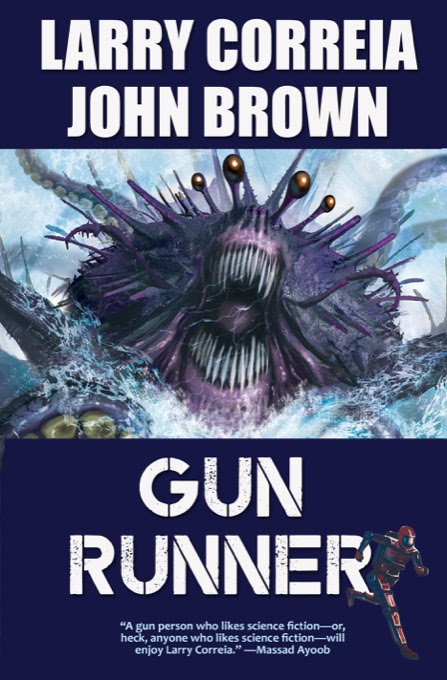
    Gun Runner, the action-packed sci-fi novel I wrote with Larry Correia, comes out in February. But we already have copies.

    And I’m happy to announce that this week you have a chance to WIN A STACK OF FIVE SIGNED SCI-FI AND FANTASY NOVELS that includes Gun Runner.

    Even if you don’t win, you can still get copies at Uncle Hugo’s that were signed by both Larry and I! You can pre-order one now, and get it shipped to you as soon as they’re available in February.

    Uncle Hugo’s is one of those rare indie bookshops that specializes and knows their customers. They’re the oldest independent science fiction bookstore in America.

    Share
  • |

    Monks in Mormonland (and their honey)

    We just visted the Abbey of our Lady of the Holy Trinity this week with my family. It’s nestled on over 1,800 acres of some the most beautiful country in Utah.

    I think almost every religion demonstrates virtues we can all learn from. The dedication of these good men to their beliefs and vows to God is one such example.  As is their decision to live simply. And their creamed honey blends, which you can order from their website, are delicious! So far the maple honey is my favorite. Here’s a 2 minute National Geographic video about this abbey.

    Share
  • Lone Survivor by Marcus Luttrell

    I’m a sucker for military stories. I wanted to be an ARMY Ranger was I was in my teens. Wanted to go commando. Still regret it to this day that I didn’t. And so when a friend told me about Lone Survivor by Marcus Luttrell with Patrick Robinson, I had to read it.

    In June of 2005 four U.S. Navy SEALs took up a position on a godforsaken mountain in Afghanistan close to the Pakistan border. Their goal was to capture or kill a notorious Taliban/al Qaeda  leader whose small army had been ambushing and killing Marines. The problem was: three goat herders stumbled upon the SEALs not very long after they got into position.

    If the SEALs don’t kill the goat herders, they will almost assuredly alert the Taliban force. SEALs are the best. But four against two hundred doesn’t compute. If they do kill the goat herders, then they’re sure someone will find the bodies. The Taliban will claim US soldiers are killing innocent civilians.  And the US media will pick it up. The SEALs were sure they will end up being tried for murder. It wouldn’t be the first time.

    The SEALs let the goat herders go. Within hours the Taliban show up. Four SEALs. Two hundred plus Taliban armed with rifles and grenade launchers who have the high position on a mountain with plummeting slopes and very little cover.

    Lone Survivor tells the story of Marcus Luttrell, the leader of that SEAL team, his training as a SEAL and then that desperate fight in the mountains. He and the other three SEALs fought ferociously. He was the only one to survive.

    I had to force myself not to read this book in one sitting. Not only do you get a great story, but you also get insights into what makes a SEAL and their system of values. You’ll get to know a man who makes you want to stand up for God and country. And you’ll marvel at the courage of those who fight in our armed services.

    I loved this book. May God bless the men and women who risk life and limb for all the rest of us. For the rest of us, we can see what they face in this excellent first-hand account.

    Share
  • The Sing-Off, Sam’s Salmon, The Englishman Who Went Up A Hill

    One of the best TV programs this fall

    American Idol was good until the judges became irrelevant and annoying. Or maybe I was just tired of the format. I didn’t think I’d watch another singing show. But I tuned into the opener for The Sing-Off on NBC last week, and holy harmonies, Batman–it was wonderful.

    Ten of the best a’capella groups in the country compete for a $100,000 prize and a recording contract with Sony Music. Unlike American Idol, the groups represent a wide range of ages—from kids in high school to older adults—and backgrounds. They don’t use any instruments, just their voices, to sing incredible arrangements of modern songs with percussion, bass, and lovely vocals. This ain’t no choir music. And unlike American Idol, the judges actually have interesting and useful things to say. Also unlike American Idol, the judges eliminate the groups until three are left. Only then do the rest of get to call in and vote.

    We were glued to the TV watching each episode. The programs are all two hours long, but move like lightening. Our favorite groups at this point are Committed and The Backbeats.

    This whole show runs a total of three weeks, one episode each on Monday and Wednesday. It started last week, continues this, and finishes next week. Some of you might be depressed, feeling you’ve already missed it.

    Not so! You can watch all of the full episodes online at www.nbc.com/sing-off/ (with fewer commercials). Then tune in for the grand finale. I can’t wait. 

    Are you kidding? From a can?

    Canned tuna fish is one of those un-meats. It doesn’t taste like fish. It doesn’t taste like chicken. I guess the all-white albacore is okay. But tuna’s not one of those spectacular foods I crave.

    So you’d think, as I strolled the isles of Sam’s Club, that I would have passed up the canned Member’s Mark Atlantic Salmon. But one of my wild culinary urges, the ones that rarely pan out, overtook me.

    I purchased a pack of five, seven-ounce cans for $11.88. I brought the pack home put it on the shelf and didn’t dare open it. What was I thinking?

    Canned salmon? Canned meat?! When was the last time you had a steak out of a can?

    It couldn’t be good.

    Of course, my sensible hesitations only last so long. I broke down one afternoon when the cupboards were bare. I saw the salmon and thought that it might go well with a salad and baked potato.

    I opened the can. It was pink, like the trout I used to catch and immediately fry when I went camping as a boy. I tasted it. And it tasted like .  .  . fish. Real fish. The light delicious taste of those trout I caught so many years ago.

    I enjoyed a wonderful meal that day and have had several repeats since. Boneless, skinless filets in water, packed with omega-3 fats, all grown on fish farms in Chile. 

    Great movie set in Wales

    I enjoy Hugh Grant as an actor. I loved him in Sense & Sensibility with Emma Thompson, one of my most favorite movies ever. And so I was curious about another movie with Grant that received two thumbs up from Siskel and Ebert. It’s called The Englishman Who Went Up A Hill And Came Down A Mountain.

    The setup is unusual. In 1917, with the war still raging in Europe, two English cartographers visit the small South Wales village to measure what is claimed to be the “first mountain inside of Wales.” The villagers are proud of their “mountain,” but become alarmed when the Englishmen measure it and find it’s not a mountain but a hill. The villagers are determined not to lose their status. Especially not to two Englishmen. What follows is good humor, drama, and a bit of romantic comedy. I think you’ll fall in love with the characters. It’s a wonderful tale. And it’s on DVD.

    As a little bonus, here are the opening lines, given to us by two narrators.

    “Narrator: For some odd reason, lost in the mists of time, there’s an extraordinary shortage of last names in Wales. Almost everyone seems to be a Williams, a Jones, or an Evans. To avoid widespread confusion, Welsh people often add an occupation to a name. For example, there was Williams the Petroleum, and Williams the Death. There was Jones the Bottle, and Jones the Prize Cabbage… which described his hobby and his personality. Evans the Bacon, and Evans the End of the World. But one man’s name was a puzzle, and it wasn’t until I was 10 years old that I asked my grandfather about the man with the longest and most enigmatic name of all.

    “Grandfather: The Englishman Who Went Up a Hill but Came Down a Mountain? Now there’s a long name for you. And a long story. You are not going to fidget, are you? For this is a story… an epic story. Yes, epic.”

    Share