John’s Reviews – books, movies, whatever

  • Some 101 for Congress and the President

    It’s not really rocket science.

    1. If you have loans outstanding and the payment is due, you owe the creditors a payment. Payables for Idiots 101.
    2. If you have received goods and services, then you owe your vendors a payment. Payables for Idiots 102.
    3. You pay your bills. End of story. That’s what grown ups do. If you have to float some debt for a few months, you do it. And you staple a note to your head to stop spending like a slot machine junkie. Payables for Idiots 103.

    The debts we have are for goods and services we’ve already received. So increase the debt limit and pay your damn bills. What about spending?

    1. You do not spend more than you take in year after year. If you do, that’s called running your business into the ground. In the case of the Congress (primarily Harry Reid’s Senate at this point, although many, but not all, of the Republicans were happy to go along with dumb spending earlier) and the President, it’s the country they’re running into the ground. Spending for Idiots 101.
    2. If you’ve got all sorts of cool things planned like Acorn subsidies for pimps and Antarctica Jell-O wrestling grants for scientists, but you can’t afford them—i.e. you have to go into debt to get them–you cancel those plans. Spending for Idiots 102.
    3. The problem is that Congress and the President buy all sorts of crap and expect to put it on a credit card when it comes due. And there’s nothing to prevent them from doing it.
    4. They’re like irresponsible teenagers. They need controls that won’t allow them to overspend. Kind of like putting limits on a teenager’s cell phone minutes. Or forcing them to use a debit card. When they’re out of cash, they get a card denied response from their vendors.
    5. So you set spending limits, debt limits, and force them to balance the budget each year, except in extreme emergencies like when space aliens try to wipe out humanity. Spending for Idiots 103.

    This means you pass Cut, Cap, and Balance and quit spending money you don’t have. Really difficult stuff. What about getting out of debt?

    1. You eat rice and beans until you’re debt is gone or down to a manageable level. That means you cancel crap you can’t pay for. Sorry earmarks, you’re gone. Sorry grants for nude artists in trees, you’re gone. Sorry subsidies for PBS, you’re gone.  Finances 200: How to Not Be A Money Moron.
    2. You figure out how to reduce your current cost structure. This means you figure out a way to reduce the costs of Medicare, Medicaid, Social Security, and every other service or product you provide, cutting those that aren’t essential. You hire someone like Mitt Romney who knows how to go through every line in a budget and turn a bloated ship around.  Finances 300: No, You Can’t Pay For Your Sister’s Hair Implants with My Money.
    3. You remind people this is the freaking U S of A. A place where a man or woman can make themselves. Not where the government changes your diapers and feeds you mush three times a day. Communism and socialism have failed. They were badly conceived utopias, much like multi-level soap and vitamin marketing schemes that are supposed to usher in the Second Coming.  Finances 400: The USA Buried the USSR for a Reason.
    4. You increase your revenues.
    5. However, if you raise taxes, you’re actually going to depress your revenues. Think about this. Which car company has bigger revenues–Lamborgini or Honda? Who is going to put out, if they’ve got Louie the Fingers and his buddy Jockstrap taking increasing amounts of their money in a protection racket? Don’t be a thug. Be an enabler.  Do what Wal-Mart does and go for volume.  Do what Ebay does–create the environment that entices tons of commerce, entices people to dramatically increase their transactions. Transactions go through the roof; you take only a tiny cut, and, shazam, you increase your revenues.  Finances 500: Um, Do You Want People to Work to Become Rich or Do You Want Them To Pick Up Torches and Burn the Houses of the Rich Down?

    Cut spending, reduce cost structure, and increase your revenues. That’s getting out of debt.

    Is this really that hard?

    EDIT: 8/1 Seems that “wacky” Ron Paul actually has a simple commonsense approach that doesn’t sound crazy. Why couldn’t we do this?

  • Why I’m gonna purchase Correia’s MONSTER HUNTER ALPHA on Monday

    I’m going to be purchasing MONSTER HUNTER ALPHA by Larry Correia on Monday.  Here’s why.

    Reason #1: Correia delivers the goods

    I read MONSTER HUNTER INTERNATIONAL.  I ended my review of MHI saying Correia was going to be a writer to watch.  Well, for those of you who haven’t been watching, not only did Correia  sell tons of copies of MHI, he also made the New York Times best seller list with his second book AND sold TV rights to the MHI series to a major TV producer.

    Why would his books generate such a response? Because they’re so dang fun. That’s why. And Correia isn’t just a flash in the pan one-trick pony. Far from it, as demonstrated by Reason #2 below.

    I told you in my review of INTERNATIONAL that I don’t read books that don’t suck me in. I don’t give them 70 pages to warm up and get going.  I don’t care who wrote the book. I don’t care if the author is a big lug with guns. I don’t care if he has status and money or friends who can put the hurt on me. I don’t care if the author is my girl’s godmother and brings me Walker Shortbread Rounds (which are evil cookies that exert mind control). If the book bores me, I put it down. That doesn’t mean that books which bore me aren’t wonderful. Sales and numerous reader exclamations of delight and satisfaction attest to the the fact that many are. It’s just that I’m a reader of little patience. I love it when a book starts with a bang and keeps me hooked. And Correia’s books do exactly that.   

    Reason #2: Correia’s getting better

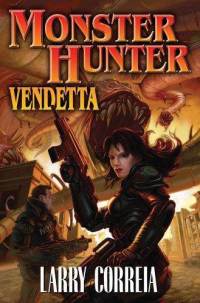
    I read MONSTER HUNTER VENDETTA recently.  I should have reviewed it, but I’ve been so freaking busy I barely have time to shave or appear in public because I’ve begun to look like the Unabomber. But here’s the deal with VENDETTA–it’s better than INTERNATIONAL.  

    Yes. Better.

    Well, expect for maybe the opening paragraphs. The quote and first few paragraps that opened INTERNATIONAL are hard to beat. This doesn’t mean the opening of VENDETTA is weak. Heck, no. VENDETTA trounces the openings of most novels and steals their lunch. And then it continues to delight all the rest of the way through. It’s just that it didn’t quite deliver the same jolt as MHI. But 500 or 503 watts, what’s the difference?

    So with VENDETTA, are there guns? Yes.

    Monsters? Check.

    Action? There’s action galore.

    It appeals to my testosterone right off the bat (even though Larry reports that a good number of his readers are women). But there are guns, monsters, and action in a lot of stories that stink. What Correia does is not only give us great action, but he also gives us wonderful new situations.  For example, you will never see the scene set in the ghetto of Birmingham, Alabama that appears here in any other book. Never. It’s a Correia original. But even more important than great new situations, is that he gives us a first-person narrator who is delightful to be around. I’m talking about Owen Zavasta Pitt, the accountant monster hunter. His responses to the situations he gets in just make me laugh, as do a number of the responses of the other characters. My only wish is that Correia would tone down some of his language just a bit.  It is possible even when writing about military characters.  But you can’t have everything, and Owen’s such a loveable lug, I overlook it.  Hey, maybe Milo will help him out on that as the series progresses.

    Furthermore, Pitt isn’t the only character who I find delightful or interesting.  In VENDETTA there is also Holly, Agent Franks, and G-Nome, one of Correia’s best yet. Of course, there’s also the Doctors Nelson, the former hunter Carlos, Melvin the troll, and Earl Harbinger who have their own moments to shine. As do Owen’s dad and brother. And Dorcas, MHI’s secretary with the plastic leg. Heck, I even like Susan.

    So how many is that–eleven already? How many wonderful characters do most authors give you in one book? Two or three?

    And that’s one of the things that is is better with VENDETTA than INTERNATIONAL.  In INTERNATIONAL, as good as it was, some of the characters just didn’t get the stage time they needed to shine. But here Correia declutters his scenes so we’re not trying to focus on too many people. The result is that those we do focus on each have the their moments and lines. The other thing I noticed was that Correia deftly orients us to each new situation. For those of you who are writers, let me suggest you look at Correia’s technique in VENDETTA for introducing characters and settings. 

    Another good thing: he wipes out a Girls Gone Wild camera crew in the first chapter. Anyone who does that gets a few points in my book.

    VENDETTA doesn’t attempt to become bigger in scope than INTERNATIONAL (as if it could). Instead, it feels like another episode in a great tale. And I’m happy with that because it promises more to come. I’m back with characters I like and situations that make me laugh and magic crap that evokes some oohs and aahs and every now and again makes me wish I’d come up with it for my own use.

    Finally, VENDETTA leavens the humor and action with a couple of poignant moments. I’m thinking of a chapter with Carlos, another scene with Owen’s dad, and one with G-Nome.

    As you can see, VENDETTA’S packed with goodness.

    With ALPHA, I’m expecting to hook up with at least one of the gang for more exploits and laffs. Will Correia get even better? I have no doubt he will. But who cares–he’s already delivering great stuff.  

    Reason #3 Did I mention that Correia makes me laugh?

    Just didn’t want to forget that. Furthermore, I swear I read somewhere that laughter increases your health and makes you live longer. So not only am I getting a great read, I’m extending my days upon the land.

    Reason #4 Monday is a special day

    Not any old Monday. But the 25th of July.

    Why is this special?

    Because it’s the first day of the first week of the book’s release.

    Now I know I’m going to buy this book sometime. But buying it in the first week lets me do something I might not be able to do at some other time.

    Because Correia has given me hours of pleasure, I figure I can tip him for his good service by helping him make the best seller list again.  And a book has the best chance of making that list in the first week of release. (For those of you interested in how that works, Larry gives a good explaination here.) Making a best seller list does all sorts of good things for an author, and, as a result, that author’s readers.

    So Monday’s my day to leave the tip on the table and tell the owner to keep up the good work.

    The New York Times list is a good one. But I’d like to see him on the USA Today list, which measures sales so much better than any other list out there. My fingers are crossed.

    For those of you who are Correia fans or who have been putting off giving his stuff a go, now’s the time to either get MHI and begin the series or ALPHA and continue the delight.

    EDIT: After I posted, I couldn’t wait and just went ahead and processed my order. Pre-orders will count in that first week, and after writing this I couldn’t resist. Looking forward to more hours of laughter and some great characters.

  • Cranford, Balsamic Vinaigrette, Nebo Grotto Falls

    Cranford

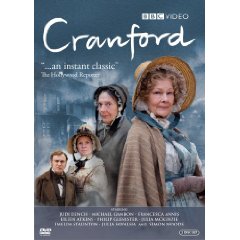
    For those of you who love stories like Pride and Prejudice, have I got a TV mini-series for you—the BBC’s five-part Cranford.

    The series is set in the 1840’s in England in the fictional village in North West England and focuses primarily on a handful of the town’s single middle-class ladies who are forced to deal with lace-eating cats, marriage prospects, and prank valentines, as well as death, loss, and a changing culture. There are also two stories about the male inhabitants woven in as well—one about a new doctor and another about a young boy of the lower class who has a chance for something better.

    I will confess that when I saw this arrive in the Netflix envelope, I wasn’t at all excited. The cover’s too cold–all blue with a bunch of sour-looking women. In fact, I decided not to watch it. But the laughter of my wife and daughters lured me back upstairs to the TV, where it took about seven seconds for me to revise my earlier decision. The characters are delightful. In fact, some of their lines are such a joy to listen to, we had to rewind many parts to watch them again and again.

    The series is based on three novels by Elizabeth Gaskell, a British novelist, which were published between 1849 and 1858. The sets made us feel as if we where there. For example, one of the things I noticed was the lighting. Incandescent bulbs weren’t invented until the late 1800’s and took many more years to find their way into most houses. So the directors, instead of making it feel all Hollywood, seemed to rely heavily on the light at hand, as those inhabitants would have. When a scene was in a house, it felt as if they were only using the natural light coming in the windows or the candles being burned. Of course, this is just one of the many details that made this series an excellent period piece.  

    The best news of all is that I just found out there’s more–a two-part special called Return to Cranford. I can’t wait until it comes in the mail. Don’t let the cover fool you. This is a wonderful mini-series. It has poignant and sad moments, but is also full of humor and wit.  And the ending is perfect.   

    Kroger’s Balsamic Vinaigrette Dressing

    I love balsamic vinegar and oil on bread. But I never think to make it. And I never thought of what else it might go with. That was until a relative left behind a bottle of Kroger brand Balsamic Vinaigrette Dressing.

    I just happened have a homemade bagel handy, squirted out a bit onto a plate and dipped.  Lovely.  So then I tried it on salad and even splashed some on tomato or turkey sandwiches. It’s delicious. Only 80 calories for a whole tablespoon. In fact, it was so good we bought four more bottles because I don’t want to run out.

    Kroger, of course, is a grocery conglomerate. In Utah, it owns the Smith’s, and that’s where you’ll find this delight.

    Nebo Grotto Falls

    The mountains and canyons of Utah are literally desert oases. That’s where our clear streams run, the forests grow, and the wildlife congregates. In the summer, the canyons are a refreshing source for cooling winds. All this meant that, as I grew up, “forest” and “refreshing” became intertwined in my mind. Only when we moved to Ohio did I learn that some forests can also be muggy and hot and not at all refreshing to a desert boy perishing in the humidity.

    Because I love Utah’s canyons so much, we hike and walk them all throughout the summer.  We recently went down to enjoy the Stadium of Fire and the heat (yes, I love dry heat) in Provo. However, we didn’t just hang out in the city. We made time to hike a few trails in the surrounding canyons.

    We love Rock Canyon (just above the Mormon temple in Provo), Hobble Creek Canyon (Springville), as well as Mapleton and Santaquin canyons.  However, there’s another special place that you’ll want to visit should you find yourself in the Provo area. It’s a short little hike just off of S Canyon Road (also known as Nebo Loop Road) which runs from Payson south through the Mt Nebo Wilderness area to Highway 132.

    The trail head is just a few miles into the canyon south of Payson and is marked with a simple sign that says “Grotto.” There’s a little bit of parking on the side of the road. The hike is 0.6 miles along a wooded stream.  The grotto itself is more than worth it.  You can find directions here: http://www.utah.com/thingtodo27245.htm

  • Donald Rumsfeld, The King’s Speech, Aquatic Ancestor Apes & Talking Bacteria

    Donald Rumsfeld

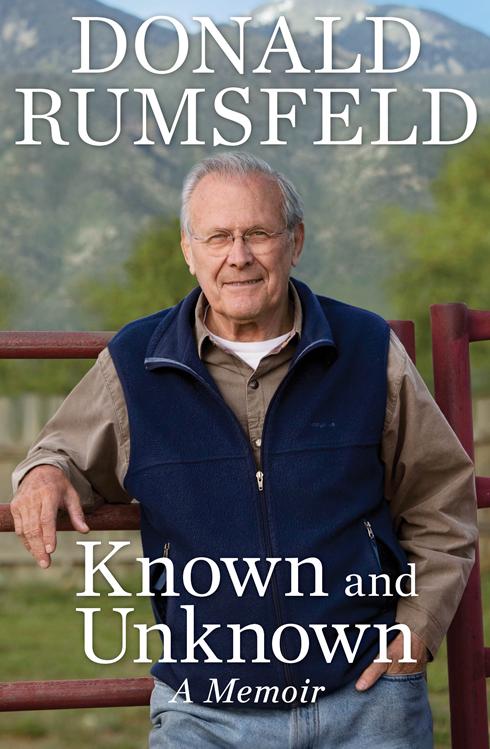
    I just finished Known and Unknown, a fat memoir by Donald Rumsfeld, and enjoyed every page.  Rumsfeld served as the Secretary of Defense under George W. Bush.  But Rumsfeld’s service didn’t start there. He was a Navy pilot, an assistant to a congressman during the Eisenhower days, and, in the early 60’s, a four-term congressman from Illinois.  He held various positions in the Nixon White House in the late 60’s and early 70’s, including ambassador to NATO.  He was Chief of Staff and Secretary of Defense when Ford took over from Nixon.  Reagan tapped him to be a special envoy to both the Middle East after the Beirut bombing and to the Law of the Sea treaty discussions.  He was the president of Searle, a pharmaceutical, as well as General Instrument, the company that pioneered HDTV.  Only after all that, did George W. Bush bring him on as Secretary of Defense.

    When writing novels, I try to create characters worth knowing, either because of their interesting personality or skills or because of the events they take part in. Donald Rumsfeld is just such a character, except he’s no fiction.

    In his memoir he shares insider information on everything from Watergate to 9/11 to the war in Iraq. What emerges is a fascinating look into many of the most important events in the last forty years.  You’ll get insight into some of the issues experienced in various White House administrations and see what really was going on with waterboarding, Guantanamo, Abu Ghraib, hurricane Katrina and many other of the hot button issues in the Bush years. There are some laugh out loud moments where his understated humor shines through. There are also parts where he reveals some of his differences with others that worked with him in the various administrations, including issues with Nelson Rockerfeller, Colin Powell and Andy Card. But in everything he writes he’s fair and restrained and attempts to present the facts accurately. This is no attempt to settle scores.  Just a wonderful read.

    If you are interested in politics at all, I think you’ll enjoy this book. Moreover, I think you’ll come out a little wiser, maybe a little better person, for having spent a few hours with Donald Rumsfeld.  

    The King’s Speech

    I do not watch many r-rated movies.  They are usually too vulgar or pornographic for my prissy tastes. However, I did my research on The King’s Speech, and having heard so many glowing reviews, Nellie and I rented it.

    It was wonderful.

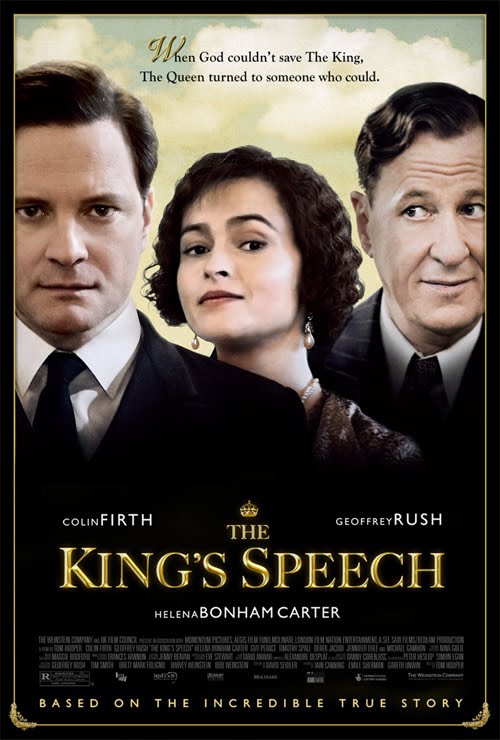
    The movie tells the story of prince Albert Frederick Arthur George of Britain who did not ever expect to inherit the throne and did not want to, in part because of his stammer. Can you imagine having to be a public figure like a king and have to deal with something like that? Most of us dread the thought of public speaking. Can you imagine having to try with a stammer?

    But Albert’s lot was not to live the sheltered life. He became king when his brother abdicated the throne because of improprieties in his personal life. The day before the abdication, Albert went to London to see his mother, Queen Mary. He wrote in his diary, “When I told her what had happened, I broke down and sobbed like a child.” That is not the entry of a power-hungry man.

    He assumed the throne in 1936, when England ruled over almost a quarter of the world’s population. Three years later in 1939 WW2 broke out and Britain’s king needed to be able to address the people.

    In the movie, Colin Firth plays Price Albert. Geoffery Rush (Captain Barbossa in Pirates of the Caribbean) plays Lionel Logue, the unorthodox Australian speech therapist to whom Albert’s wife turns for help. The script is wonderful and the star-studded cast is spot on. There are moments of humor and poignancy and triumph. I was caught up in this movie as much as any I’ve seen.

    If you like English dramas, you’ll enjoy this one. And the profanity, the reason for the r-rating, is not there to depict casual vulgarity. It was part of a technique used by the therapist. In the end, you’ll overlook it and find yourself on pins and needles, rooting for this fine man.

    Aquatic Ancestor Apes & Talking Bacteria

    I’ve written about TED before. The annual TED (technology, entertainment, design) conferences, in Long Beach/Palm Springs and Edinburgh, bring together the world’s most fascinating thinkers and doers, who are challenged to give the talk of their lives (in 18 minutes or less). The folks at TED record these speeches and put them up for free on their site for the rest of us to watch. And I just watched two dandies.

    The first is by Elaine Morgan who says we evolved from aquatic apes (sigh, just when you think you’ve found grandpa Eddy hanging out in the trees, you learn he’s an imposter). Morgan is a Welsh writer for television and also the author of several books on evolutionary anthropology. In the speech she describes the reasons why it makes sense that humans had aquatic ancestors. Along the way, she illustrates key principles of science, including why science by consensus is no science at all. Her manner is so delightful and engaging I think I could listen to her for hours, preferably around the dinner table. Watch her right now. She just might convince you.

    The second speech was given by Bonnie Bassler, an American molecular biologist, who has been part of the team that discovered key insights into how bacteria talk. It appears that bacteria do not invade a host and start doing damage. No, they wait until their numbers are sufficient that they have a chance of surviving. They coordinate defense and mount attacks as a group. Who would have thought? Knowing how this works is not only interesting all by itself, but it has stunning implications for medicine and fighting infection. Bassler is a fascinating and enthusiastic presenter. Among other things, you’ll end up seeing that humans are more bacteria than you could imagine. Watch her.