The first time I attended a high school prom in Rich County, I thought the Rich County people were from another planet.
I was married. My wife Nellie had grown up in Rich County, and said that we had to go to her little brother’s prom.
“Your brother’s prom?” I asked. Like, what?
“Yes, my brother’s prom.”
Weird, I thought. Because in the big city, older brothers and sisters who have graduated simply do not go to high school proms.
But I’m always up for strange new experiences, and so we went.
And I can report that it was indeed strange. In the big city, grandma and grandpa do not attend the prom, nor do mom and dad or little brothers and sisters. And they most assuredly do not sit in the stands and watch the junior class perform a dance.
But that’s what they did in Rich County. And so I sat next to grandma and grandpa who were nigh unto eighty years old and watched an announcer present the junior class. There was a makeshift stage. And the announcer would announce the names of a young woman and a young man. On the stage, the young woman would take the arm of a young man, and then he would escort her out to the center of the floor to the applause of everyone in the gym. The couple would then perform a little action—he might twirl her, or she him, or she might jump in his arms, or he in hers, or she might lift her dress enough to show she was wearing cowboy boots that matched his, or dozens of other little creative things, and then they’d walk to the side to make room for the next couple.
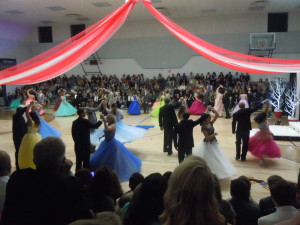
In Rich County, there are only forty or so kids in a class, so it didn’t take long. When the juniors were all announced, the whole junior class, in their tuxes and dresses, spread out and took their places on the floor. A song began to play, and then they performed a dance that had been choreographed specifically for the occasion.
When it finished, the mother or father of each junior went out onto the floor and danced a slow dance with their son or daughter.
They then presented the seniors in the same way, after which the parents of the seniors went out and danced with their sons and daughters.
Only when that dance ended did the lights dim and the “normal” dancing begin. Nellie and I danced a few songs, and then she said it was time for us to get some refreshments and go.
And that’s what we did, leaving the teens to their evening.
I had never before seen anything like it. I laughed and wondered. Those funny hicks, I thought.
I took a job in San Francisco for a few years, then another in Columbus, Ohio. And then, years after that hick prom, Nellie and I moved from the big city to Rich County. That was almost thirteen years ago.
This last Friday I watched as my third daughter was announced and walked down from the makeshift stage. She was escorted by a young man, looking handsome in his tux. I watched him twirl her and another girl (he got to escort two). And when all the seniors had been presented, I got to dance with my girl at the prom.
I cannot tell you how sweet that was to look in her eyes, to see my little girl grown up into this beautiful, strong woman. I thought about how she was soon going to leave us, and tears threatened to spring into this papa’s eyes, but she smiled and said, “Don’t you dare.”
What’s a man to do? I obeyed. And instead of blubbering, we danced.
When we finished, I gave her a hug and a kiss on the forehead and returned to the stands.
I’ve danced six times with my girls at these Rich County proms—once when each was a junior and once when they were seniors. And I love this tradition.
I love that a huge part of the community comes out to the dance. I love that we honor and applaud these great kids. I love watching the juniors in their gorgeous dresses and handsome tuxes perform these beautiful, formal dances that remind me of something you might find in Victorian England, something that seems to have stepped right out of Pride and Prejudice.
Juniors performing danceParents dancing with kids
What an excellent evening.
How lucky I am that places like Rich County exist, and that I get to live in one of them.
Folks running for office, especially our wonderful citizens running for local county offices, business owners, and any of the rest of us who what to persuade people to listen, I’ve got something for you.
I will bet that most of you aren’t aware that you’re muddling your message and losing votes, sales, and converts to your causes.
Of course, maybe you’re way ahead of me. I thought I knew what I was doing. I have a master’s degree in business, spent a few years in business consulting, have created a few small startups, and currently am a product manager for large software company. Despite all of that, I had somehow missed something vital. Something simple and powerful. Something that has a dramatic effect on sales, votes, and converts. On getting people to even listen to what I had to say.
And I’m not alone. I saw another company struggling with it this weekend.
On Saturday I went and watched the latest Marvel movie at a theater in Logan. One of the pre-movie video ads was for a local company called Conservice. I don’t know how many thousands of dollars they spent on the ad they played. Or how much they spent on the many other ads we’ve seen over the years. But when it finished, I turned to Nellie and said, “I still don’t know what that company does or why I should care.”
“I know,” she said. “I know.”
We were both baffled. After years of seeing their ads, we still have no idea what they do, how it would make our lives better, or what action we should take to use their service.
They have wasted thousands and thousands of dollars on their marketing.
There’s another local company that advertises during those pre-movie slots. It’s called ARS. I saw one of their ads this weekend as well. But it only reminded me of what I already know. I know exactly what they do, how it would make my life better, and what action to take.
If you have a flood, fire, or plumbing backup—whatever—they clean it up. “Got a mess? Call ARS.” That’s their one-liner.
If I ever have a mess, I will call ARS. I will never call Conservice. I have no idea what they do.
What’s the difference here?
Clarity.
And what generates that clarity?
A complete focus on the customer. The ARS ads are all about the customer and their problems and needs.
The Conservice ads, on the other hand, are all about Conservice. We’ve been in business for x years. Here’s what our building looks like. Here’s a worker planting a bush. Blah, blah, blah.
The ARS ads are all about me, the guy in the theater seat, the thing I want and the problem I have. ARS features me as the hero in my own story. They present themselves as the helper—the Yoda or Gandalf or Haymitch who helps the hero get what they want. You got a mess? We’ll help you.
The difference in the power of the two ads is night and day.
Of course this means it’s been verified that I’m a dolt. After all the years in business and education, I should have known this. But the surprising truth is that I’m not alone.
I look at the marketing we do at the billion-dollar company I work for and see this same issue everywhere. Millions of dollars spent on muddles. I look at company websites on the internet and see more muddles. I recently listened to pitches by many of our local citizens running for office and saw the same thing. It seems this communication muddle afflicts a lot of us.
About five years ago, when I began investigating an idea for a new company, I came across the Lean Startup method pioneered by a guy at Stanford and began to see the light. But a few months ago, the curtains were completely pulled aside to let in the sunshine. And wow! What a revelation.
If you want to get people to listen, you have got to hear what Donald Miller has to say. He’s consulted with thousands of companies on how to clarify their message so people will listen. His framework and method make clarifying your message so easy.
He calls it the StoryBrand framework, and it’s brilliant. What it does is help you clarify your message so that a customer or voter or whoever will know within three seconds:
What you offer
How it will make their life better
And what action they should take if they are interested
But it goes beyond that. It helps you actually define what you should be offering in the first place. It’s a powerful product development tool. I’ve started using this in all my business efforts. And in my training and presentations.
For example, I just used it to develop a presentation I delivered at a huge writer’s conference last week. The results were that after the presentation, I had a line of people wanting to thank me. I had people telling me I made them cry. Others wanted to give me a hug. They were grateful. I had people tell me it was the best presentation of the conference.
This was not because I’m brilliant. I’m a dolt, remember. It’s because I used the StoryBrand framework to focus on those people. Their needs. Their problems. Their aspirations.
If you’re running for office, if you have a business, if you want to persuade anyone to do anything, then let me recommend you listen to this guy and learn about this framework.
Get the revelation. Get out of the muddle. And get people to listen.
And when you’ve finished the Miller stuff above, read How to Write Copy That Sells by Ray Edwards, the guy who has partnered with Miller. It’s all about clarifying your message as well.
No, really. It’s true. You just have to spend smartly. And in a special way.
Over the course of your life, if you make what the average American does, more than a million dollars will flow through your hands. And yet so many of us don’t feel rich. That’s because money is like the Gingerbread Man. Turn your back on it, and it’s out the door, rudely taunting everyone as it flies by. And then it gets eaten by a fox. Such a waste.
But it doesn’t have to be.
Let me share with you THE best method I’ve found for managing my money. It takes tons of anxiety out of spending and saving. And, if you’re a Dave Ramsey fan, it is the one thing upon which everything else he teaches depends. If you’re not a Ramsey fan, it doesn’t matter. After getting a job, this is the first thing you must do to get rich.
Here’s the big secret. It has three parts:
1) Decide how much you’re going to spend on various things BEFORE you spend it
2) Make what you have left in each spending category EASY to track
3) Manage the things you can’t foresee
To do the first two parts, you’re going to create a special kind of spending plan. We won’t use the term “budgeting” because “spending” is so much more fun, and because that’s what we’re going to do anyway. To understand how to do this, you need to watch three videos.
Before you do, please know I earned a Masters degree in accounting. I’ve used Quicken for more than twenty years. Neither of those things has helped me manage my money like this simple method. If you’re looking for a better way to manage your money, this is it.
First, watch this video to get an overall idea of how this method works.
Note: you can use actual envelopes and cash for everything if that makes you happy, but you really don’t need to. The idea is to think of pre-allocating your monthly income to categories of expenses AND then having an easy way to track what’s left.
Now, watch this bubba explain how he does it.
But John, didn’t he say the same thing?
Basically, but he has a fun accent. Besides, it’s good to see another example. And please note again: you don’t have to use actual envelopes and cash, although many swear by them.
Finally, watch this one. No, it’s not just another repeat. There are some additional important ideas illustrated here.
This video brings up the idea of why simply tracking an overall account balance isn’t very helpful. It also shows you WHY envelope categories are–they make it immediately apparent how much money you have to spend for a thing. If you just use Quicken to track what you spent (looking in the past), you’ll run into troubles. Let me tell you, I know this from experience. We use Quicken, and have for years, and plan use it for some time to come because it makes taxes and bank reconciliation a snap. But Quicken only tracks what you spent. Tracking, as important as it is, is not the key to success. The key is pre-allocating BEFORE you spend. And then tracking so you know what you have left in that category. And making that tracking EASY.
The final thing you have to do is manage the things you can’t foresee because things rarely go exactly to plan. Unexpected things ALWAYS come up. Your daughter will crash the car. Your husband will get appendicitis. You will forget that you had a $200 school sports expense.
Okay, fine. Things happen. But how do you manage them if you can’t foresee them?
If it’s really small, you simply adjust your plan. For example, if you need $30 more in food, you can transfer it from fuel if you have some extra there.
You manage larger things by building up an emergency fund. Ramsey suggests starting with a $1,000 emergency fund and then trying to get two to three months of living expenses—about $10,000 to $15,000 for most people. Unexpected things WILL happen and cost your money. So build up some cushion to take care of them.
Finally, you manage the really large things by getting proper insurance. This is what insurance is for. The types of insurance you need include (1) homeowner’s or renter’s, (2) auto, (3) medical, (4) long-term disability, (5) long-term care (for those 60 and older), and (6) life insurance. You may add true identity theft insurance as well.
Okay, so that’s the overview. If you want to try this, here’s how you do it. It’s fairly easy.
STEP 1: get your head straight
Resolve that you will NOT use credit for anything. You will not spend any money you don’t have. You will not put another dime on a credit card, and this despite the fact that the plastic devil companies are begging you with offers almost every day to sign up for their cards. (Hum, I wonder how they afford all that junk mail.) If your monthly bills are greater than your income, then we have to fix that first. But the new law of the land is zero new debt.
Next, always remember to allocate your money to these categories first—shelter, food, adequate clothing, and adequate transportation. This means if you have a crunch month, you would NOT pay credit card bills before food, even if you work for Visa.
STEP 2: get your blank sheet & pencil
Get out a piece of paper and pencil (not a pen) or open an Excel spreadsheet. Whoa, that was an easy step.
STEP 3: list your monthly income
List your expected monthly income at the top from all sources.
STEP 4: list your spending categories
List your spending categories. You’re going to split them into two groups.
The first group goes right below your income and includes all of your recurring monthly expense/spending categories. Not the amounts you spend. Just the categories. Things like mortgage, electricity, phone, groceries, dining, etc. Make sure you include some entertainment/fun money.
The second group goes below your recurring monthly expenses and includes all of your major annual periodic expense/spending categories. Things like Christmas, vacation, clothing, kids back to school stuff, etc. And things you want to save for—a couch, iPhone, car, etc. Your emergency fund goes here as well.
Decide how much you will spend in each category this month. You should have 0 dollars when you get to the bottom of the sheet. Spend (allocate) every dime BEFORE you start the month. You’re going to do this at the beginning of each month. And you will probably have to adjust it a couple of times during the month.
You will probably have categories that don’t get any money this month.
You will also have categories that get money, but you won’t spend any of it this month. These are your periodic expenses. Your goal is to have the cash up front to pay for them, so you have to save for them. Remember, you are NOT going to take on any new debt.
For example, if you’re saving up for Christmas, you allocate some money for that out of this month’s funds and TRANSFER it to savings. Then it will be there when you need it. You could draw the cash out and put it in an actual envelope, but you don’t have to. Just as long as you keep a record of the total amount in savings and what it’s all supposed to be for, i.e. total savings in July = $1,000: $500 for back to school, $200 for Christmas, and $300 for my trip with kids to Six Flags in 2013.
STEP 6: mark the “watch” categories
Some of the categories you need to watch closely, and some you don’t. The ones you need to watch closely will be your “envelope watch” categories.
The categories you don’t need to watch as closely are those that are automatically taken out of your account each month. And those you will write a check once a month for. These things include mortgage, car payment, electricity, etc. These are NOT categories you need to use actual envelopes for. You can track it on paper or in the spreadsheet. Not much happens with these categories.
But there are other categories that you’re going to be spending throughout the month, and it’s easy to over spend if you don’t track them. Groceries, dining, entertainment, gasoline, a specific vacation, etc. are all categories that you make multiple purchases with each month and are flexible/discretionary and need to be watched closely. So while everything is tracked in a category/envelope on paper or on the computer, you’ll track these with either a real envelope and cash or a virtual one using that free software you saw in the third video or a piece of paper with a running category balance in your wallet.
STEP 7: have fun and spend!
Now go out and spend!
Before spending, check your envelope. Do you have enough money? If you do, spend and be happy. If not, save up for it or find a way to save money in another category and adjust so that you’re still spending the same total amount. Never spend what you don’t have.
If you feel you need something not planned for, well, you have to get it later OR transfer something out of another envelope. I just make myself wait a day or three, and usually the urge to buy, Buy, BUY! goes away, and I see I don’t “need” it right now. Or maybe a more affordable option presents itself.
If the kids want something, and you feel guilty you can’t give it to them, just tell them what’s in the envelope/category, and tell them they can save for it or choose something else in that category that will fit with what you have left.
If you’re tracking envelopes virtually or using the paper balance in your wallet, you MUST update your envelope AFTER every purchase so you don’t spend more than you have. If you find you just can’t seem to remember to do this, go to the cash method.
That’s it!
Of course, that’s not quite it because even though it’s easy, if you haven’t done this before, it might take some adjustment. Give yourself a month or three to get it down. Because when you do, it WILL produce great results and peace. It’s doing that for us.
If you feel you need more info, I suggest you read Dave Ramsey’s Complete Guide to Money. Here’s the first chapter to sample: Complete Guide To Money sample chapter.
Happy spending.
EDIT: here’s another video to watch: http://www.youneedabudget.com/. Then read about the method: http://www.youneedabudget.com/method. This one highlights the idea that you need to make sure you realize that things will happen that you cannot foresee. No plan survives contact with the enemy.
My daughters have introduced me to Studio C, a comedy program that started with The Divine Comedy troupe on the BYU campus who all growed up and were given a gig on TV. They do these hilarious skits.
Next is John Branyan’s brilliant “Three Little Pigs”. My family and I have been enjoying this for months.
Finally, here’s something to think about. You know I enjoyed Jonathan Haidt’s book The Righteous Mind. Matt Wolfe pointed it out his TED talk to me. The one that preceeded his book. If you’re conservative, like I am, this talk will, at times, annoy you. But the ideas behind it are great.
Two weeks ago I published the top 200 novels and authors of YA fiction. As I stated then, looking at bestselling novels only gives one view into what readers are enjoying. Looking at library circulation gives another view that complements sales. These rankings are based on the circulation (number of times the book was checked out) at the Logan Utah Libarary which serves a community of over 100,000 residents.
This week I present to you the top 200 Juvenile (these are mostly middle grade) novels of 2010. These are from the 5,377 different titles that were checked out. I can’t claim these lists show what’s most popular nationally. I’m confident the libraries in each region of the nation will have lists that vary a little or a lot from these. However, this does show what’s being read in this neck of the woods. Furthermore, all of these should be great reads for middle graders, teens, and adults.
As before, the list features a lot of authors who live in Utah or have ties to Utah. The number of titles are in ( ).
Obert Skye (8)
Brandon Mull (6)
James Dashner (3)
J. Scott Savage (2)
Matthew Buckley (1)
I’m surprise at just how much these folks dominate this list. They’re rock stars! If I’ve missed anyone, let me know. For the previous lists, see these links:
It was date night with daughter number 4. I asked her what she’d like to do.
She said she wanted to play a computer game. She likes the ones on friv.com. Probably because there are a couple hundred to choose from, and they’re free.
Every time we’d play games before, we’d play Miragine War. Warriors, monks, zombies. My army against hers. Sometimes I’d win. Sometimes she’d win. It’s a fun game. It gets a little tedious with the back and forth, but we always had a good time with the slaughter.
This time she wanted to play something new called FireBoy and WaterGirl.
The animation is done in a style similar to FancyPants, which I just love. Not as exaggerated, but still fun movement. The two characters are cute. FireBoy dies in water. WaterGirl dies in fire. Both die in the green mud. And the interesting thing is that it isn’t a competition. I don’t have anything against games that pit players against each other. I love them. But this one was a nice change. The two players actually have to help each other to progress. Part of the fun is figuring out exactly what each of you have to do and in what order to make it through the scenarios.
So daughter 4 and I laughed and yelled and cheered when we didn’t die. We had a great time. We must have played for at least two hours.
If you’re looking for a good date, give FireBoy and WaterGirl a try. Oh, and if you go to Friv.com to play it, it’s the little guy with the burning head.
I met Janci Patterson a few years ago when she was shopping her book Chasing the Skip to NY publishers. It’s about a girl named Ricki. Her mother flakes and runs off, and so Ricki goes to live with her estranged Dad who happens to be a bounty hunter. I was hooked right there. But it gets better. Ricki gets to ride along and help and, wouldn’t you know it, develops a crush on a guy the dad is chasing.
I loved the premise. Traditional publisher Henry Holt loved it too and thought Janci had done a great job telling the tale, so they made her an offer that Janci accepted. It was published in 2012.
Sounds like a match made in heaven, right?
Well, Janci just released another book called Everything’s Fine, a mystery about a girl named Kira. Her best friend commits suicide immediately after her first date with her longtime crush, Bradley Johansen. Kira’s devastated and wondering why. She’s sure the answers are in her friend’s journal. As she searches for it she quickly learns she’s not the only one who wants that journal. Someone else is trying to keep the secrets the journal contains hidden.
Another great premise. And this book won the Utah Art’s Council award for Best Young Adult Novel. Clearly, Janci can tell a story. But Janci didn’t take this one to NY.
She’s publishing it as an indie.
Here are her own words explaining what helped convince her going indie was doable.
A Paradigm Shift
For years I refused to think about self-publishing. This wasn’t because of the stigma, honestly, but because of all the work I watched my self-publisher friends put into creating, shipping, and marketing their books. I couldn’t do that! I told myself. I wanted to be a writer, not a publisher.
When it became obvious to me that self-publishing was the next logical step in my career, I was terrified. Having published with a big publisher, I wasn’t willing to skip steps in the publishing process–it was my editor’s keen eye and the rounds of revision we did together that transformed CHASING THE SKIP from a messy draft into a product I was proud of. I wanted to be just as proud of my independent work, and for that, I knew I’d need help.
I knew just enough about book and cover design to know that I couldn’t slap them together on my own and expect them to be instantly good. But when I did the math on what I’d have to pay an editor and a book designer and a cover designer to put out even one book (let alone the several I have waiting), I knew that I couldn’t afford it. Self-publishing felt even more impossible than selling books in New York–I knew how I wanted to do it, but I didn’t have the resources.
So it was with this trapped feeling that I attended the Precision Editing Group’s workshop on indie publishing last fall. The workshop was packed with great information, but the thing that impacted me the most was a presentation by Heather Horrocks. She was talking about the importance of editors, and as a side comment, said something to the effect of, “yes, all my books have now been edited, but when I first got started, I didn’t have an editor because I couldn’t afford it.”
It’s not my intention to suggest that editing isn’t important, because it is. But that one sentence blew my mind. I’d been working with the New York publishing paradigm for fourteen years. And in that world, there are very few ways to be published. You query agents. You send books to publishers. You do your very best to follow all of the guidelines and to do everything perfectly right, hoping to minimize the barriers that stand between you and success as a writer.
But this self-publishing thing was a whole different game. I sat in the audience at the workshop, stunned. That was the moment when I finally realized this truth: there are as many ways to publish as there are people who are publishing. There is no one right way to do it. There are so many things you can do that can help you succeed. It’s better to do something than nothing, because nothing is never the road to success. Even if that means you’re doing it wrong.
So when I got home, I made a list of my assets. Forget about what I lacked. Forget about what I didn’t know. What did I know how to do? What resources did I have access to? And, most importantly, who could I ask for help?
If you’re looking to self-publish, I’d suggest that you do the same. Because here’s the thing–your list of assets is going to be uniquely yours. You have a unique set of skills; you know a unique network of people. You don’t need to worry about who and what you don’t know. Instead, focus on what you do have, what you can do. If you’ve been writing for years, you probably have some book-related skills. If you’re part of a community of writers to which you regularly contribute, you probably have some friends who you’ve helped in the past, or can help in the present, who would be motivated to help you out in return. Start from there, and you can pick up the rest as you go along.
In the end, I did have my book edited (repeatedly!) and my cover designed by a graphic designer. I was able to do that because I had friends who believe in me who were willing to enter into financial agreements that didn’t involve them getting paid in full upfront. I wouldn’t have thought to work out those arrangements when I was focused on doing things right–it was only when I opened my vision to look at what was possible that I began to envision what shape my own unique path might take.
Each path to publication is different, not only for each writer, but also for each book. With all the options available to us, it’s not enough to focus on our feet, doing only the next “right” step. Opportunity is everywhere. Focus on what you have, and even if you don’t win the jackpot on the first try, at least you’ll be playing the game.
5 Comments
Thanks John, often times we take for granted circumstances that are common to us until we are forced or choose to do without! My four daughters are grown and on their own now and oh how I miss this type of interaction with them. As we grow older I believe “Tradition” does become more important!
As a Rich High Graduate, ’88 to be exact, I have often mentioned the quirky style of prom that we had there. I now live in a bigger city(not to much bigger but bigger) and I wish that the kids,and parents, here could experience the fun in having the whole family there. I never got the experience of dancing with my daughter at prom. Thanks so much for bringing a flood of memories back to me this morning. Great Article.
I grew up in Rich County and had the privilege of being part of this wonderful Prom tradition. I have since moved away to a place that does nothing of the sort, and when I told my own daughters of the dance we all had to learn and that most of the community attended to watch said dance be performed they just looked at me dumbfounded. Prom in Rich County is something very special and I am so glad to know that the tradition continues so many years later.
It was an awesome experience to grow up there in Rich County
What a beautiful tradition! I wish all proms were like this!
Thanks John, often times we take for granted circumstances that are common to us until we are forced or choose to do without! My four daughters are grown and on their own now and oh how I miss this type of interaction with them. As we grow older I believe “Tradition” does become more important!
As a Rich High Graduate, ’88 to be exact, I have often mentioned the quirky style of prom that we had there. I now live in a bigger city(not to much bigger but bigger) and I wish that the kids,and parents, here could experience the fun in having the whole family there. I never got the experience of dancing with my daughter at prom. Thanks so much for bringing a flood of memories back to me this morning. Great Article.
I grew up in Rich County and had the privilege of being part of this wonderful Prom tradition. I have since moved away to a place that does nothing of the sort, and when I told my own daughters of the dance we all had to learn and that most of the community attended to watch said dance be performed they just looked at me dumbfounded. Prom in Rich County is something very special and I am so glad to know that the tradition continues so many years later.
It was an awesome experience to grow up there in Rich County
What a beautiful tradition! I wish all proms were like this!