LTUE schedule

Life, The Universe, & Everything is an awesome writer’s and science fiction & fantasy conference. This year’s will run Thursday, Feb 13th through Saturday, Feb 14th and is going to be packed. There will be presentations and panels with Orson Scott Card, Brandon Sanderson, LE Modesitt, Jessica Day George, Lisa Mangum, Larry Correia, and dozens of others.

For those who missed my presentations at LDStorymakers last year, this is your chance to see them.

VIVID & CLEAR (Friday at 7:00 PM)
Despite the often repeated 11th commandment for writers—show, don’t tell—writers NEVER show. They can’t. It’s all tell, tell, tell. The trick is to tell in a way that helps your readers imagine with such vividness and clarity that your story triggers an emotional response. In this hour we’ll explore a number of simple but powerful prose techniques that help you do just that.

STORY TURNS (Saturday at 9:00 AM)
Story turns–cliffhangers, rugpulls, plot twists, reversals, surprises, revelations (and more)–are a core part of an exciting plot, pacing control, and making a reader want to turn the page. In this workshop we’ll explore the main types of story turns and how they work so you can use them in your writing.

I’ll also be participating in the RULES FOR WRITING MAGIC panel (Friday at 5:00 PM).

For more details about all the wonderful panels and guests, go here: http://ltue.net/Schedule

Share

Similar Posts

  • |

    Writing Update: Curse, trebuchets, CONduit, book industry, & Robinson Wells

    As of 5 PM this last Saturday I have finished 15,000 words of the climax of Curse of a Dark God. I think I have another 10,000 to go and the book will be done. I’m so close to the end of this draft! So don’t let the progress bars fool you. The ending is coming together fabulously–lots of spectacle, big reveals, and major heroics. At least, I think so.

    While working on this, I had to spend a number of hours finding out how strong a wind must be to pick up humans and stones. I also needed to know the destructive forces of various classes of tornados and hurricanes. Why would I need to know such things? I write fantasy, for Leroy’s sake!

    (Yes, that’s good English; I’m a writer, and one of my prerogatives is to make up silly versions of common expletives using the names of friends and enemies.)

    Here’s why: I just can’t write if I don’t believe in what I’m writing. And when I’ve got monsters (skir) that can generate winds that will be used in a siege, well, I had to know the terminal velocities of what these creatures could throw, and what that might mean for fortress defense. I had to know the limitations and ramifications.

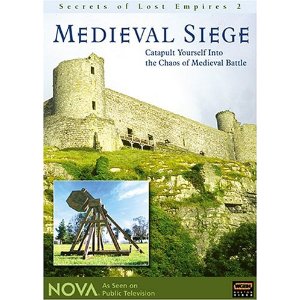
    I won’t rehearse all the fascinating details (and it WAS fascinating), but all that research did lead me to a wonderful documentary. It’s called Secrets of Lost Empires 2: Medieval Siege and was produced by Nova in 2000. You can get it on Netflix or Amazon.  In the film, fifty carpenters worked day and night to create and test what they dubbed “the fourteenth century version of the atom bomb”–the trebuchet (tre-byou-SHAY). The trebuchet as the most popular throwing machine in Europe during the middle ages. If you love the history of medieval war, you’ll love this film. You might want to add to it a reading of the excellent Ancient and Medieval Siege Weapons by Konstantin Nossov, which you can get via the inter-library loan program.

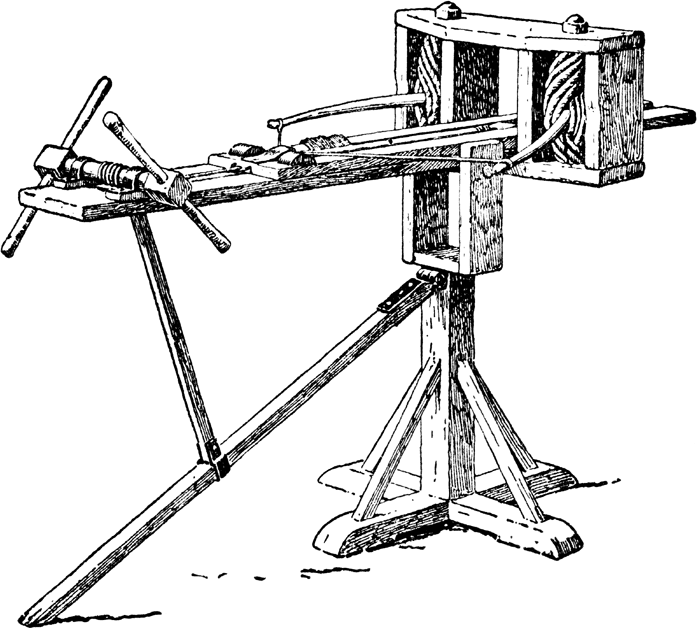
    I’ll share two cool factoids for you history fans. “Catapult” means “shield-breaker,” “cata” meaning break or penetrate and “pelta” being the name of the shield used by the Greek light infantry. The original catapults were NOT big spoons–they sped arrows and balls along a track like a crossbow. However, instead of using the spring force of a bow, they used torsion-springs, which is what you get when you twist fibers that want to be straight. In the case of catapults the fibers were ropes made out of animal sinews or hair (horse or human, a woman’s hair being considered the best) and soaked in oil. Click on the image to see a larger picture. 
    A modern example of a torsion-spring are those balsa wood airplanes with propellers attached to a rubber band that’s hooked to the belly of the plane. To fly them, you rotate the propeller round and round, twisting the rubber band. Then you let the propeller go. Because the rubber wants to be straight, it reverses the twist, spinning the propeller the opposite way you twisted it. 

    You might think these torsion-spring engines were weak. But one catapult was reported as being powerful enough that an arrow shot from it broke through a shield, and the armored warrior standing behind it, at a distance of 400 yards! Hence, the name.

    The other factoid is that “trebuchet” comes from the French term meaning to overthrow. If you saw Return of the King, you’ll recognize them as the engines used on the towers of Minas Tirith. Trebuchets are simply an evolution of the staff sling. When it came to breaking castle walls, there was nothing more effective until the cannon appeared. Of course, in my book I use them a bit differently. You’ll see.

    One funny thing. I watched the movie with my oldest who was just as fascinated with the engines as I was. When she was telling my wife about the film, she kept referring to trech-uh-butts. Which, I guess, is as fair an attempt at “trebuchet” as any. However, my wife kept picturing buttocks and couldn’t figure out what the heck my daughter was talking about–“You were watching what with your father?!”

    The French make things so hard . . .

    ***

    The Monday after CONduit I left for work in Mexico and then Vegas. I didn’t get back until this week. So I just wanted to say I had a great time at the con. Loved chatting with all the folks there.

    It was great to see the Larry Correia, Paul Genesse, Jessica Day George, Isaac Stewart (and his brother Dan), Mette Harrison, Eric James Stone, Darren Egget, Julie Frost, Sandra Tayler, LE Modesitt, Josh Perkey, Nicole (whose husband is an Orem cop and I lost his number), Daniel Who-I-Sacrificed-to-My-Editor, and the Dungeon Crawlers Radio guys.

    It was also nice to speak with Julie Wright who was one of the initial judges for the Whitney Awards. She’s always nice to chat with, but this time it was especially nice since she said reading Servant of a Dark God was like eating chocolate. I’ll take chocolate praise any day.

    I also met new author Janci Patterson who just sold a YA with a great premise. It’s called SKIP and is about a young girl whose parents are divorced. The girl has to go stay with her dad who lives in a trailer and is a bounty hunter. I’m a sucker for bounty hunter stories. Especially this one, because she goes out with him and falls in love with one of the guys her dad has to haul in. I’ve slaughtered the pitch, but I got that good old writer’s envy when she told me about it. Can’t wait to read it.

    I also got to see Barbara Hambly. I was at LTUE when she was there like 20 years ago. We loved her stuff. She suddenly dropped out of the writing scene in the early 90’s and now I know why–it appears Del Rey dropped all their midlist authors except for Anne McCaffery and someone else. Hambly was one of the causalities.

    ***

    After Hambly’s main address, I sat with a few authors and had a brief discussion about the book industry where it was suggested the industry was shrinking–fewer readers, fewer sales, doom, doom, doom. But that is exactly opposite all the data I’ve seen.

    1. Book sales have an annual average growth over the last seven years of 1.1%, adult paperbacks are growing 2.9% http://www.publishers.org/main/IndustryStats/indStats_02.htm or http://www.publishers.org/main/IndustryStats/documents/S12009Final.pdf . Now, this doesn’t show units sold. So it could be that they sold fewer units for more money per unit. Still, it shows at the very least that $$$ aren’t shrinking.
    2. The New Book Titles report here shows an increase in the number of titles: http://www.bowker.com/index.php/book-industry-statistics — 80% increase from 2002 to 2009.
    3. Reading rates are actually on the rise: http://johndbrown.com/2009/03/literary-reading-rates-on-the-rise/
    4. Finally, I contacted Bookscan for their numbers for an ALA conference I did last summer. This is just juvenile fiction, but the numbers are in units. Now, I don’t know if they added more sources to their database and so that caused a rise, but I explained to them what I was trying to do—see trends over time—and this is the data they provided. According to their numbers, more juvenile books are being sold now than in 2004. Click on the graphic below. This means we have more and more readers rising up through the ranks! One author asked how much of that was Rowling and Meyer. During that period books by those authors accounted for an average of 7-10% of all juvenile fiction. Bookscan categorizes “juvenile” as everything for kids. That means from Go, Dog Go up through what we consider Young Adult. R&M accounted for an average of 33-36% of what Bookscan categorizes as science fiction, fantasy, or magic within the juvenile mega-category. What all that means is the growth is across the whole category, not just with their books.

    So I’m very sanguine about the book industry’s prospects. Today’s youth seem to be able to play computer games AND read in great quantities.

    ***

    Finally, one last bit of news. Robinson Wells was the one of the main ones to start the Whitney Academy and the Whitney Awards. Well, he just got some fabulous news. Here’s the announcement from Publishers Marketplace: “Robison Wells’ YA debut dystopian thriller VARIANT, a modern-day LORD OF THE FLIES, set at a boarding school where not everything is as it seems and every day is a fight for survival, in a significant deal, in a three-book deal, to Erica Sussman at Harper Children’s.”

    For those of you who don’t know, here are the PM deal categories.

    • “nice deal” $1 – $49,000
    • “very nice deal” $50,000 – $99,000
    • “good deal” $100,000 – $250,000
    • “significant deal” $251,000 – $499,000
    • “major deal” $500,000 and up

    Oh, baby. Someday. Someday. Of course, I’m nothing but happy for Mr. Wells!

    Links

    Share
  • |

    You’re invited to join the novel writing workshop pilot

    I am developing an online novel writing course and am looking for folks to pilot it with me and give me feedback. I’m thinking I want to limit it to 10-12 folks.

    It’s free and will probably take two or three months to complete. If you join, your job will be to do the work. And there will be work. I’m thinking 10-15 hours of work per week. Please don’t ask to join if you don’t want to make this commitment. I only want folks who are serious and ready to give this a shot. In addition to the work, you’ll need to report your experience with the course as we go, sharing with me where you get stuck, what’s confusing, what’s helpful, what does and doesn’t advance your skill. In fact, if at some point the course just isn’t providing you any value, you are welcome to drop. That’s good feedback too.

    It’s going to be a blended format that includes self-paced work and some type of weekly online meeting. I will be guiding the class. At the very least, we’ll meet and chat at my site. I don’t know if we’ll do a live meeting or not. Still working that out.

    I struggled for many years, trying to figure this stuff out, then had a number of epiphanies during Orson Card’s boot camp and continued from there. Of course I still have lots to learn. But I want to share what I have.

    I love teaching and have been teaching in one form or another for the last 20 years. I’m currently an education program manager at a large software firm. What this is all means is that I’m trying to build a course that guides folks through a process that will help them learn to WRITE novels. Not just talk about them.

    So this is not a series of lectures with quizzes that test your ability to recall, although I will quiz you.

    It’s not a course with an end goal of teaching you what I’ve learned about the concepts and principles of plot, character, and setting, although you will need to learn that.

    This is about increasing your ability to get ideas, develop them, and then write.

    It’s about doing the work. It’s about production. It’s about finishing product. And having a good time doing it.

    If you already feel comfortable with your ability to finish novels, this is NOT the course for you.

    You can learn more about the course here by clicking The Path in the On Writing menu.

    Probably the only other thing you need to know is that the class is a PG-13’ish class. While the stories can deal with intense and adult themes, as the teacher, I’m not interested in working with stories with explicit or detailed sex or lots of language of the sort that would earn a movie rating more restrictive than PG-13.

    Remember, this is a pilot. Even though I’ve taught about writing for a number of years to various audiences, there might be some rough spots. We might find we need to change the work requirements or activities or any number of things.

    If you’re interested, click on the Contact link on the menu of my site, and shoot me an email.

    Edit 1/30/15: I’m getting a number of excellent questions about the time commitment and schedule. Let me answer them here.

    The gap I’m trying to fill

    First, you have to understand that I am not interested in talking about novels and writing novels. I’m interested in helping folks finish novels. That’s a big gap I see in most writing instruction. It’s the gap I had. There was nobody to help me move from the theory to the writing, and writing all the way to the end. So this isn’t a class about novels. It’s a class where I hope to help you learn a number of techniques for developing and finishing one. And to learn those techniques, you have to actually use them. Which means you have to develop and finish a novel 🙂

    So why 10 hours as a minimum?

    If you’re a slower writer, it’s going to take you around 50 hours to develop and write a novel of 25,000 words. That’s the size of one of Louis L’Amour’s smaller novels (which we call sometimes call “novellas” today). It’s the size of some smaller romances. A lot of indies are writing serials around this size. If you want to write a 50k book, it’s probably 100 hours, maybe more. A 75k novel? 150-200 hours. The development and first draft of a 100k novel? 200-300 hours.

    These are not exact times. Some writers are faster. But you get the picture. Writing a novel is a big project. And I’ve found that it’s just too hard to get any traction on less than 10 hours per week. When you spend much less time than that, you spend most of your time just trying to remember what the story is about. I’ve found it’s best to keep your writing engine hot, or at least warm.

    So will these 10 hours be in meetings?

    No. I don’t want to have a lot of meetings. That’s the beauty of online. We will have deadlines. But you should be able to complete you work during the times that suit you best.

    What’s the course schedule?

    I can’t give you an exact schedule. I haven’t timed everything. Figuring that out is part of what we’re doing in this course. But I do know what I want you to learn and how I hope to help you learn it. We’ll just have to see how far we get with each weekly 10-hour chunk.

    Share
  • Where in the Sam Hill is Curse of a Dark God?!

    Because of so many reader requests, I think it’s time to explain.

    Alas, I must report that she ran off with a no-good tramp. I’m sure she’s realized her error. Either way, I’ve formed a posse. We’re hunting her down.

    That’s the true story. For those that want the boring press release that obscures the facts, you may read what follows.

    The first draft of Curse of a Dark God was delivered to the editor in August of 2009, two months before Servant of a Dark God was released. That draft had some issues with a few of the story lines. These issues crept (they did not run or slouch) into the text because the author, stressed about an aggressive deadline, decided to adopt the fix-it-when-you-finish-just-get-er-done-you’ve-got-a-freaking-deadline methodology of writing.

    But a book of 230,000 words is a big old momma. And if something in a beginning chapter is off, it wankers a whole heck of a lot of story that follows, much like a line of dominoes. But it’s not just one story line. This book had multiple interconnected story lines. So issues in one line rippled out into others. What this meant was that the changes that needed to be made weren’t wee things that could be dealt with in a few weeks. When the dust settled, it was clear the book required a substantial rewrite, even though the draft contained gobs of cool story.

    So much for that fix-it-later experiment. You can be sure the author won’t be using that on large books again.

    So the author wrote another draft of 245,000 words and delivered it in August of 2010. The story rocked. Unfortunately, there was a miscommunication on size (and there’s no use in having a drama about what was said and who was at fault and why fairies are always tiny hot chicks; despite our best efforts, life is full of bumps; the best thing to do is learn from them and move forward). The book actually needed to be in the 170,000 – 180,000 word range. Same as Servant of a Dark God.

    In a 10% edit, you’re tightening a story, cutting out the fluff. In an edit designed to reduce the book by 30% or more, you’re cutting off arms and legs and removing things like livers. The story can’t survive such cuts unless the thing was obese to begin with and just needed to go on a diet. Unfortunately, Curse of a Dark God draft 3 was fairly lean, given the amount of story it contained. It was NOT a candidate for Biggest Loser.

    The upshot is this third draft is going to be another major rewrite. Which means, given publishing lead times, that it’s going to take a number of months to get it on the shelves.

    (fricken, ricken, grumble, frag a friggen nack)

    Because I’m just starting on the outline, we don’t have a delivery date yet. As soon as we do, I’ll post it.

    I apologize to all of you expectantly looking forward to the next book. When I started this series, I promised myself that I would not leave my readers hanging. I was determined that my books would come out in a timely fashion. And I have been working like a devil to do just that, but sometimes things happen. What I can promise you is that this draft will go quickly. Furthermore, I already have book 3 outlined. It should go quickly as well.

    I know some of you are asking why? Why, the word limit? Aren’t there are plenty of monster books out there?

    There are. In fact, about half of Robert Jordan’s Wheel of Time books are roughly the length of draft 3. Publishers do sell fat books. However, the bigger the book, the harder it is to make it profitable.

    First, bigger books cost more. There’s the cost of the additional paper and editing, but there’s also the extra money to ship and store.

    Second, you can’t put as many copies out in the stores. You can’t because they take up more of the space that might be allotted to an individual book. So instead of being able to have stores stock four or five copies of a 120k novel, they can only stock two or three of a big old momma in that same space.

    Third, bigger books cost you, dear reader, more money. Sure, the publisher might eat some of the additional costs, but some of those costs will be passed onto you.

    So because of the increase in cost, the publisher needs to sell more copies; however, the limit on display space and the higher price make it harder to sell those additional copies and actually may lead to selling fewer copies.

    Do you see the bind?

    This doesn’t mean big books can’t be profitable. It just means that it’s not as easy. It’s a bigger risk. Part of me would want the publisher to take that risk. But the other part of me knows that slow and steady usually wins the race. Neither I nor the publisher want to gamble the long-term viability of the Dark God series. Now, if Tor was doing this all in paperback, this might not be such a big issue. But we’ve got the sweet hardback/paperback deal. And business projections have to be done in that world.

    So the short of it is that we’ve run into some business limitations, and it’s going to take me a bit more time to deliver.

    I wish I could announce a date at this time, but I can’t. I’ll finish up the outline for this draft and run that by the publisher around Christmas. Then it’s back to work. I promise that what you’ll get will be my best. And that’s what you want, anyway, even if it takes a bit longer to get it into your hands.

    Share
  • Book Academy schedule

    Thursday, September 30, 2010.

    All day writer’s conference at UVU in Orem, UT.

    Folks, this looks like it’s going to be an excellent seminar. Larry Gun-Crazy Correia will be there as well as Brandon Mull, Jeff Savage, Traci Hunter Abrahamson, Rob Wells, and a whole bunch of other great authors. You can see who will be doing what and where right here: Book Academy Agenda 2010 PDF. More details on the Calendar.

    You can find registration information on the Book Academy site.

    Share
  • This pass through CURSE is done!

    Oh, this feels soooooooo good. Here are the stats.

    • 58 chapters
    • 205,000 words
    • I received the green light midway through April. Finished 27 weeks later.
    • Looking at my time records, it took me a total of 345 hours to finish this draft.  And the lion’s share was new stuff.  This took less time than it normally does for me, but it’s the freaking forth time through and I know the world and characters.
    • I averaged about 13 hours per week. It still bothers me I couldn’t get that closer to 20 hours.
    • This translates to a rate of about 600 words per hour, and that’s with daily edits, thinking, backtracks.  I’m not going to win any speed contest, but at least I’m consistent.

    Of course, it took me an additional 105 hours of work to finally get an outline we could agree on. If I add that, it brings my stats down a bit. But, overall, I’m pleased. For those who want to read an excellent article on writing productivity, look at Kevin J. Anderson’s “The Mathematics of Productivity.”

    Now I need to take the next two weeks to cut about 10%. And fix the weather stripping on our French doors to keep the hordes of  #@!$%! spiders from coming in. Wish me luck.

    Note: it bugs me my bullets don’t show up. Some day I’m going to get someone to fix the stylesheet on this website.

    Share

2 Comments

  1. Mike,

    That would be awesome. The problem is I don’t have the equipment. And am so busy finishing up Curse that I don’t dare divert myself.

    Author S. James Nelson http://sjamesnelson.wordpress.com/, who wrote Van Bender, recorded all of the previous ones but I’m sure the man is busy with his books. I really wish I had a good answer for you on this one.

    If there is anyone reading this who would like to record, please contact me 🙂 I’m sure I can swing some goodie your way.

Comments are closed.