Gun Runner wins Dragon Award

I was very happy to receive news that GUN RUNNER, the novel Larry Correia and I wrote together, just won the 2021 Dragon Award for Best Military Science Fiction or Fantasy Novel.

The Dragon Awards are a set of literary and media awards presented annually by Dragon Con in Atlanta, Georgia for excellence in various categories of science fiction, fantasy, and horror novels, movies, television, and games.

And the cool thing is that these awards are voted on by fandom, meaning thousands and thousands of folks voted.

Past winners have included authors such as Terry Pratchett, Brandon Sanderson, Rick Riordan, and Stephen King.

As stated in earlier posts, the seed came from Larry’s eleven-year-old son, Joe.

When Larry and I sat down to develop an idea for a workshop we were holding for Life, the Universe and Everything, a large annual writer’s conference in Provo, a number of years ago, Joe was listening in on the stairs.

We settled on a genre, and then Correia asked, “Hey Joe, what’s cool?”

Joe immediately popped up and said, “Giant robots, bandits, and murderers.”

“We looked at each other and said, ‘Dang, that IS cool.’”

Forty minutes later we had the key elements we needed for the story we’d use in the workshop. A number of years after that workshop, Baen Books wanted a collaboration from Larry, and that story was one of the first he thought of.

Larry and I are both frequently asked to present at writers conferences. And one of the tips each of us shares to new authors is to loosen up and have fun. One of the keys to writing an entertaining story is to simply ask, “What’s cool?” And go from there.

I’m thrilled and honored that those who voted selected Gun Runner for this award.

Share

Similar Posts

  • Federal Spending 1972-2011: What The?!?

    Last week a chart made the rounds, ranking the Presidents since Reagan on spending.  Look at Reagan.  That happy man is a freaking profligate. Obama, on the other hand, heck, he’s doing better than Bill Clinton.

    Except there are a few problems.

    First, I can’t tie this data out to the official CBO numbers.

    Second, it does a bit of apples and oranges because the numbers are based on each president’s whole time in office.  What does it mean when Obama increases the debt by 35% over three years, but it takes Bill Clinton almost EIGHT YEARS to increase the debt that much?  A better measure would be an average per year.

    Third, some have suggested this chart monkeys with the numbers, allocating the first year of each president’s first term to the previous president.

    Fourth, the president isn’t the only one in Washington. Senators and Congressmen also have responsibility.

    Finally, while a % increase in debt is a helpful measure, it’s not the only story. And it can be misleading if viewed on its own. For example, if we have $1 of debt, and I increase that to $10, I’ve increased our debt by 1000%. Holy Schnitzel!  But if we have $500 million of debt and I increase it to $600 million, I’ve only increased it by 20%. Which is worse?

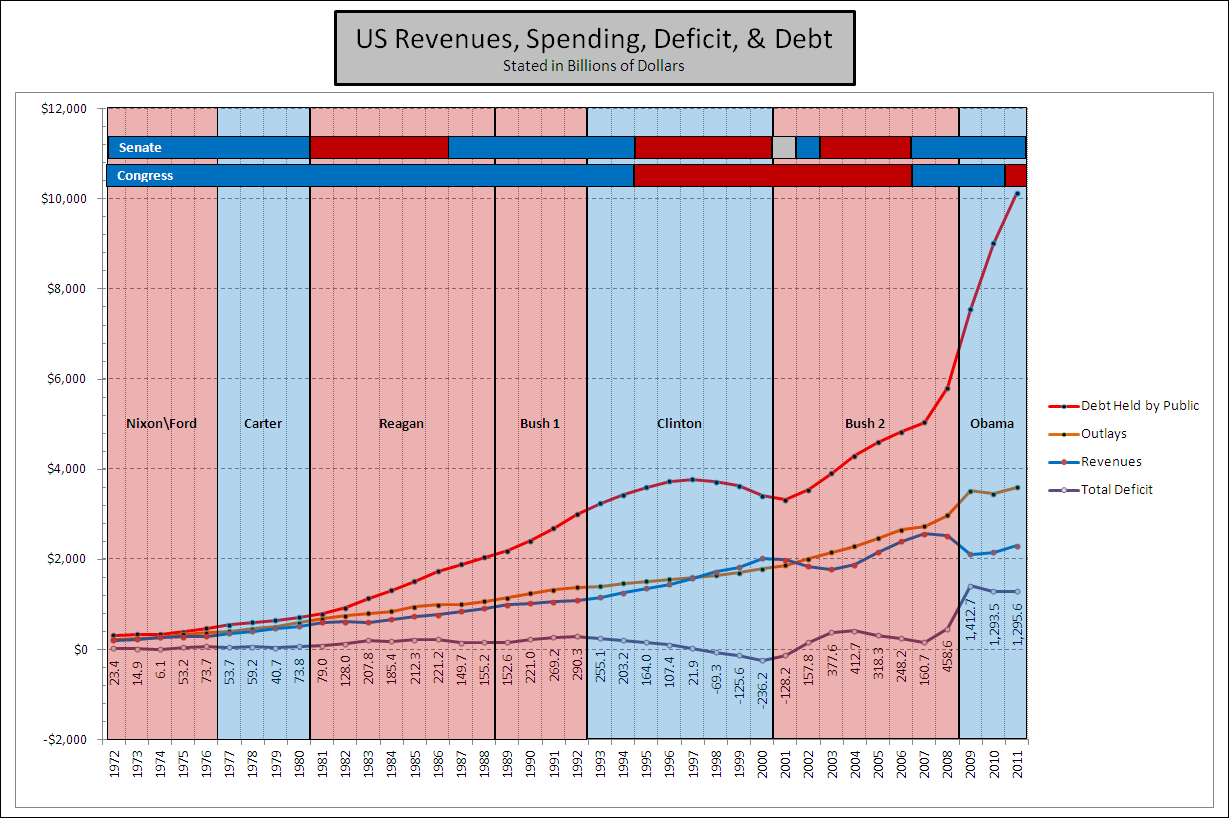
    So I went out to the CBO and took their numbers from 1972 – 2011.  You may get the XLS file yourself: http://www.cbo.gov/publication/42911. Then I made sure to identify who was in charge when and marked it with spiffy colors (Red is Republican, Blue is Democrat). Here are the results. Click on it to see it in its full size glory.


     What does this tell us?

    First, there was only ONE four-year stretch in the LAST FREAKING FORTY YEARS where the folks in Washington did not spend MORE than they took in. That was the four year period from 1998 – 2001.

    What the?!?

    Look at that chart again. There is a serious and systemic spending problem in Washington.

    What happened in 1998 to change what had been going on for almost three decades? That was when the citizens got fed up with Washington, threw out a great number of the Senators and Congressmen, and bought into the Contract with America.  This was when Newt Gingrich was Speaker of the House. This was when Clinton was getting pounded for all sorts of stuff and worked with those particular Republicans in Congress to balance the budget.

    Second, the deficit, the purple line at the bottom, tripled when Obama took office.  And stayed!  Who put that first chart together? Oh, yeah. It was Nancy Pelosi.

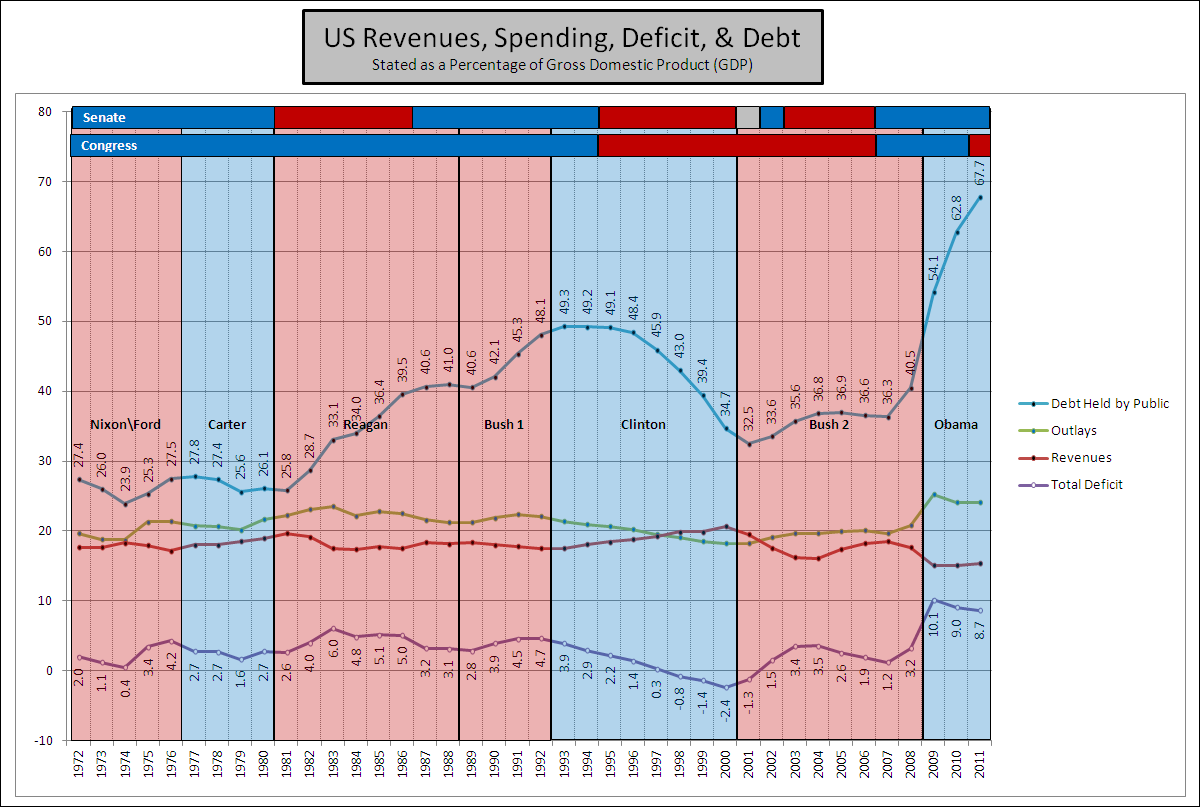
    You might say, well, raw dollars is good.  But what’s really important is how big a percentage that spending is of our nation’s GDP. If you’re spending 100 billion when the nation is producing 1 trillion, that sounds big, but it’s actually not as big a deal as when you’re spending 100 billion and the nation is only producing 200 billion. Okay, let’s look at these numbers as a % of GDP.

    Again, 1998-2001 were good years. On a % basis, the folks in Washington during that time did better than anyone else in not spending the nation’s wealth.  There’s no doubt that Reagan, Bush 1, Clinton during his fist 3 years and the Congress during those times were all happy to be big spenders.  Look at the debt burden during their years. But Obama and the Democratic majorities in Congress since 2007–drunken sailors compared to those guys. And then the Republicans come in and it doesn’t change. Gridlock?

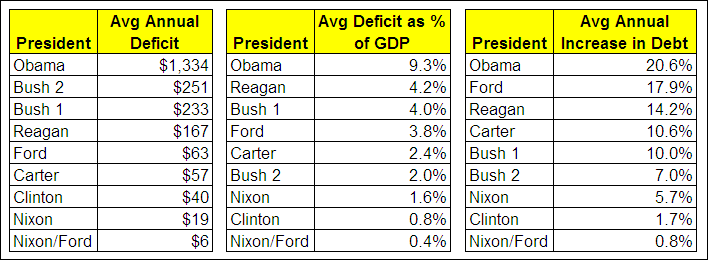
    Let’s look at our presidents since 1972 and see how well they do on an annual basis. Those numbers in the first list, BTW, are stated in billions.

    Seems to me the most fiscally responsible groups were those in charge during the latter part of the Clinton years, the Nixon years, and the year when Nixon resigned.  It appears that during that year the folks in Washinton were so busy with the Watergate scandal they forgot to feed their spending appetites.

    Bottom line: as I said before, Washington has a serious and systemic problem with over spending.

    And when I say “systemic” I mean it appears the whole thing is rigged to produce over spending. We don’t just need new people out there. We need a system that prevents the overspending. We need an ammendment that requires a balanced budget and caps the size of the government in relation to GDP.

    We also need to find a way to incentivize Congress to pass a budget each year.  No budget, no pay is a good idea. The current House has indeed passed a budget. But the Democratic Senate has not, preventing us from having a budget at all. Obama submits budgets, but not a soul in the Senate, Democrat or Republican, will vote for them. It’s only the Republican House who seems to want to actually do their job. How can that be? Read It’s Deja Vu All Over Again with National Fiscal Policy for more info.

    This November we need to get a bunch of folks like those in 1998 back in Washington. A President AND a Congress who will actually finally tame the nation’s out of control spending.  Let me suggest you look at your Congressman’s and Senators’ records.  How have they voted? As for President Obama, well, I’m looking at the numbers above.

    Related Links

    Share
  • Good Stuff! Factfulness by Hans Rosling

    Are things really bad as they seem on the news?

    Are they getting worse?

    Do we actually have an accurate picture of what’s going on in the world?

    The answer is no. Not even close.

    The normal American’s view is completely skewed. And negative. And that’s because the news is prone to be overly dramatic.

    We think we’re learning what’s going on by watching the news, but we actually getting an incredibly skewed view. And that view is wrong.

    In his book Factfulness: Ten Reasons We’re Wrong About the World and Why Things Are Better Than You Think, Hans Rosling identifies a number of things we get wrong, but also the 10 reasons why, and how to avoid our tendencies to skew the data.  

    It’s a fascinating book.

    For example, Rosling wanted to see how well we understand the scientific projections of how our population will grow. After all, a lot of people think we’re headed for an overpopulation nightmare.

    In 1950 there were fewer than one billion children (aged 0-14) in the world. By 2000 there were almost two billion. How many do UN experts think there will be in 2100?

    1. 4 billion
    2. 3 billion
    3. 2 billion

    What do you think the right answer is?

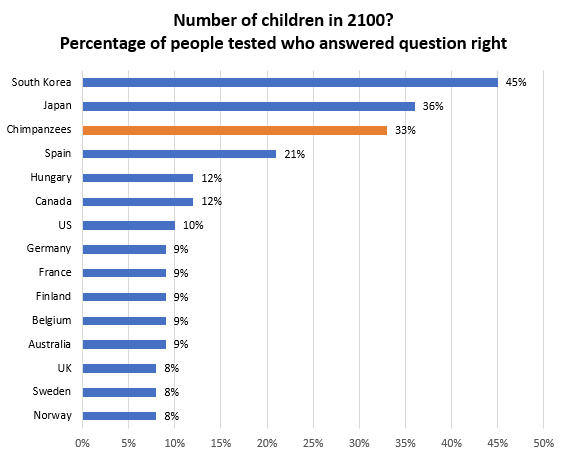
    If a bunch of chimpanzees had to answer the question above, each would choose an answer randomly. And 33% of them would get it right.

    But when you ask humans the question, most of them get it wrong. Most of them, in fact, do worse than the chimpanzees. It’s not even close.

    Rosling asked 12,000 people in 14 countries were asked this question, among others. Here’s how many got it right in various countries.

    To be clear, no chimps were tested. That bar is in there just for comparison. But if they were, that’s how they’d do.

    So how is it possible that humans do so spectacularly worse than the chimpanzees?

    It’s not because chimps are secretly studying world population stats and hatching schemes. It’s because we humans think we know something, but, in reality, what we think we know is wrong.

    And in this case, we think they know that the population is going to keep growing and growing and growing.

    But it’s not.

    The right answer above is C—there are 2 billion children now, and there will be 2 billion in 2100.

    The world has hit the peak number of children it will ever have at any time.

    There are around 6 billion people on the earth today. As those 2 billion children get older, the UN experts project the total population to fill out and grow to 11 billion in 2100 and then level off.

     That means there is no overpopulation nightmare on the horizon.

    Can this be true?

    Read Rosling’s book.

    Well, what about literacy levels? Poverty? Racism? Wars?

    And what about the news—don’t we see the world going to pieces every night?

    If you want an eye-opening experience, read Rosling’s book. He delivers all the insights with clarity, expertise, and humor.

    Best of all, when you’re done, you’ll have a set of tools to help you correct the picture.

    And while you’re waiting for the book, why not watch Rosling in action in this TED talk where he shows the data on population.

    Share
  • |

    My First Year as an Indie Author

    On November 24th last year, a little over 13 months ago, I released my first indie title—Servant: The Dark God Book 1. That release was the official rise from the sideways swamp crash I had with Tor Books.

    BTW, sideways swamp crashes in publishing, which can be caused by all sorts of reasons, are not uncommon. Most writers will take a hit or three in their career. That’s just part of the writing business. The question is what happens after the swamp crash?

    In my case, I got to work. And, boy, was it a lot of work.

    The results have been positive. It was not a phoenixian rise from ashes to glory; it was more like a damp crew patching the ship in the jungle with whatever they had at hand and then launching with nothing but a few birds making any noise. We are by no means past the many perils and obstacles on the path–right now a solid hit from just about anything could knock us out of the sky.

    But we are airborne.

    We are flying.

    And by that I mean the business is delighting readers and generating income.

    I’ll probably hit close to 23,000 paid sales since that launch. The large majority of them were for Bad Penny. To give you some perspective, a single title will make the official Publishers Weekly bestsellers lists (of traditionally published authors) hardback and paperback categories when the title has sold around 100,000 copies in the year. The top dogs report sales of a few million.

    It’s clear the John D. Brown crew has got a ways to go.

    But we don’t have to reach that lofty level to be viable. It would be awesome. At the same time, it’s helpful to be realistic. There are somewhere between 300-400 titles on the adult hardback and paperback list combined. The same on the children’s lists. So I estimate there are around 700 traditionally published books, fiction and non-fiction, that sell at those bestseller levels. That’s out of the millions of trade titles available on Amazon.

    The good news is that the majority of writers making a living don’t appear there. The fact is that you don’t have to sell 100,000+ copies of a single title in a year to make a living. In the indie world, you can do just fine with what Russell Blake calls base hits and doubles.

    So are we making a living?

    Those sales have generated enough net profit to purchase us a nice used vehicle and a few other things. Better than a poke in the eye with a sharp stick (as my neighbor Mike Carr used to say), but making $10-20k can’t replace the day job. Not even close. Still, it’s a beginning.

    Will our crew make it?

    Can they survive the ferocious flying monkeys?

    Stay tuned.

    In the meantime, I want to summarize a few things I’ve learned about indie publishing and give a few shout-outs.

    First, I want to thank all the readers who decided to give one of my books a shot. From the reviews and sales, it appears the majority found just what they were looking for (and there was much rejoicing).

    Second, a big thanks goes to Larry Correia. Not only is he generous and enthusiastic, but his audience is as well. The Monster Hunter Nation made a definite difference for me this year.

    I want to thank LL Muir and Diane Darcy, two romance writers who have been incredibly generous in sharing their indie insights and support.

    Devon Dorrity and Dixon Leavitt spent hours, HOURS, of their time helping me with covers. I can’t thank them enough.

    I also need to thank the Codex Writers. There’s a small group of us indies there, and they’ve all be very helpful in sharing insights about what’s worked for them and what hasn’t.

    I’ve found other resources helpful as well. The Passive Voice kept me current on the industry. Russell Blake’s blogs gave me a clear-eyed opinion of what it takes to succeed. The Calibre ebook editor has saved me many times. And Anne-Marie Concepcion’s online course on using InDesign to publish ebooks was a very good introduction, as were Dean Wesley Smith’s online courses on interior and cover formatting.  I list other resources I found useful in my Resources for Indie Writers post.

    Okay, so what have I learned?

    1. Nothing happens without visibility

    This is retail. If your product is not somewhere that people can see it, they won’t buy it.

    I was in Wal-Mart the other day. My sister calls it the Evil Empire, but she’s a Tarzjay snob. I myself am a value shopper. I want what I want, and I want to pay as little for it as possible. At the same time, I’m not going to go out of my way to get it because searching around costs time and money. So if I’m looking for something in Wal-Mart and I don’t see it on the shelves, guess what? I buy something similar that will do the job.

    Wal-Mart used to stock Marzetti’s Ranch Dip. The best vegetable dip EVAR. But then sometime this year, they stopped stocking it.

    Why?! Why do they stop stocking stuff the moment I find it?!

    (Hey, maybe that’s why they’re the Evil Empire . . .)

    I mourned for a few seconds. And then I purchased the Lighthouse dip. It’s good. If they put Marzetti’s back on the shelves, I’ll switch back immediately. But the point is that if it’s not in front of my eyeballs when I go shopping, I ain’t gonna buy it.

    And I’m finding retail is the same with ebooks as it is with everything else. You can have the best product in the world, but you aren’t going anywhere with it until you are visible to your buyers.

    2. There are a couple of ways that I was able to make my stuff visible

    The way to make my stuff visible was not by publishing on Amazon, Nook, and the rest.

    Publishing means nothing.

    Think about it. There are, right now, 3,079,561 books in the Kindle bookstore.

    Yes, three million!

    If those were physical books, and we lined them up spine-out like we do on a bookshelf, and we assumed the spines average about an inch in width, they would make a line 48.6 miles long.

    For us Utahans, that’s a line of books that stretches from the Mormon temple in downtown Salt Lake City, past Provo, and ends in Springville! (Look up your own local distances to get an idea.)

    That’s the kind of visibility you get by publishing your book, which is nada.

    So if getting it in the store that’s 50 miles long didn’t help, what did?

    Getting on a bestseller list.

    I sold thousands of copies of Bad Penny on Nook when I was on the Nook’s top 100 list. I rose to #3, in the entire Nook store, then hung out around #50 for about a month. And when that burst of sales that made me #3 fell out of the algorithm (30 days later), I fell off the list. My sales dropped like a stone. Not to nothing. But they were a fraction of what they had been.

    How did I get that #3 slot to begin with? The same way I rose to #30 for a few hours in the Kindle store, then slowly dropped to the 1,200s for a few days. I got it by placing an ad with the king of book advertising services, aka BookBub.

    How did I get onto BookBub? Here’s their requirements and tips. Please note that the reviews of Bad Penny were part of what made the book appealing to BookBub.

    How did I get reviews? By using other ad services to make my book visible and getting mentions on blogs like Larry Correia’s and a few others. And by following recommendations in the book Let’s Get Visible and Your First 1,000 Copies and the suggestions of others who are selling well. And that’s a key thing too–looking to see what folks who are selling well are doing, not those who aren’t.

    Of course, readers also liked the books enough create word of mouth. And I can track some of my sales spikes to specific posts or people. The ultimate goal is to have so much word of mouth that everyone’s talking about you. But until that time, I ain’t going to rely on word of mouth alone.

    Why not?

    Because I’d like to increase my odds of success. I’d like to accelerate them. And thinking that word of mouth alone is going to do that flies in the face of everything I’ve learned about retail. Read what I had to say about books and lemonade and tending your garden for more. Consistent efforts with methods that actually have some track record of success seem to have helped a great deal.

    BTW, Bad Penny is currently in the top 10 of three of Amazon’s thriller lists. I guaran-dang-tee you that being on those lists is a big factor in me selling somewhere around 60 copies a day. I saw that with Nook. Being visible starts a virtuous cycle–more people give you a try; if they like the book, they spread the word, which leads to more sales, which keeps you visible, which prompts more new readers to give you a try. Yeah, you’ve got to be good. But you’ve got to be visible first.

    3. In most cases, books in a specific genre are substitutes

    When readers purchase a book, they are looking for a certain type of experience. And my book’s experience isn’t so singular that readers can’t get something roughly similar from another book.

    I love Lee Child. But Robert Crais provides an experience that’s basically inside the same ballpark. So does Nelson Demille and a whole host of others, including me.

    If Lee Child stops writing or slows down his production to one book every four years, I’m not going to stop reading thrillers. There are plenty of other authors that give me the general adrenaline, surprise, action experience I’m looking for. I’ll be sad, but there are a lot of good authors out there. And I’m sure a few will become my new Lee Child.

    Of course, we aren’t all exactly the same. I provide a noticeably different tale than Lee Child does even though we’re in the same Lone-Ranger-vigilante-justice action genre. And so, if I produce the best tale I can, I will find some readers will come to prefer me to Child because I line up more with their tastes than he does.

    In addition to continue to work on visibility and craft, this means I’ve got to up my production. I’m going to try for 2.5 brand new books in 2015. That’s nothing for some folks. But that’s a good stretch goal for me.

    4. There is no one sure-fire way to success

    Even though visibility and studying your craft helps, nobody I know who is doing well has a replicable step-by-step program that guarantees success. There are some activities that seem to make the odds better, but there is no guarantee.

    For example, from what I wrote above about BookBub, you’d think that’s the brass ring. Nope. I know other authors who have run promos with them and didn’t have near the success Bad Penny did.

    Russell Blake’s advice on this seems to square best with my experience. See the links to his blogs here to see what I’m talking about.

    5. Figuring out how to make a living with this has a lot in common with Lean Startup principles

    The basic concept behind lean startup is that when you’re in a market without a lot of info on what works, the company that wins is the one that learns what works the fastest. And you do that by conducting experiments.

    You experiment to see if you’re offering any value to the intended audience. You experiment to see if you’re promo methods are actually feeding your engine of growth. You experiment to see if your audience really is big enough.

    The experimental approach taught in the lean startup stuff has freed me from a lot of anxiety. Success or failure is not about me personally. It’s about my techniques. It’s about my craft and business skills. It’s about me learning how to learn quicker.

    I’m approaching my thriller and epic fantasy properties as experiments. I’m approaching various visibility methods as experiments. My current state of craft is an experiment. If what I’m doing with my current properties doesn’t work, I can pivot and experiment with something new.

    The question is whether I can learn what works–to find an opportunity to add value and provide that value–before I run out of runway.

    If you’re interested in these ideas, let me recommend The Lean Startup by Eric Ries, which explains the general principles, and Running Lean: Iterate From Plan A to a Plan That Works by Ash Mayura, which shows you how to start to implement them. These two books have changed how I approach the writing business.

    Bottom Line

    The bottom line is that I love developing stories and sharing them with readers.

    I knew this already, of course. But having the ship up and flying again made it hit home in a big way. I enjoy the process of developing a story. I love the research, the story generation, the surprises that come along the way. And I love the emails I get and the discussions I have with readers who have read my books and enjoyed the heck out of them.

    So that’s the big summary.

    Year two stands before us. Let’s hope John D. Brown and company can learn and produce at higher levels than we ever have before.

    Have a wonderful 2015!

    Edit 1/14/2015: Here’s John Ellsworth, another indie author, with a similar tale. Although I’m jealous of his seven books in a year. I need to get cracking!

    Share
  • Harry Reid’s Chickens

    Are we all wearing Coke bottle glasses with this government shut down?

    First, it seems silly to me when reporters ask Americans who is causing the shut down. It’s like, duh, if either party just gave into the other party’s demands, we wouldn’t have the issue. Which means that BOTH parties are causing the shut down.

    Second, it seems a lot of folks have forgotten that this is precisely what should happen.

    What?

    Yes, our government is designed to allow these types of things.

    But, John, isn’t that just asinine?

    No. It’s not an oversight. I think it’s smart. Even if it causes some pain.

    Let me explain what it seems some in the media and elsewhere are forgetting.

    This is not a nation that belongs to a government. It’s not a nation owned by some lord or entity. This is a nation of individuals who decided to band together because we thought that banding together would allow us to protect our lives, liberty, and pursuit of happiness better than if we stood alone individually.

    This is a nation of individuals who said, you know, we think we can figure things out better together ourselves than having someone dictating to us what we’re going to do. We’ll get together and talk. We’ll argue. We’ll persuade. We’ll try to convince each other of our individual ways of thinking. And when enough of us are convinced that we should do something, we’ll act.

    We’ll set up a process for talking and making decisions that ensures everyone can be heard. It would be great if we could get 100% agreement on everything, but we know that’s not realistic. At the same time, we don’t like the idea of forcing our will on others. So we’ll make a compromise; we’ll set up the rules for making decisions so it requires that a good majority of us are in agreement before we can take action, especially on matters that are important to a lot of us.

    Finally, we’ll make sure no individual or group can take control and deprive us of this way of living. We did the monarch thing, and we’re done with that. We will not bow to any king ever again. We’re going to be very careful about this one item because a lot of bad things begin to happen when any one person or group gets too much power.

    So we set up the rules and started working together this way. And the basic premise under all of this is that we would respect each other’s free will. We’re a land of liberty. We’re a land where we get together and agree on a course of action. Not one where we impose our will on others.

    One of the main methods we used to ensure that no individual or group could take control of the rest of us and that a good majority of us must agree before taking a course of governmental action was to distribute the power to make and enforce rules. We did this in a wide variety of ways. We did this because power’s a slippery thing and easily abused. Furthermore, because we knew no system is perfect, we also set up a system of checks and balances so that if one person or group abused their power, we could stop them and force them to remember to respect the freewill that the rest of us have.

    So what has caused this shutdown?

    It’s very simple.

    A lot of Americans do not agree with Obamacare. By most polls, it’s a majority of Americans. They were not listened to when it was being developed. They were not listened to when it was made law. They feel it was passed, not with open discussion, but a lot of chicanery. They feel it’s not some minor regulation, but a very big thing that will infringe on their rights to live how they want to live.

    Now, it might be that all their fears are unfounded. It might be that Obamacare is going to usher in utopia. Many signs suggest it’s not going to do anything of the sort. But let’s just say it is the finest piece of legislation ever. Let’s say is a celestial piece of governing.

    That isn’t enough.

    It’s not nearly enough.

    Because this is not a nation that belongs to any group. We are a nation of individuals who have banded together, agreeing that we will talk things out amongst ourselves and only act when a good majority of us agree on a course of action. This is a nation that tries to tread lightly on each other’s liberty.

    But many of the folks in Washington back in 2009-2010 forgot this and forced this thing called Obamacare upon the rest of us; in doing so, they violated one of the basic agreements of our compact. If they had followed the underlying intent of our union, they would not have done what they did. They would have crafted legislation that a good majority of us could get behind.

    In 2010, those of us who protested this use of power voted in new folks into the House of Representatives to deal with the matter. In fact, when given the chance, Americans (both Republican and Democrat) in the heavily Democratic state of Massachusetts voted Republican Scott Brown into office, hoping to stop this legislation in the Senate before it became law. But Harry Reid didn’t listen. He didn’t care. He and Pelosi and Obama weren’t interested in allowing a full national discussion. He and the others were more concerned with getting their way. And so he used a parliamentary trick to force it through.

    This shut down is about one group of people forcing their will on the rest of us. It’s about using the checks and balances designed into the system to correct such errors. It’s about the chickens of some poor decisions coming home to roost.

    I know the shut down has caused issues. It’s a partial shutdown; 13% of the government. I think 87% is still funded and running. Still, I know it’s causing some pain.

    But none of that pain needs to occur. Everyone wants to fund cancer research. Everyone wants to help poor single mothers. Those things aren’t the issue. The issue is that not everyone agrees with Obamacare.

    If you’re a supporter of Obamacare, let me ask you this: if the tables were turned, what would you do?

    Would you not stare at the folks trying to force their will on you and say, hey, come on. We’re adults here. We all agreed that we wouldn’t do anything unless a good majority of us were convinced it was the right course of action. Let’s get together and come up with something a good majority of us can get behind.

    If you’re an opponent of Obamacare, you too should recognize that a good portion of your fellow citizens are clamoring to change the way things are. They’ve been clamoring for some time. Should you force your will on them? Or should you sit down and listen and try to come up with something that addresses the points we can agree on?

    I don’t know if the folks many of us voted to go to Washington will stick to their guns and correct this. I hope they do. And I hope that those on both sides who have forgotten one of the basic tenets of our social compact will wake up and remember we are banded together, not to game the system to get what we want, but to act on only what a good majority of us want.

    Share
  • I spent 7 days in a car with Larry Correia, International Lord of Hate, and lived to tell about it

    Larry-Correia
    I think this was taken when someone stole  the ILOH’s Cheetoes

    Seven days.

    San Diego, Phoenix, and a wild trip through Wyoming, around Denver, and back to Utah.

    Seven days.

    Five nights.

    In Arizona, I was told by a wild-eyed denizen of the Barnes & Noble we were signing at that my epic fantasy book was true–we are ruled by lizard people!

    Imagine how shocking it was to learn that. I mean it doesn’t have anything to do with my book, but lizard people? A hollow earth? Is the CIA in on it? I don’t think I’ve recovered yet.

    In San Diego, we rode around with Dave Farland in his old four-door sedan. A Lincoln? All I remember is that it was big and floated like a dream. After some narrow misses, Dave asked me to drive. Two big guys up front. One older, rough-looking guy being chauffeured in the back. At one point we walked to a restaurant during the day like some made man and his two goons. The restaurant was empty except for three rough characters sitting around a table on the far side. They looked at us, sized us up, then looked away. We sat at a table on our side.

    In Wyoming we drove in high winds that sent streams of snow across the highway like multitudes of slithering snakes. At one point we passed one semi that was on fire, winds howling about. About an hour later, we passed a truck driver out in the median, thigh-deep in snow, a huge knife in his hand. He was trying to saw off the frozen antlers of an elk that had been hit. I looked up at his rig as we passed and did not see anyone behind the wheel. I swear the thing was rolling slowly down the highway, unmanned.

    On the way back from Denver, we rode along a wintery, icy highway with trucks and cars littering the sides. Larry white-knuckled the steering wheel, but we made it. Two big guys, one 6’4″ the other 6’2″, in a tiny Ford Focus.

    Did the very road fear the Lord of Hate? I cannot tell.

    On this trip, Larry, that man of hate, brought a bag of Walmart beef jerky that smelled like, well, a particular kind of flatulence. What kind of person does that to beef? But we ate it. Because you do such things on epic journeys.

    Now, here’s the thing. If you spend any amount of time with me, you will eventually tell me your life story.

    You will.

    Not because I’m a prier. But because I’m simply and sincerely interested. In people. If you work for the sanitation department, I’m going to want to know about garbage trucks. If you bowl, I’m going to want to know about bowling. If you’re some kind of wackadoo, I’m going to want to hear your wackadooness. Sooner or later, you’re going to talk. And, yes, there will be things along the way that I just might put in my zing file. That’s not why I’m talking to you. But sometimes the slices of life are too good not to capture.

    So you put Larry Correia, International Lord of Hate, into a car with me, and he’s going to spill his guts.

    Let me tell you what I found. Oh yeah, wait until you hear this.

    Larry loves Bridget, his wife. No, do not turn away in horror. You must hear the rest of the tale.

    He doesn’t like taxes, which is outrageous. Simply beyond the pale.

    He’s a strong advocate of the right to bear arms. He figures people are safer with guns than without. And he was loaded. I remember getting to the hotel in Denver and seeing he draw his guns and put them on the table. A Kimber/Bul Poly .45 from his waist and a little Kahr MK9 on the ankle. Frightening. Of course, I never worried about going anywhere with him, but the guns had nothing to do with that.

    He doesn’t like the idea of a small group of people in Washington telling folks what they need to do. He’s not anti-government. He just likes a minimal amount of government. This too is outrageous. Government is the source of all good in the world.

    He doesn’t like a lot of what Franklin Delano Roosevelt did. One of those things he doesn’t like is the rounding up of Japanese Americans and putting them in war camps. Another was Roosevelt’s attempt to pack the Supreme Court with justices who would rule his way, essentially eliminating that branch’s check on the presidency. Nor does he like Roosevelt for being the first president to explicitly embrace deficit spending. The list with Roosevelt could go on. Of course, we all know that wise people everywhere thought Roosevelt made the right choice on these things.

    Larry honors the folks who serve in our military and law enforcement. Big time. Guys and gals who put their lives on the line or support those who do. I roll my eyes.

    Larry’s a big believer in pulling yourself up by your boot straps and getting to work. He worked on his father’s dairy farm milking cows early in life. Busted his chops in school. Busted his chops at work. Busted his chops writing novel after novel. And now he lives on Yard Moose Mountain. A supposed example of can-do economic mobility, which all smart people know is a farce.

    I mean, work? Come on. Do you see how unreasonable the man is?

    He’s an accountant and pretty good with numbers. Ergo he doesn’t like a lot of bureaucratic waste. It stinks to his accountant soul. And he saw a lot of that as a military contractor. I’m really for a lot of waste of taxpayer dollars, but I let him have his say.

    Larry was once a bouncer.

    He’s a big guy, but got his trash kicked in some early amateur MMA. But he still loved it.

    LarryCorreiacismale
    The International Lord of Hate in multiple colors

    In a friendly wrestling match, he broke his roommate’s toe, and said roommate responded by breaking the International Lord of Hate’s nose. Yes, the nose, Ladies and Gentlemen.

    Larry is funny.

    Larry has a lot of friends because, shocker, he’s a friendly guy.

    He’s also kind of a sheepdog.

    Larry is a capitalist. And it appears he’s the dirty greedy kind who uses his capitalistic ties for helping folks down on their luck.

    There’s more. But let me tell you what I never heard. I never heard him make a racist remark. Not even when he told me about growing up in California’s Central Valley, or when some idiot kids who had been tasked with beating someone up to to join a Hispanic gang targeted him. Never heard him make a misogynistic remark.

    I did hear how he loved to argue with folks on the internets. And then saw that later when I started reading his blog. It’s clear Larry likes a good fight. He’s a barbarian with big boots. But, in truth, he’s a friendly barbarian.

    That’s the expose. I know. Shocking, isn’t it.

    Now he’s gone and done this Hugo thing and calls people names and uses four-letter words on his blog posts.

    I’ve found that Larry in person is not quite the same as Larry online when you disagree with him. In person he’s usually very conversational when you disagree.

    Some might say he needs to be more polite online. Use more class.

    They might have a point. Sometimes I think he steps over the line. Then again, they might not. He does get people to listen. And some of the things he has to say are insightful and worthwhile. Others are just plain funny.

    Whatever your opinion, all I know is that if you’re wanting Abraham Lincoln, you’re going to have to look elsewhere. If you come out swinging, he’s not going to regale you with Kumbaya.

    larrycorreia
    The International Lord of Hate radiating fearsome hate

    And because he fights the way he does as Internet Larry, his posts seem to push some folks buttons to the point that they actually miss his intent.

    For example, when Larry responded to Alex MacFarlane’s call for “an end to the default of binary gender in science fiction stories,” he never once suggested that we should discriminate against the folks MacFarlane wants to read stories about. He never suggested there shouldn’t be any such stories. Nor did he ever suggest folks who are discriminated against never have a case. His point was that the best way to write an entertaining story was to put the entertainment first, not some political agenda. His point was also that he’s sick of folks trying to foist their interests on him and everyone else. If you want to write about certain types of characters, do it. But don’t tell everyone else they must.

    That was lost on some people. All they saw was someone who disagreed “rudely,” and they saw red.  I’d be seeing red too if I felt ruded upon. At the same time, they still missed his point. A lot have missed his point about the Hugos as well.

    But whatever happens with this latest kerfluffle, I had to tell my tale. Because I spent seven days with Larry Correia, International Lord of Hate. It was nip and tuck the whole time, but I survived his horrible onslaught. And then we enjoyed some ice creams and tropical trail mix, which I can happily report smelled a lot better than the beef jerky.

    Share

7 Comments

  1. congratulations!!!!John, you deserve this and there will be more recognition and plaudits in the future

Comments are closed.