LTUE 2026 Presentations

I always enjoy presenting at the Life, the Universe and Everything writers conference. This year they asked me to present the following.

The 3 Little Secrets that Make Plotting So Much Easier

No, the secrets don’t have anything to do with the hero’s journey; 3, 7, 8, or 9 acts; Lester Dent; or cat-saving beats. An average novel has around 40 to 70 scenes. If you’re like me, those abstract plot structures spark an idea or three, then dump you in front of a blank wall. So where in the heck do all the other scenes come from? Well, a whole heap of them stand up and present themselves when you use these 3 little secrets. If you struggle with plotting, this is your chance to put that behind you for good and start generating fun and exciting plots with ease. Come learn the 3 little secrets that make plotting so much easier. 

Here’s the handout.

Vivid And Clear

Despite the oft-repeated 11th commandment for writers—show, don’t tell—writers never show. They can’t. It’s all tell, tell, tell. The trick is to tell in a way that helps your readers imagine with such vividness and clarity that your story triggers an emotional response.  In this session learn the five critical prose techniques that help you do just that. 

Here are the presentation slides.

Share

Similar Posts

  • Federal Spending 1972-2011: What The?!?

    Last week a chart made the rounds, ranking the Presidents since Reagan on spending.  Look at Reagan.  That happy man is a freaking profligate. Obama, on the other hand, heck, he’s doing better than Bill Clinton.

    Except there are a few problems.

    First, I can’t tie this data out to the official CBO numbers.

    Second, it does a bit of apples and oranges because the numbers are based on each president’s whole time in office.  What does it mean when Obama increases the debt by 35% over three years, but it takes Bill Clinton almost EIGHT YEARS to increase the debt that much?  A better measure would be an average per year.

    Third, some have suggested this chart monkeys with the numbers, allocating the first year of each president’s first term to the previous president.

    Fourth, the president isn’t the only one in Washington. Senators and Congressmen also have responsibility.

    Finally, while a % increase in debt is a helpful measure, it’s not the only story. And it can be misleading if viewed on its own. For example, if we have $1 of debt, and I increase that to $10, I’ve increased our debt by 1000%. Holy Schnitzel!  But if we have $500 million of debt and I increase it to $600 million, I’ve only increased it by 20%. Which is worse?

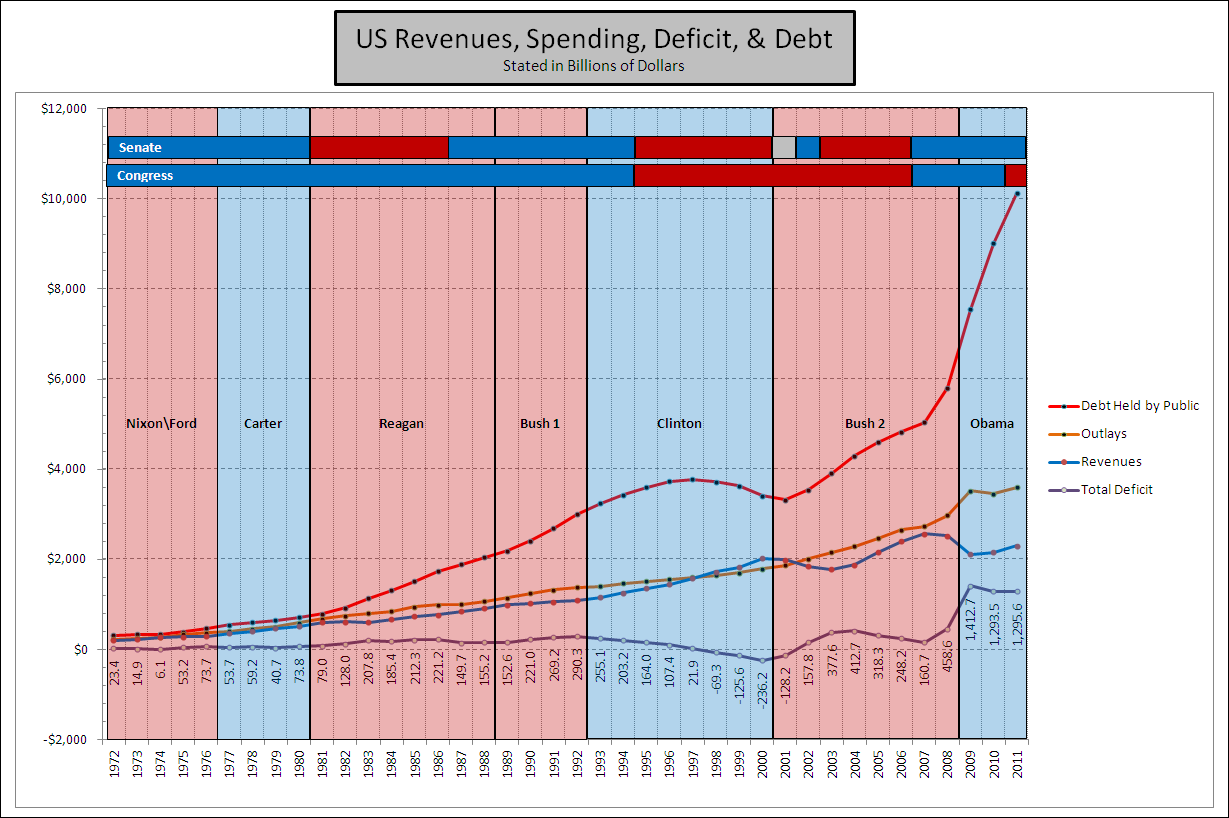
    So I went out to the CBO and took their numbers from 1972 – 2011.  You may get the XLS file yourself: http://www.cbo.gov/publication/42911. Then I made sure to identify who was in charge when and marked it with spiffy colors (Red is Republican, Blue is Democrat). Here are the results. Click on it to see it in its full size glory.
     

     What does this tell us?

    First, there was only ONE four-year stretch in the LAST FREAKING FORTY YEARS where the folks in Washington did not spend MORE than they took in. That was the four year period from 1998 – 2001.

    What the?!?

    Look at that chart again. There is a serious and systemic spending problem in Washington.

    What happened in 1998 to change what had been going on for almost three decades? That was when the citizens got fed up with Washington, threw out a great number of the Senators and Congressmen, and bought into the Contract with America.  This was when Newt Gingrich was Speaker of the House. This was when Clinton was getting pounded for all sorts of stuff and worked with those particular Republicans in Congress to balance the budget.

    Second, the deficit, the purple line at the bottom, tripled when Obama took office.  And stayed!  Who put that first chart together? Oh, yeah. It was Nancy Pelosi.

    You might say, well, raw dollars is good.  But what’s really important is how big a percentage that spending is of our nation’s GDP. If you’re spending 100 billion when the nation is producing 1 trillion, that sounds big, but it’s actually not as big a deal as when you’re spending 100 billion and the nation is only producing 200 billion. Okay, let’s look at these numbers as a % of GDP.
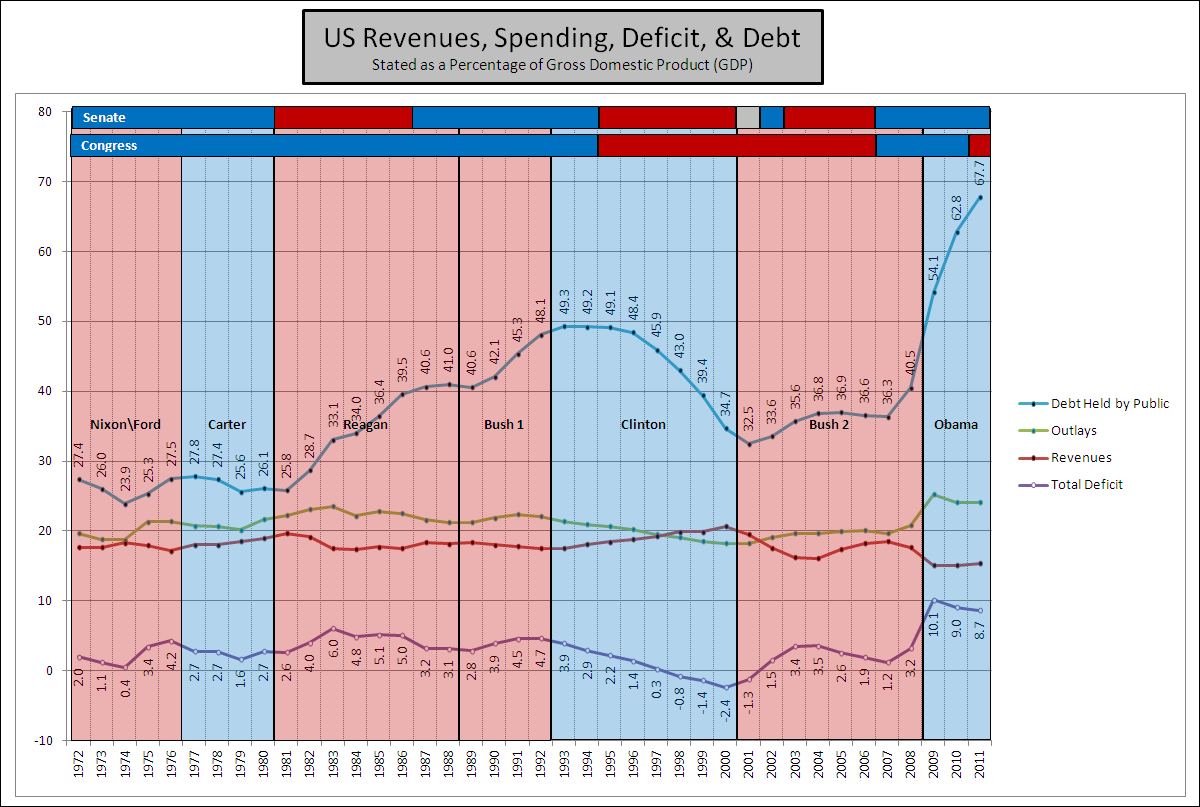
    Again, 1998-2001 were good years. On a % basis, the folks in Washington during that time did better than anyone else in not spending the nation’s wealth.  There’s no doubt that Reagan, Bush 1, Clinton during his fist 3 years and the Congress during those times were all happy to be big spenders.  Look at the debt burden during their years. But Obama and the Democratic majorities in Congress since 2007–drunken sailors compared to those guys. And then the Republicans come in and it doesn’t change. Gridlock?

    Let’s look at our presidents since 1972 and see how well they do on an annual basis. Those numbers in the first list, BTW, are stated in billions.
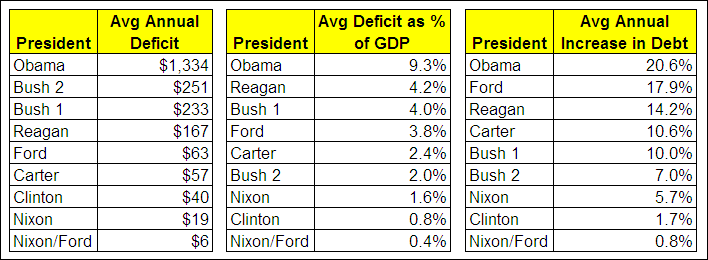
    Seems to me the most fiscally responsible groups were those in charge during the latter part of the Clinton years, the Nixon years, and the year when Nixon resigned.  It appears that during that year the folks in Washinton were so busy with the Watergate scandal they forgot to feed their spending appetites.

    Bottom line: as I said before, Washington has a serious and systemic problem with over spending.

    And when I say “systemic” I mean it appears the whole thing is rigged to produce over spending. We don’t just need new people out there. We need a system that prevents the overspending. We need an ammendment that requires a balanced budget and caps the size of the government in relation to GDP.

    We also need to find a way to incentivize Congress to pass a budget each year.  No budget, no pay is a good idea. The current House has indeed passed a budget. But the Democratic Senate has not, preventing us from having a budget at all. Obama submits budgets, but not a soul in the Senate, Democrat or Republican, will vote for them. It’s only the Republican House who seems to want to actually do their job. How can that be? Read It’s Deja Vu All Over Again with National Fiscal Policy for more info.

    This November we need to get a bunch of folks like those in 1998 back in Washington. A President AND a Congress who will actually finally tame the nation’s out of control spending.  Let me suggest you look at your Congressman’s and Senators’ records.  How have they voted? As for President Obama, well, I’m looking at the numbers above.

    Related Links

    Share
  • What you need as a storyteller

    Brand-StorytellerOne of the most important things I ever learned about telling stories was in Orson Card’s weeklong boot camp where we “workshopped” stories by doing zero workshopping. Zero critiques. In fact, critiques were verboten.

    Instead, Card asked us to simply provide a report of what he called the three grunts a reader makes when things aren’t working–where it was boring, unclear, or didn’t ring true.

    We were to provide a report of our reader reaction, including parts that really entertained or interested us. NOTHING more.

    He compared it to going to the doctor. We were to report our “symptoms.” The writer’s job was to diagnose if it was an issue and prescribe a remedy, if any.

    Doing that with 19 stories over three days was amazing. It totally opened up what story was about. And taught me what beta reading was all about. One of the most insightful writing experiences I’ve ever had.

    Nowadays when I read, I try my best to simply report. And that’s it. If, afterwards, the writer wants to brainstorm ideas together, that’s fine. But I don’t ever want to diagnose and prescribe because there have been too many books that didn’t work for me that delighted tons of readers. My critique or advice would have been exactly the wrong thing.

    All I can do is report my reaction. And then think about what would have fixed it for me.

    Kristine Rusch recently wrote a great article about this and other things called “Writing by Committee” in which she suggests a list of things authors need to be successful. Give it a read. I think she makes a lot of good points.

    And a few I disagree with. She is quite forceful about writers not acting as first readers. I think that’s bunk. And she says as much in the comments. If a writer can give a reader response instead of a critique, that’s as helpful as a non-writer giving a reader response. I also disagree that you have to toss something and start over if it doesn’t work. If it’s fundamentally broken, sure. But many times a small adjustment gets you back on track.  Finally, yes, a story has to be surprising. At the same time, you had better deliver the type of experience you promise your reader. And that’s all defined by genre. You can’t promise your readers a thriller and deliver a romance. That only leads to irritated readers. I believe you have to consider your audience. But these are all quibbles. The article is great.

    BTW, please note I used “storyteller” in the title. I did that on purpose. More and more, I find I’m not interested in writing. “Writing” doesn’t seem to convey what I’m after. However, I am interested in telling cracking stories.

    Share
  • Good Stuff! Just Mercy

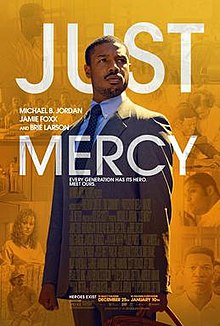
    Just Mercy movie poster

    In other countries, the government can throw you in jail for no cause. It can keep you there indefinitely awaiting trial. And it can manipulate the trial to prevent you from mounting a defense.

    In other countries, there is no trial by your peers. Instead the government is prosecutor, judge, and jury. 

    Our criminal legal system has so many wonderful protections in it. But there are times, as good as it is, when it convicts people of wrongs they didn’t do. Including murders they did not commit.

    I can’t imagine being in that position. One day I’m pursing my dreams, enjoying my family, going to the movies, walking my dog, hiking. The next I’m hauled off to jail, convicted, and put on death row.  And nobody will listen to me.

    Luckily this doesn’t happen in the vast majority of cases. But it does happen. And if it happens to you, wouldn’t it be nice to have someone show up one day and say, “I’m going to work like a dog to reveal the truth and get you out of here.”

    The movie Just Mercy tells the true story of just such a case. Walter McMillian is on death row for a murder he did not commit. And then one day a young defense attorney shows up and says he’s come to help.

    This movie will have you on the edge of your seat and make you think. There are two or three moments where some crass language is used. So check it to make sure it meets your requirements. If you end up watching, I think you’ll really enjoy this tale. We did.

    Share
  • |

    Diagnosing Quantum of Solace

    ***SPOILERS***

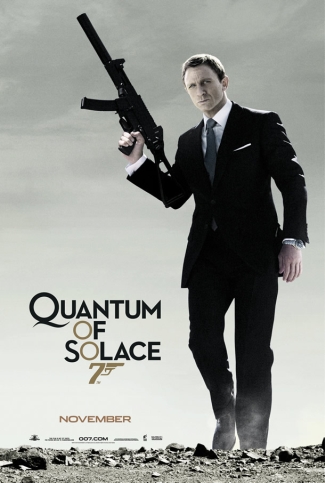
    Last night I went out with my wife and some friends to watch QUANTUM OF SOLACE. I was so excited. But when the movie ended, I was totally unsatisfied. There was no release. Nothing. It just ended.

    There was lots of great stuff in it. Love the character and style of this new bond. Loved CASINO ROYALE, but this just didn’t work for me. My diagnosis has two parts.

    MINOR ISSUE: clarity in story. The chase scenes were so choppy I couldn’t get a feel for what was going on so I could worry for Bond. All I did was get sick to my stomach. Part of the way through I told my wife I was going to write death threats to the freaking director. Who in the world thought that was a good idea? It doesn’t mimic battle etc. In battle you are HYPER alert and focused. Your world doesn’t turn into chaos.

    But it was more than the chase scenes. There were times when I did not know what was going on. Why was Bond going to his friend from movie 1, why was he watching that guy pick up a bag at the play, why was he going to the party, etc.?

    If he’d shared any of his plans, I could have gotten worried when antagonistic forces thwarted him. As it was, I was just watching him do stuff and only realizing at the end what the goal was.

    The basic principle of suspense is to let me know what they need to do and why they need to do it, then let me worry as I see the operation fall apart. Or let me know the danger and see them walking into it. But time and again they didn’t provider the viewer with the necessary information in this movie. 

    MAJOR ISSUE: ineffective story structure. I think for a film to build to a huge climax and release, the hero has to find himself in more and more desperate circumstances. His situation has to become darker and darker until we see no way out for him. By the end of act 2 his plans etc. should all be in shambles. He’s out of options.

    In this Bond I rarely felt he was in danger. Yes, there were some fight sequences which were tense, but he never ended up in worse shape afterwards. We got messages that he was being framed for murders, but I never really felt the screws tightening on him. So it never got darker and darker for him.

    His plans seemed to only be delayed, not destroyed. In Casino Royale, his car is wrecked and he’s taken captive and is going to die. He loses. In this one, nothing. Even when his plane is shot down going out to the desert, it’s just a delay. They walk to the bustop and are soon back on track.

    There might be another point about something being at stake. The water grab is a great idea, but we’re talking a 50 year plot. It’s not THAT urgent.

    A FIX?

    I think they could have done more by playing up the revenge/mystery of the last one. Yes, have the water grab, but make this personal to him. He’s searching for the answers to who was behind his lover’s death. Why not?

    Then get the villain, the US CIA, and the British hunting him down with real resources. He evaded everyone fairly easily in this one. He’s running FROM all these forces, barely one step ahead, until he gets caught by them. And it’s one of Green’s guys in the CIA or something like that who captures him. So he’s totally screwed. Then have the Black CIA officer do something to spring him. He’d probably have to die for it.

    I’m sure there are more and better options. But do something so that Bond is running for his life, FAILS, then pulls it out. Not chasing down the bad guys one by one with relative ease.

    Just one option. Thoughts?

    Share
  • Pew Study on American Reading Habits

    Pew Research Center just published the results of a national study surveying reader habits. It answers questions like:

    • Do folks read ebooks more often on cell phones, e-readers, or computers?
    • How many books does each age group read per year?
    • How do readers under 30 discover books to read? 

    Lots of great stuff. You can read the full survey here: http://libraries.pewinternet.org/2012/10/23/younger-americans-reading-and-library-habits/

    Share
  • LTUE 2024 Writing Presentations

    Yesterday, I gave two presentations at Life, The Universe, and Everything, a SFF writers conference in Provo, Utah. A number of the attendees wanted copies of the presentations. I’ve linked to them below.

    There are two types of plots that power almost all successful commercial fiction. Are you using them in your stories? Do you know how they work? In this class, you learn both plot types, their key beats, the 3 big mistakes writers make, how to generate scenes, and much, much more. Come learn how to make plotting easier and deliver the ride your readers are looking for.

    My lecture notes.

    The #1 thing that slays more writing dreams than anything else is the writer’s own head games. In 2005 I fiddled with death. Cognitive therapy (and God and a good counselor) saved me. And gave me an explosion of insights about writing stories and the distortions that sabotage so many of us writers. In this class, you learn the distortions, the truth, and a tried-and-true technique for removing the distortions that anyone can follow. You don’t need to struggle anymore. Banish your writer’s block, fear, imposter’s syndrome, comparisonitis, and more. Come learn how to unleash your awesome creativity and have a blast writing.

    PDF of presentation slides.

    Share

2 Comments

  1. Thank you again for a great LTUE, and thank you for being so open with your material, including posting it on your website. You’re awesome, Mr. Brown!

Comments are closed.