Some 101 for Congress and the President

It’s not really rocket science.

  1. If you have loans outstanding and the payment is due, you owe the creditors a payment. Payables for Idiots 101.
  2. If you have received goods and services, then you owe your vendors a payment. Payables for Idiots 102.
  3. You pay your bills. End of story. That’s what grown ups do. If you have to float some debt for a few months, you do it. And you staple a note to your head to stop spending like a slot machine junkie. Payables for Idiots 103.

The debts we have are for goods and services we’ve already received. So increase the debt limit and pay your damn bills. What about spending?

  1. You do not spend more than you take in year after year. If you do, that’s called running your business into the ground. In the case of the Congress (primarily Harry Reid’s Senate at this point, although many, but not all, of the Republicans were happy to go along with dumb spending earlier) and the President, it’s the country they’re running into the ground. Spending for Idiots 101.
  2. If you’ve got all sorts of cool things planned like Acorn subsidies for pimps and Antarctica Jell-O wrestling grants for scientists, but you can’t afford them—i.e. you have to go into debt to get them–you cancel those plans. Spending for Idiots 102.
  3. The problem is that Congress and the President buy all sorts of crap and expect to put it on a credit card when it comes due. And there’s nothing to prevent them from doing it.
  4. They’re like irresponsible teenagers. They need controls that won’t allow them to overspend. Kind of like putting limits on a teenager’s cell phone minutes. Or forcing them to use a debit card. When they’re out of cash, they get a card denied response from their vendors.
  5. So you set spending limits, debt limits, and force them to balance the budget each year, except in extreme emergencies like when space aliens try to wipe out humanity. Spending for Idiots 103.

This means you pass Cut, Cap, and Balance and quit spending money you don’t have. Really difficult stuff. What about getting out of debt?

  1. You eat rice and beans until you’re debt is gone or down to a manageable level. That means you cancel crap you can’t pay for. Sorry earmarks, you’re gone. Sorry grants for nude artists in trees, you’re gone. Sorry subsidies for PBS, you’re gone.  Finances 200: How to Not Be A Money Moron.
  2. You figure out how to reduce your current cost structure. This means you figure out a way to reduce the costs of Medicare, Medicaid, Social Security, and every other service or product you provide, cutting those that aren’t essential. You hire someone like Mitt Romney who knows how to go through every line in a budget and turn a bloated ship around.  Finances 300: No, You Can’t Pay For Your Sister’s Hair Implants with My Money.
  3. You remind people this is the freaking U S of A. A place where a man or woman can make themselves. Not where the government changes your diapers and feeds you mush three times a day. Communism and socialism have failed. They were badly conceived utopias, much like multi-level soap and vitamin marketing schemes that are supposed to usher in the Second Coming.  Finances 400: The USA Buried the USSR for a Reason.
  4. You increase your revenues.
  5. However, if you raise taxes, you’re actually going to depress your revenues. Think about this. Which car company has bigger revenues–Lamborgini or Honda? Who is going to put out, if they’ve got Louie the Fingers and his buddy Jockstrap taking increasing amounts of their money in a protection racket? Don’t be a thug. Be an enabler.  Do what Wal-Mart does and go for volume.  Do what Ebay does–create the environment that entices tons of commerce, entices people to dramatically increase their transactions. Transactions go through the roof; you take only a tiny cut, and, shazam, you increase your revenues.  Finances 500: Um, Do You Want People to Work to Become Rich or Do You Want Them To Pick Up Torches and Burn the Houses of the Rich Down?

Cut spending, reduce cost structure, and increase your revenues. That’s getting out of debt.

Is this really that hard?

EDIT: 8/1 Seems that “wacky” Ron Paul actually has a simple commonsense approach that doesn’t sound crazy. Why couldn’t we do this?


Share

Similar Posts

  • |

    I need your insight!

    R-moviesLast year I posted about a service I’m working on to get ratings on books for sex, violence, and language. I posted similar thought about YA books in “Since When Did Young Adult Become The Cure For Cancer?“.

    I’m back.

    I did lots of customer discovery last August in an effort to see if book ratings is a problem worth solving, i.e., are there lots of avid readers who would love content ratings and sign up? All my interviews were very positive, but I didn’t finish validating our ideas because I had to stop to get books out and because we discovered some things that made us change some of our assumptions. I started up again a few weeks ago, this time with a team.

    To continue the project, we need to interview 20-40 avid cleaner romance readers. Folks who probably read just such a book last month.

    Why?

    The biggest problem startups like this have is assuming they know what the customer values, being wrong, and building something nobody wants. So before we build anything, we need to first understand exactly what readers are doing today to solve this problem and where (and if) they are struggling. If we can validate the need, I think a lot of folks will be very happy having popular clean reads delivered to their email every week.

    If you know someone who fits the bill, please send this post to them. They can shoot me an email by clicking the contact link in the menu bar.

    If you fit the bill, please contact me.

    It would be incredibly helpful to me to hear about how you approach this and ask you a few questions. It won’t take more than 20 minutes, and there’s no need to prepare in advance.

    Hope you had a great 4th!


    Share
  • |

    Update and Fage

    I passed the 90% mark today on SERVANT. It’s been wonderful going back through this story, remembering why I loved these characters so much. The cover too is coming along. I’m looking forward to revealing it in the near future. Right now everything looks like it will release on target, although that may change.

    While you’re here, you know I have been on a quest for delicious low-sugar yogurt for some time. I have found it at last. Behold.

    Fage 2 percent yogurt

    No Greek yogurt has a better taste or texture. And there’s no added sugar. Add some fruit and it’s heaven.

    It’s pronounced “fa-yeh.” Except, how do you pronounce that? Who comes up with product names nobody can pronounce? 

    But it doesn’t matter how you pronounce it. We luvs it, Precious.


    Share
  • Good Stuff! Those looking to seal their asphalt in Ogden, Logan, and Bear Lake areas

    AndersenAsphaltFolks with asphalt driveways and parking areas, I have something you’ll be interested in.
    I have a nice long driveway, about 5,500 square feet of asphalt. We hadn’t touched it since 2005 when it was installed. But asphalt doesn’t last forever. If it’s not periodically sealed, it weathers and cracks, and then the water gets in and undermines the whole structure, and soon you get pot holes and alligator cracks and the thing becomes a mess. Last year some small cracks began to show, and we knew we couldn’t put it off any longer.

    I called a number of places for quotes and availability. And the person who gave me the best quote and quickest turnaround was Caden Andersen of Andersen Asphalt. The name will sound familiar because that’s the Caden that grew up in Rich County. He and his brother took over his grandfather’s long-standing business.

    And I am happy to report that they did an excellent job at an excellent price. They came and cleaned the whole thing with wire brooms (although I power washed it before they came), filled the cracks with hot tar, then sealed everything with two coats. Their service was friendly and prompt. And they went the extra mile. There were some large cracks in the city’s road right before you turn off into our driveway. They filled those cracks with tar as well for no extra charge. The result is a beautiful driveway that’s going to last for quite some time.

    They have two locations right now, one in Cokeville, Wyoming and the second in South Ogden, Utah. If you live within an hour or two of either of those places and need to seal some asphalt, I highly recommend you give Andersen Asphalt a call.

    Share
  • Brown’s Breakfast Burrito, The Way Back

    The Way Back

    GULag is the acronym for the government agency that administered the main Soviet forced labor camp systems in the early 1900’s. In Romanized Russian that’s “Glavnoye upravlyeniye ispravityel’no-trudovih lagyeryey i koloniy” which means “Chief Administration of Corrective Labor Camps and Colonies.”  The term “Gulag” quickly morphed to represent the camps themselves, which housed a wide range of convicts and many political prisoners.  It’s also come to stand for the repressive Soviet system with its arrests, interrogations, transport in unheated cattle cars, forced labor, destruction of families, years spent in exile, and early and unnecessary deaths.

    The Gulag was a meat grinder. An estimated 1,053,829 people died in the Gulag from 1934 to 1953.

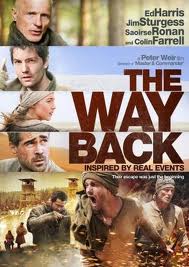
    Some of those camps were in Siberia, one of the most remote and harsh places on earth. Sawomir Rawicz was one of those who claimed to have escaped such a camp in Siberia. He wrote about it and his subsequent 4,000-mile walk to freedom in India in The Long Walk. That story inspired Peter Weir to write and direct The Way Back, which tells the story of a group of men who attempt to escape out of Siberia, across the Mongolian wastes, and into India.

    The film stars Ed Harris (who is interesting in anything he does), Colin Farrel (also starred in Ondine), Mark Strong (the villain in Sherlock Holmes), Saoirse Ronan (the fabulous lead in Hanna), and Jim Sturgess (the boyfriend in One Day). One of the group is an outright murderer. The others are all political dissidents—a teacher, priest, businessman, artist, etc. I found the performances honest and believable. But it wasn’t just the characters–the screenwriters subtly used syntax and word choice to transport the viewer.

    But more important than the believability were the various tensions and stories contained within the escape plot. Each of the men, and the lone girl, has a story, and the film gives space for the stories to be told. As for the lone girl: Ronan was amazing in Hannah.  She’s amazing here. Furthermore, the role she played here leavened the whole film with something it wouldn’t have had otherwise.

    The story will surprise you, make you shed a tear, think, and laugh. When you’re finished, you’ll talk about it. It’s that kind of a film. If you like dramas with action and suspense, I think you’ll like this film.

    As always, use KidsInMind.com to see if it contains things you might find objectionable.

    Brown’s Breakfast Burrito

    How about a meal that’s so good you’ll want to slow way down to savor each bite? A breakfast that will keep you full until lunch? A tasty repast that isn’t loaded with mind-numbing calories? Let me suggest the John Brown breakfast burrito. It’s full of succulent umami, bursts of piquant pepper, healthy mushrooms, and lots of filling protein. And it only takes about 10 minutes to prepare. The recipe below makes one burrito. Scale it up to feed more.  

    VEGGIES

    • 1/4th red bell pepper, chopped into small pieces
    • ½ to 1 cup of mushrooms, sliced
    • Dash of thyme

    EGGS

    • 2 eggs (120 calories)
    • 1 T milk or half-and-half
    • Salt
    • Pepper
    • Dash paprika
    • Dash garlic powder
    • Dash onion powder

     THE REST

    • Pam cooking spray
    • 1 tortilla (150 calories)
    • 1 ounce of Jimmy Dean Premium Pork sausage (90 calories)

    If you don’t have one of the spices, don’t freak out. It will still taste great. But the spices really take it to the next level. Here are the instructions. 

    1. Start with your veggies. Spray pan with Pam and sauté peppers for two minutes on medium high heat. Add mushrooms. Give them a spray of Pam and dash with salt. Cover until the mushrooms sweat (release their water).
    2. Next is the sausage. While mushrooms are cooking, start your sausage frying.
    3. Finish veggies. Uncover mushrooms. Just before you finish them, sprinkle with a dash of thyme. When the spice becomes fragrant (its smell rises up in delicious glory from the pan), remove the veggies from the pan and cover to keep them warm.
    4. Cook eggs. Turn heat down to medium low. Beat eggs, milk, salt, pepper, paprika, garlic powder, and onion powder.  Spray pan you used for veggies with Pam, then cook your scrambled eggs on medium low heat, stirring and scraping the whole time. And keep it on medium low—no browning or burning of eggs allowed! Cook until the eggs glisten with the last bits of moisture. Remember: you don’t want dry desert eggs. You want soft succulent ones.
    5. Assemble the glorious concoction. Put the veggies, scrambled eggs, and sausage in your tortilla and wrap it up smartly. (What does “smartly” mean? I don’t know, but it sounded good, didn’t it?)
    6. Go to heaven and return singing. This means you eat your breakfast burrito, but you do it savoring each bite. This is food meant to be enjoyed, not gobbled.

     As for calories, I estimate about 360 for the main ingredients. Veggies really don’t count in my book. Come on! Nobody gained weight eating turnips. But I’ll round it up to 400 just to be safe. Add in a glass of water and a piece of fruit and you’ve got a 450 calorie breakfast that starts your day off with delight, gratitude, and the joy of redemption. It could also make those you cook for kneel down upon the floor in well-deserved homage. And that’s always a nice thing for the cook.

    Share
  • Good Stuff: The Free State of Jones

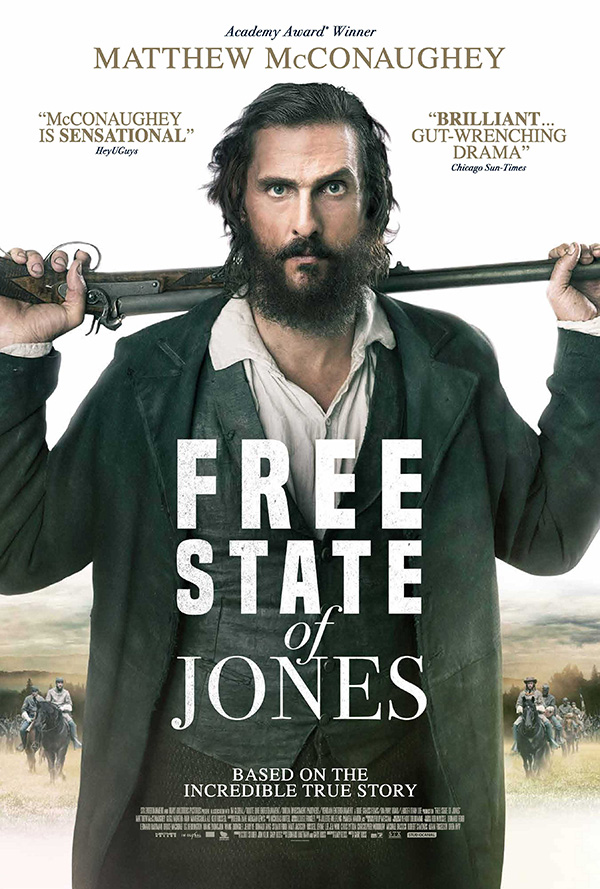
    I recently watched a moving and surprising film called The Free State of Jones, starring Matthew McConaughey. It’s about Newton Knight and how he led three counties in Mississippi to break away from the Confederacy during the Civil War.

    Think of that. On January 9, 1861, Mississippi declared it’s independence from the United States over the issue of slavery. They were the second state to do so. South Carolina was the first. On reflection, it makes sense these two states seceded first because they had the highest portion of the population as slaves. South Carolina’s population was 57% slave. Mississippi’s was 55%.

    Mississippi’s declaration of independence from the Unites States starts with this paragraph.

    “Our position is thoroughly identified with the institution of slavery—the greatest material interest of the world. Its labor supplies the product which constitutes by far the largest and most important portions of commerce of the earth. These products are peculiar to the climate verging on the tropical regions, and by an imperious law of nature, none but the black race can bear exposure to the tropical sun. These products have become necessities of the world, and a blow at slavery is a blow at commerce and civilization. That blow has been long aimed at the institution, and was at the point of reaching its consummation. There was no choice left us but submission to the mandates of abolition, or a dissolution of the Union, whose principles had been subverted to work out our ruin.”

    The rest of the declaration simply elaborates on that theme. However, not everyone in Mississippi agreed. The folks in Jones County, way down in the southeastern part, were mostly non-slave holders and cattle herders and had little use for a war over a state’s right to maintain the institution of slavery.

    Led by Knight, on October 13, 1863, with the war still raging, folks in Jones County and adjacent counties formed a separate government known as the “Free State of Jones”. They fought at least fourteen skirmishes with Confederate forces and went so far as to raise an American flag over the courthouse in Ellisville and send a letter to Union General William T. Sherman declaring Jones County’s independence from the Confederacy and asking for support.

    This movie is based on those events and, importantly, some that occurred after the war ended.

    The film is rated R for a scene with some Civil War battle injuries. And perhaps because of the use of the n-word. What it delivers is a powerful depiction of the issues of the time and the courage of one man who’d had enough. If you like history and action, I think you’ll enjoy this movie.

    Share
  • Shadow and Bone

    Last year someone recommended Shadow and Bone by Leigh Bardugo to me. I noted the recommendation and then promptly forgot it because my reading queue is two years long. But this last week my wife brought some books home from the library, and there, sitting on top, was Bardugo’s book.

    I opened it. Page one listed the orders of magic. I was immediately drawn to the names. They were Grisha, “soldiers of the second army, masters of the small science.” They had divisions of corporalki, etheralki, and materialki, who are the order of fabrikators.

    I don’t know what it is, but I love, not steampunk (well, I don’t know if I don’t love steampunk because I really haven’t read any, but I do think dirigibles are vastly overrated), but the mixture of machinists and engineers and magic set in the late 1800’s, the time period when Sherlock Holmes was running about. It’s something I can’t resist.

    And “fabrikators”? Russian? Oh, baby.

    Most epic fantasies are set in some kind of old German or English medieval setting. Nothing wrong with that. We luvs them, Precious. But something different is nice as well. Recently, Peter V. Brett and Saladin Ahmed have given us fantasies with a Middle Eastern flavor. But I haven’t read an epic fantasy with a Russian flair since C. J. Cherryh’s Rusalka series. And here on page one I’ve got magic and machinists and all these Russian sounding terms.

    Awesome.

    I turned the page. The opening paragraph of the prologue pulled me right in, and I was off and running, soaking up this little snippet about an orphaned boy and girl who, fast-forward in the next chapter, are now in the army. Not the second army that’s made up of Grisha, but the first army that’s made up of soldiers with rifles who have to slog through mud and march while a handful of Grisha of the second army roll by in a carriage.

    Alina, the girl who is now working with the army’s cartographers, and Mal, who is a tracker, are heading with the troops toward the Unsea, the Shadow Fold, this darkness that cuts the country in two and is full of these horrors called volcra. They enter the Shadow Fold, are attacked, and Alina unconsciously calls forth a powerful magic.

    Of course, she can’t reproduce it, but it’s a magic that might be used to banish the Fold forever. The rest of the book is about Alina avoiding assassination, trying to learn how to summon her magic, and being pulled into a surprising and terrible plot. It’s also about her and Mal. Yes, there’s a love story here, but this is NOT a romance where everything focuses on her feelings and his feelings and touches and sighs and unbounded quivering.

    This is an epic fantasy, remember? Those books that delight readers with dark lords and magic? Well, there’s plenty of that here, plus secrets and a number of delicious plot twists. There are escapes and chases and battles. And, yes, that love story that isn’t overblown but feels very real indeed.

    Epic fantasies come in lots of different sizes. This isn’t one of those huge doorstop epics with twenty sprawling plotlines. This focuses on one point of view and one storyline, which means you are able to enter the story very quickly, much like the epics by Hambly and McKinley and so many others.

    It’s a terrific read. Give it a go. If you enjoyed Vin in Brandon Sanderson’s Mistborn and Cinna and Katniss in Hunger Games, then I think you’re going to love Shadow and Bone. I’m certainly looking forward to the next volume.

    Share

9 Comments

  1. And you establish a pro-growth, pro-jobs tax policy (which may or may not include actual tax cuts) to increase revenues. The tax surplus of the late 90’s was not the result of government frugality, it was the result of economic growth – people makine more money than expected.

    Now, stop with the politics and get back to your revisions…

  2. I agree wholeheartedly. If my parents could explain saving and debt to me in primary school, then how can the concept escape whole governments? And I mean that plural. My state government is cutting *everything*… excluding rates, of course. Anyway, I thought I’d weigh in with James C and add an idea I’m partial to.

    We could simplify our tax system, so the average person could figure out how much money he or she owed without having to buy a computer program or pay someone to figure it out.

    Of course, this would get rid of a whole lot of loopholes, making everything much fairer. Some people wouldn’t like that. They might leave. They’d have probably been using loopholes, though, so their loss would be a smaller blow than you might think. To counterbalance that, there’d be a blossoming of small business. By not having to pay as many accountants, entry and running costs for virtually every industry would be lowered (Economics: 101). It’s a way to apply James C’s idea of promoting entrepreneurship while not cutting the actual tax rate.

    Speaking of which, the government wouldn’t have to pay so many accountants to look for tax cheats – or perhaps rake more money in by keeping all of its accountants, while making it vastly easier to *catch* cheats.

    Of course by ‘we’ I mean Australians. Not being a resident of the USA, I’m not going to claim privileged knowledge about your nation. But a few years ago, Australia’s treasurer explained our business tax law could be reduced from bulky tomes to flimsy handbooks. I reckon that would have solved a lot of problems, but there are those with power who didn’t like the idea (see my comment about people exploiting loopholes).

    It might not work to the same extent in the USA, but a similar idea appeared in a rather prominent USA-based magazine. It was being detailed as a possible strategy to help deal with the bind you’re in over there. I’d give its name, but I’m scared of breaching copyright. Is it okay if I say the title rhymes with lime? And rhyme, actually.

    But hey, why listen to an Aussie? We don’t complain when our government gives money to schools. We *do* complain when our pollies want to give less money to schools. We *even* complain when the government gives more to private schools than public ones. It’s as though we don’t think the market will regulate itself so everyone gets a fair go. Course, I’d like to totally change the way we do education, but this isn’t the time for that little rant.

    Maybe it’s because we used to get exploited by rich people. Or maybe it’s because of all of the beer we drink. But, if you think about it, the commies have practically taken over, down under.

    P.S. Sorry, John. I don’t mean to write a little essay with every post.

  3. I think it’s the beer, Heath (grin).

    Having gotten a Masters degree in accounting and worked for a big accounting firm for a few years, I agree the tax code should be simplified. AND it should include more people. When almost half the people aren’t paying any sort of income tax, there’s something screwy. BTW, link out to the Time article.

  4. I could have sworn you worked for Arthur Andersen, John. Doesn’t that mean we have to take your financial advice with a shovel of salt? 😉

    All kidding aside I think you’ve got it nailed here, particularly the part about increasing revenues long term with tax incentives. The Cut, Cap and Balance Act actually gives a blueprint for that if you read between the lines (quote from Wikipedia):

    “Cap on future spending
    The bill proposed that federal spending would be scaled back based on the glide path for the fiscal years below as a percentage of the Gross Domestic Product (GDP):
    2012, 22.5% of GDP.
    2013, 21.7% of GDP.
    2014, 20.8% of GDP.
    2015, 20.2% of GDP.
    2016, 20.2% of GDP.
    2017, 20.0% of GDP.
    2018, 19.7% of GDP.
    2019, 19.9% of GDP.
    2020, 19.9% of GDP.
    2021, 19.9% of GDP.”

    The liberals are screaming that this means we are going to spend less and less money on entitlement programs, push poverty through the roof, kill off the elderly, etc. What this really does, however, is give a firm incentive to the government to grow the economy.

    If Barney Frank wants to spend all sorts of extra money in 2014, he needs to start working *today* on revving up the economy so that in 2014 he will have more money to spend. Same thing with everyone else in Congress who wants to put their name on bills to buy votes from special interests but has no desire to pay for what they are buying. Grow the economy every year and we will have more money to spend without needing to kill off the value system and work ethic that got us here in the first place.

  5. I like that idea a lot. Get the money now so you can spend it on whatever great project you want later. Not vice versa.

  6. Sorry, I read that article in dead-tree format, in a magazine that has since been shredded. You can search the archives if you like, but I’m not quite that dedicated.

    There is this, however, which mentions a few of the same issues: http://www.time.com/time/magazine/article/0,9171,975330-1,00.html

    Still agree with you, by the way, on regulating income and expenses. That’s the most basic tenet of good financial practice there is. I mean, it got us out of the Great Depression, but that’s because money needed to be injected into the system. We have plenty of money now; it just isn’t circulating the way it needs to be.

Comments are closed.