Slides for my LDStorymakers Presentations

I loved attending the LDStorymakers conference this year. It was awesome, fun. I chatted with old friends and met new ones.  Got (stole) a great story idea from Donald Carey, the Conference King. Enjoyed Provo–love the weather down there this time of year! Attended some great presentations on writing. Gave some that seemed to help a number of folks. It’s a special delight to deliver a presentation that both entertains and helps. Furthermore, my family came down with me. So I got to hang out with them in the evenings. My daughters sneaked into the mass booksigning and got autographs from some of their favorite authors.  They were giddy with delight.

It was bliss.

I also worked with Isaac Stewart on a mock up of the new cover for SERVANT, and dude. DUDE.  If we can swing it, the covers for the Blacksword Books version are going to rock.

Anyway, I promised many people I would post my presentation slides here. Here they are in PDF format:

Vivid and Clear

Story Turns

And for those of you in the Story Turns class wanting that fine car chase clip, here it is!

Share

Similar Posts

  • |

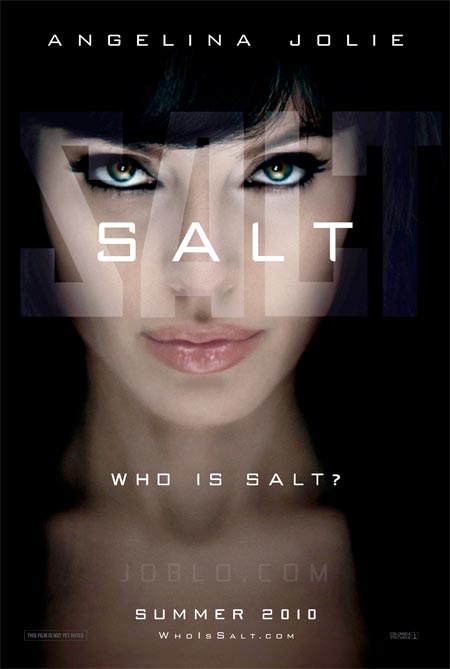
    Jolie, Salt, & trading suspsense for surprise

    Last week I went and saw Salt. Wow. The movie started with a bang and was off to the races with lots of great action. Unlike many action films where the characters perform stunts which are simply too hokey for me to buy into, I found myself believing in all but two of Salt’s. So I was wowed most of the time instead of thinking about whether they were using wires or what or that it was all so wrong and geeze don’t these guys have consultants? They weren’t as stunning as the opening of Casino Royale, but what is? 

    But it wasn’t just action. The premise and acting were all great as well (yes, I recant, I slammed Jolie a while back as an actress cast only for her face value; and while you know that’s one of the reasons why she was here, she still was convincing in her role). Furthermore, the story had a lot of great reversals and reveals. But this was also its ultimate downfall.

    When I got to the ending, I did not feel a climax release. No catharsis. No afterglow. It just ended and left me feeling empty. It’s an awful feeling. Totally unsatisfactory. Such a maddening cut off. 

    But why? It was all so good up to that point.

    *** SPOILERS ***

    As I was talking it over with Nellie I believe I indentified the answer: in their effort to be surprising, the director and writers removed everything that would have built suspense. So instead of getting a Sixth Sense ending where the surprise adds to the climax and gives it a wonderful texture, we got a slap of surpise and then nothing.

    For me to feel relief, triumph, and the desire to stand up and cheer–all those great climax emotions–I have to be worried about a character. Stressed, thinking they’re going to fail. They need to fight courageously against insurmountable odds and actually come to a point where it appears all is lost. Where I groan inside. All this creates massive pent up worry and anxiety for them. And at that point, the character snatches victory from the jaws of defeat.

    Boom! The climax floods me and it’s delight, relief, cheer, joy.

    It’s just like a football game where we bite our nails until the very end. Where our non-ranked team is playing the #3 team in the nation. Maybe we jump ahead in the second quarter, but in the third we fall behind. We make some great plays but can’t catch up. And when we do put points on the board, the other team immediately responds. There are three seconds left. We’ve stalled at the twenty yard line. We have one more play. From the moment it starts it appears to be broken, our QB is going down, and then . . . he passes to a running back who has made some space. Who is standing open in the end zone! Yeeeeeaaaaaaahhhhhh!

    In order to feel a release a climax, something has to build up. The thing that builds is worry, fret, desperate hope. This is what we mean when we talk about suspense. We know the team’s goal, see their predicament, see the overwhelming odds. See them about to lose it all. The dread of defeat and what will be lost rises.

    But in Salt the director and writers went for the effect of surprise instead of suspense and triumph. The moment Salt starts in on the Russian president I thought she was the bad guy. Yes, there was the bit about the spider that had me wondering. Yes, I knew she felt anguish about her husband being killed (that smart little reveal in her expression). I knew all of that. But the movie kept me busy thinking she was the bad guy up until almost the very end. Everything in the film lead me to believe this. Not because I didn’t get it. I got it precisely. It’s exactly what the director wanted. It was the setup for the big surprise/reversal at the end.

    But when they went for surprise by not letting the audience know what Salt was really up to, the immediately removed the possibility of suspense. So I didn’t feel any suspense at her infiltrating the old group of spies. No relief at her killing them–that was just her revenge. No suspsense when she went to the White House. Nothing when she chased the president down the elevator shaft. The whole time I was thinking, crap, they really did indoctrinate her. She’s bad.

    More importantly, there was no rooting, no worry building to release proportions.

    Not until the very end do we realize what she’s been trying to do. Oh, the role reversal with her and Ted Winter (btw, like Liev Schreiber who plays the part) was all a big surprise, as it was designed to be. But the surprise faded and there was . . . nothing to replace it. That’s how surprise works. It’s a relatively short effect. 

    Yes, she kills Winter. Yes, he was a threat at the end with his scissors, but I didn’t care that much. I hadn’t been whipped into a fever pitch. Not like I was in Gladiator with the emperor and the lead in the coliseum. There was no pressurized worry ready to burst. There wasn’t any because we hadn’t had any time for it to build and because by that time nothing for Salt was really at stake. The one meaningful thing she stood to loose–her relationship with her husband–was taken away from us in an earlier scene when he was shot dead. So what was at stake? A big old nuclear war. Well, who cares about that? Nobody. It’s too generalized. We cared about Salt and her husband.

    The result was that the director and writers traded climax for surprise. Alas.

    So here’s my conclusion. Surprise is a relatively easy effect to create. You simply have something unexpected but logical occur. Relief, triumph, climax needs something much different. And surprise can be a part of it. But in our effort to build surprise we must not remove the conditions necessary for please-dear-mother suspense. Suspense requires we root for and worry about a character for a significant period, our unease growing until it’s drawn taut, straining. All the time something significant has to be at stake. Something we can sympathize with. Something personal to the person we care about. Only then can we feel the climactic release. Only then will we stand up and cheer in holy-crap-no-way relief and delight.

    Share
  • How to tell an author you don’t like their book

    Mette Harrison wrote a blog about how various authors respond when they read a book, don’t like it, and then the book’s author asks them directly what they thought of the book. 

    Here’s my response.

    As an author when I ask someone, especially another author, about their experience with my story, I’m looking for a data point to see how the book’s working or to get some insight. I realize others might be looking for validation. And, of course, I hope that everyone who reads my stuff finds nirvana even if I know that is not going to be the case. But I don’t ask unless I want data. And so I would hope they would report their experience accurately. I also hope they do it in friendly and helpful manner.

    So because that’s what I want, that’s what I try to do for others.  And the sandwich+ method has been one good way for me to do that.

    1. State something specific that works for me, e.g. “I love your character Bill because he’s so outrageous.”
     
    2. State the key thing that’s giving me trouble. For example, I might say, “I am having a hard time with the pacing.” But then I ALWAYS want to give the context of me as reader when it applies to my reaction, e.g. I’m a terribly impatient reader, I like to feel hope in what I read and know I don’t like as much despair as many other readers do, I can’t stand clowns (this is true: clowns are some of the scariest creatures out there, second only to crocodiles). The author should know these readerly things when they apply so the author can understand where the comments are coming from.

    If the book’s in pro shape and I think the issue is mostly my tastes, then it’s also useful to compare their work to another successful piece or author that had the same issue for me, e.g. “This reminds me of Twilight; I know people love it, but I just couldn’t get into that book either for the same reason.”

    I don’t think this is fluff. I think it’s part of being accurate. Our reality is what we focus on. And if I make a statement that leaves an author thinking I think the work is bad, then that’s not accurate because the truth is I think I’m not in the audience.

    If I think it’s a craft issue, then I highlight the main thing I think is causing the problem. A laundry list is usually useless. But thoughtful focus on the key issue can be very helpful. If I can’t tell whether it’s a taste issue or a craft issue, I admit it.

    3. State something else that’s working for me, e.g. “While I just couldn’t get past all those clowns freaking me out, I did think your chapter openers were compelling. I always wanted to read more, but then, alas, clowns.”

    4. The + is not just leaving statements hanging. Asking some sincere questions after demonstrates my genuine interest. And I am interested. If the book is unpublished, I might ask about their plans for the book, are they going to be doing another draft or shopping it, or if my reaction is common. If it’s published I might ask how it’s being received, what others are liking about it, and what’s next.  Maybe they tell me about another project they’re working on that sounds fascinating.

    This is what I’d want an author to do for me–be accurate, interested, and friendly. In such a context, someone having issues with a story is not such a big deal. It really isn’t.

    Share
  • More 10-to-20’s

    I just posted this in one of the comments sections and realized it would be useful to everyone.

    There’s another part to this that has to do with text. There will be more 10-to-20’s that go along with it. But I think I’ll be trying to create that presentation as a video for the site. We’ll see. Right now I’ve got to finish CODG. But when you finish the ones I assigned, I suggest you add these.

    1. BEGINNINGS. Go to the bookstore or library and pick up 10 to 20 random fiction books off the shelves and then sit down with them. Pick up each and read the first two pages. Note which ones pull you in and which resist you. Identify the cause. Then see what patterns you can find.

    2. 3 GRUNTS. Find 10 to 20 short stories or chapters from different books. Read them over three or four days. Do NOT read them looking for problems, but just as you would any book you’d picked up for enjoyment. While reading make a note of any section where your interest flags, the writing or story is unclear, or you just don’t believe it. These bumps are what Orson Card calls the three reader grunts. They occur when a story is unclear, unbelievable, or boring (i.e. you grunt huh? come on? or who cares?). When you’ve finished, look for the patterns that caused this response in you. ***This is one of the key things we did in Card’s boot camp that made me feel like the mists were being parted*** 

    3. ENDS. Look at the endings to 10 to 20 novels or short stories that you’ve read. Identify which you enjoyed the most and which you did not. Look for causes. See what patterns emerge.

    4. SMALL BEGINNINGS AND ENDS. Do the beginnings and ends analysis 10 to 20 chapters and then 10 to 20 scenes.

    Of course, you can look at anything this way–plot turns, magic systems, aliens, settings, dialogue exchanges. Get 10 to 20 of them. Identify which are interesting to you and which aren’t. And then try to see the patterns. But I’d recommend you start with those above.

    Share
  • |

    “The Fringe Benefits of Failure, and the Importance of Imagination” by J.K. Rowling

    This is J. K. Rowling’s 2008 Harvard commencement speech, “The Fringe Benefits of Failure, and the Importance of Imagination.” It’s one of the best speeches I’ve ever heard. Watch and then watch again. Read the full text here.

    Two quotes that in no way can do justice to the whole thing.

    And so rock bottom became the solid foundation on which I rebuilt my life.

    You might never fail on the scale I did, but some failure in life is inevitable. It is impossible to live without failing at something, unless you live so cautiously that you might as well not have lived at all – in which case, you fail by default.

    . . . 

    Though I personally will defend the value of bedtime stories to my last gasp, I have learned to value imagination in a much broader sense. Imagination is not only the uniquely human capacity to envision that which is not, and therefore the fount of all invention and innovation. In its arguably most transformative and revelatory capacity, it is the power that enables us to empathise with humans whose experiences we have never shared.

    One of the greatest formative experiences of my life preceded Harry Potter, though it informed much of what I subsequently wrote in those books.

    Share
  • Advice to new writers

    Recently a fellow writer brought up this post by author Kameron Hurley. He has a lot of interesting things to say (and some cool covers in his sidebar). A Steve Martin quote features prominently: “Be so good they can’t ignore you.”

    That sounds like excellent advice, doesn’t it?

    Until you start to think about it.

    Are there authors out there who strive to be just okay? That set goals to be mediocre?

    “Marge, keep the kids away! Bring me no lunch. Because today, do or die, I am determined to write a middling tale about lukewarm characters with a so-so plot!”

    !?

    I believe our writer of measley aspirations just might just be a strawman.

    Be good enough they can’t ignore you, Martin says.

    Wow, sounds good. Except let’s test it out. Let’s take some of the least-ignored authors of our day.

    For millions of readers J. K. Rowling is NOT a great writer. And neither is Harper Lee. Or Steven King. Or Orson Card. Or Brandon Sanderson. Or Lee Child. Or Nora Roberts. Or whomever. Insert whom you will–the vast majority of the reading public ignores or eschews them.

    The vast majority of the reading public is not moved by them in the least.

    Stephenie Meyer is a great writer for some. She gave them such a moving experience they dress up and relive it all at balls. She’s a horrible writer for others. Most people haven’t read her or gone to see her movies.

    The Bible is THE most life-changing, most moving book that millions have read. For others it’s a piece of trash.

    It seems that following Martin’s advice is a really good way to lose a lot of time galavanting after shrubberies only to then have your throat ripped out by the Rabbit of Caerbannog.

    Woe is me, for I should have stayed home with my lovely wench and lovely children and eaten more peas and read about sparrows. Zounds, but the blood my mother gavest me, at nine-month cost, now flows silently onto the sterile rocks. . .

    You can create great product, stuff made with extraordinary skill, and still not be Great because you’re earth-shattering stuff speaks to and shatters only a small portion of readers.

    I say forget greatness!

    Just sing. And revel in the singing. And the new songs your voice can carry as your skill grows. And share that reveling with all who enjoy such singing.

    Because it’s not about greatness. It’s about the song.

    And then go home and enjoy the laughter and coversation of the woman/man at your hearth, the children/cats at your feet, and the lovely taste of the fresh green peas.

    (Dear me, I believe I just equated children with cats. And yet, does it not sound just right?)

    John, you ask, what about goals? What about being all you can be? Are you saying it’s okay to schlub your way through life and writing?

    You must choose your own path. But I would never say don’t have goals. Nor would I say don’t try to write the best book possible . . . for the particular type of story you’re trying to tell.

    I think we all benefit by singing our types of songs to the very best of our ability and then trying to enlarge that ability as much as we can.

    That generates more joy in the giver and the receiver.

    But the quest to be Great so some amorphous “they” (who is they?) can’t ignore you seems foolish. It disregards the idea that it’s impossible to write great books for all audiences. But that’s not its only problem. It also seems to be all about the writer, and not the sharing. Me-me-me is, ultimately, such a hollow prize.

    It seems to me that it’s so much better to quest after singing, not to be noticed, but to deliver a service that I and the reciever can both rejoice in together. And then to increase that joy.

    Share

8 Comments

  1. Story Turns was one of the best presentations I’ve attended over the years and definitely my favorite this year at the conference. Thank you!! I’ve posted a link from my FB page so others can see your presentation.

  2. I wish I’d attended your Vivid and Clear presentation. I can see the PDF but I don’t understand all of it. Any chance you’ll do some posts about it? Present it again some time?

  3. Rebecca,

    So glad to hear the presentation helped! That was a fun one.

    The Vivid and Clear one was a blast as well. I think it might have gone even better. The problem is I’m so booked right now I can’t tell when or if I might post about it. And posting my notes won’t make it more clear either.

    I’ve been invited to the League of Utah Writers conference in the fall, but I think they wanted Story Turns. If I have time in Feb, I might offer to do it for LTUE. I know that’s not the answer you were looking for, dang it.

    There’s got to be some way to find someone who attended to get their notes. Let’s see if someone drops in here and fills in the blanks.

    If not, I might have to do a post. I’d much rather record it. But again–time!

  4. I’ll keep checking back. I hate it when I go to a conference and find out that I missed an awesome class I really needed. I do have the notes from the syllabus. I’m loving your blog. I just finished the Developing Story posts. Great stuff! Your posts just make so much sense to me. Thanks!

  5. John,
    Thank you for all of the wonderful information at LDS Storymakers! I learned a lot and then I went home and shared it with my kids and now every movie I watch and every book I read I find myself saying there’s a story turn…out loud. They laugh. Good times, very good times!

Comments are closed.