Indie Thoughts: How To Sell Loads of Books

From Russell Blake.

This does not represent the only way to do things, but it’s my way, and is the synthesis of everything I’ve learned over the last 23 months of self-publishing:

1) Pick one genre that’s popular and with which you are extremely familiar, and then write in that genre. Stick to it. Don’t hop around. It confuses your potential readers and muddies who you are in their minds, and will hurt your sales. If you want to write different genres, use a pseudonym, and if you like, let your readers know that moniker is you. But stick to one name, one genre, because you’re building your brand, and brand building is a function of clarity – clearly communicating what you do, and what your product is.

2) Write a series. Why? Because readers like series, and you want to give readers what they like. Or you won’t sell as much. You can try stand-alone – I have – but my series outsell my stand-alone books 4 to 1. Once you have at least three books in the series, make the first one free. Earn your income from the rest, but give readers a whole novel to decide whether they like you or not.

3) Write a lot. By that I mean try to write at least 3 novels a year. Don’t bother with short stories or novellas (40K or under) if you’re writing fiction – erotica, romance and non-fiction reportedly to do better with short form, but I don’t know from personal experience. Write 60-90K installments in your series, and release them AT MINIMUM every four months. Every three months would be better. Every two, better still. Momentum breeds success, and readers have short memories. The current market is a hungry animal, and you need to feed it, or risk being forgotten by the time your next one releases. Sorry. It’s the truth. And don’t start whining about how X famous author only puts out one book every Y years. If you’re Dan Brown and you sell tens of millions of novels each whack, then do whatever the hell you like. If you aren’t, listen up, or chock your strategy up to, “Become the next Dan Brown” and stop reading this drivel.

. . . .

5) Allocate time every day to write, and be disciplined. I suggest minimum one hour per day, or 1000 words. I actually ignore that and shoot for 5000-7000 a day when writing a novel, but that’s just my approach, and it’s not for everyone. My point is that you must be disciplined about your writing and develop that muscle. If you don’t make it a habit, you won’t write enough to put out one novel every four months, and you’ll already be way behind the curve.

6) Allocate time every day to market. I recommend a 75%/25% writing to marketing mix. So spend an hour writing every day, and fifteen-twenty minutes marketing (social media, blogging, interviews, message boards like this). Two hours writing, half hour to forty minutes marketing. And so on.

. . . .

13) Price competitively and intelligently. Look at your genre. Where are most books priced? Are you undervaluing/underpricing your work? Price to sell, but don’t go cheap, no matter what Locke or Hocking did years ago. Use low prices occasionally to move product, as promotional pricing. But price your product consistently with the rest of your peers. Over time, you can increase prices, if your product warrants it and your readership is willing to pay it. My advice here is don’t price too low, or too high.

. . . .

19) Have realistic goals. Look at what the average person does in their first year, and their second. That’s average. It ain’t pretty. If you want to be different than average in a good way, you need to do something better/different, and you need to make your own luck. Don’t get bummed because you haven’t been an overnight sensation. I sold $300 of novels in November, 2011, after six months of 15 hour days and seven releases. In December, 2011, I released five novels I’d been working on for months, to create a massive Xmas surge. I leaped to $1450. With a dozen books out. That’s not exactly a ton for the big Xmas season. But I continued writing as though my work was in hot demand. And I kept investing in my product, losing money, until it turned the corner and I started making decent money in Jan of 2012.

20) Book selling is a retail business, and retail businesses are promotions intense. You’re only going to be as good as your last, and next, promotion. Promotions are a necessary fact of life in retail. You have to generate noise – the product won’t do it by itself. There are millions of books out there. Yours are just more books. Figure out how to get some visibility. I won’t advise you on how – there are plenty of ‘experts’ that will charge you $5 for a book on what worked two years ago. Simply put, it’s constantly changing, so you need to experiment and push the envelope, share information with others and stay ahead of the curve. But if you aren’t promoting, you’re stalling. In business you’re either shrinking, or growing. If you aren’t promoting, chances are you aren’t growing.

There are 28 tips in all at “How to Sell Loads of Books.”

Share

Similar Posts

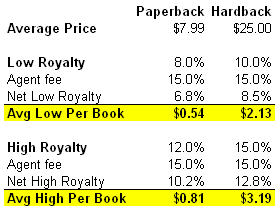
  • What does an author earn per book?

    People are always curious about this, so I thought I’d post it and refer to my previous post about what kind of sales numbers it takes to make a living as a fiction author in the US. Of course, the royalty rates depend on what’s in your contract. Many contracts have sales volume break points. For example, an 8% royalty on the first 50,000 paperbacks sold, 10% on anything above that. But this should give you a good feel.

    Earnings per book

    Share
  • Generating Story 13: The Scene Primer with Author Laurel Amberdine

    Laurel Amberdine was raised by cats in the suburbs of Chicago. She’s good at naps, begging for food, and turning ordinary objects into toys.  Having escaped the terrible weather of Chicago, she is now delighted to call San Francisco home. For many years she read a novel every day, until she got married and realized that her new husband didn’t enjoy being completely ignored in favor of fictional people. She’s working on writing science fiction and young adult novels herself now, and hopes you get to read them soon.

    I hope you get to read them soon as well. Until that glorious moment, Laurel has a fabulous tool to share with you writers. And I know it’s fab because I use it.  If you look at the text tools section on the my Story Development Framework, you’ll see that The Scene Primer is one of the tools I’ve found useful in helping me bring enough of the scene to life in my mind that I can draft it. I’ve used various bare bones versions of this for a few years now, but then I was on a forum where Laurel explained her “Template.”  And I immediately knew it would be a useful tool for me. Here’s what she had to say.

    Laurel

    While working on a complicated science fiction novel a few years ago, I found myself stuck looking the blank page with each new scene. I had already outlined the story and knew generally what was supposed to happen, but the setting was alien and the characters were strange. There was so much specific detail to figure out simultaneously, I was paralyzed. I couldn’t start.

    But I realized I did know some things, just not enough to write a new scene from the beginning. So I created a template, where I could fill in the bits I knew, and think about the bits I didn’t yet know in a simple, no-pressure way. After all, I wasn’t really writing yet, just making notes.

    The template asks enough questions that if I fill it all in, I know exactly how to write the scene. But most of the time I don’t have to fill out the whole thing. I just work at it until I know what I want to write. It’s not a worksheet; it’s a tool to get started. Once I am ready to begin, I cut and paste the template and answers over to a notes section, and get writing. Most of the time I don’t even look back at it.

    The template got me through that novel, and I continue to use it. I’ve refined the categories I use, and even discovered that I can improve my writing by adding template entries to cover aspects where I’d naturally slack off. Like, I often focus so tightly on plot that I skimp on showing a character’s emotions or unique behavors. Well, now I just put it in the template and make sure to figure that out too! Works great.

    Here is the current version:

    Summary:

    Opening/transition:

    Current Situation:

    Theme song:

    Setting, and significant details:

    Time span/transitions:

    Next big crisis or turning point:

    Foreshadowing:

    Background/worldbuilding details:

    Desired effect in reader:

    Events:

    Sequence:

    Emotions:

    Character’s unique reactions:

    Ending hook:

    Other notes:

    The colors encourage me to fill it out, because it’s pretty once it’s done. The “Summary” is what would go on a note card. In Scrivener, I just paste that onto the note card once I have it (or from the note card if it’s already filled out).

    “Events” and “Sequence” almost always wind up being the same thing, but sometimes I don’t know what order things happen in, so I fill in “Events” first.

    I listen to music while I write, and often a certain song seems to fit the scene. If I find one that does, I list it under “Theme Song.” This can be helpful when revising, because I can put the song on and get right back into the feel of the scene.

    The hardest part for me is almost always the opening line.

    John Sez

    After reading Laurel’s post on that forum, I immediately tried applying the idea to the current novel I was drafting.  I’d done sketches of the scene in my own way, but never with a list of questions to prime my thinking. That day I started a new chapter, but before I began to do my initial sketching, I took Laurel’s idea and tweaked it to my taste, coming up with my own “Template” that I call a “Scene Primer” or “Sketch Primer,” then let it direct my sketching.  It worked like a charm.  After answering five or six of the questions, I could see enough of the scene detail to begin to write.  Here’s my current version.  I’ve used it a number of times since that first day, and it’s always proved helpful.

    When starting to write a new sequence or scene, start filling these out UNTIL it comes alive and you can write. (That is my note to self.)

    WHERE ARE WE?

    • Transport: general, dominant impression then specific
    • Setting tags
    • Sights, sounds, smells, textures, tastes? 3s2t
    • Fun, cool, weird, odd, particular details
    • Time, sun, weather, etc.
    • Background or world building details?
    • Fun & cool stuff?
    • Surprises, different, twists?

    WHO IS HERE?

    • What’s the situation for each character?
    • Goals
    • Who is driving this scene?
    • What is the concrete objective for him/her?
    • What the concrete objective of other characters?
    • Motives?
    • Character transport: general, dominant impression then specific
    • Thoughts?
    • Tags?
    • Fun & cool stuff?
    • Surprises, different, twists?

    WHAT STORY LINES WILL HAVE BEATS HERE?

    • Progress or trouble?
    • Points of conflict?
    • Obstacles?
    • Fun & cool stuff?
    • Surprises, different, twists?

    OTHER OBJECTIVES AND THOUGHTS?

    A few things to note. First, like Laurel, my goal isn’t to fill in all the blanks.  My goal is to bring the scene to life in my mind in enough detail that I can write.  So I don’t fill out every blank. I use the tool to stimulate my imagination. It’s like using a match to light a candle on a birthday cake–you only use it until the candles are all burning, then you wave it out and set it aside because it has done its job. The goal isn’t to burn a match, but to light the candles.

    Second, there’s no one right version of this. My version is different from Laurel’s because she and I have different work habits and think about stories in slightly different ways. For example, sometimes I listen to music when writing, but most of the time I don’t. Maybe some day I’ll start using theme songs. But I know a lot of other authors who DO find music helpful.

    So who’s right?

    No, stop asking that question. That’s the wrong question. Music is a tool.  A tool can’t be write or wrong.  It can only be helpful or not helpful. If you find theme songs helpful, then use them. If you don’t, then don’t.

    Third, this is yet another example of the general creative principle of developing in iterations. Think of painters.  They will usually start by sketching.  The sketches are, by nature, rough and incomplete.  They’ll sometimes create a number of sketches. Some of what they sketch might make it into the final painting. Some of it may not.  At some point in time, they feel they have enough of the image (feel, composition, subject, etc.) in their minds to start applying paint to canvas.  So they’ll rough in the subject on the canvas and then began to paint in the details.

    It’s the same with writing. You start with a rough, incomplete idea. You sketch it out, inventing as you go.  Maybe you sketch the whole thing or just parts.  Then you go back and build up more detail, adding by degrees until you have enough character, setting, problem, and plot in your mind that you can form the story.

    For example, I recently sat down to write chapter 22 of my current novel. Here’s what I had on the outline (which is simply one type of sketch) :

    Recon

    1. Summarize wal-mart purchases etc.
    2. Recon their security, paint it all. It’s stiff security.
    3. Carmen or Pinto calls in—someone’s coming
    4. They’re dressed up as utility guys
    5. See her coming in the field. Not at the house. They wave her down or something

    Can you see that scene well enough to write it?

    No. Neither could I.  I knew roughly what would happen, but I couldn’t write anything because I couldn’t see anything.  Where was the house they were going to recon? What did it look like? What kind of security did they have?  Was it in a neighborhood or out in the country?  I only had the most general idea of character, setting, and plot. So I turned to my Scene Primer and started answering the questions.

    800 words later, I’d sketched out the scene and had enough detail in my mind that it had come to life. I used a lot of what I developed in that sketch. But there was some, by the time I finished my draft, that I didn’t use.  Why? The draft was another iteration of the story. And in that take, things changed and I didn’t need it. But it wasn’t wasted effort because it helped me get to the point where I could draft.

    The Scene Primer is an excellent tool to help you build up the detail when you’re starting to draft.  Give it a try to see if it’s useful to you.

    BTW, Laurel and I aren’t the only ones using the primer. Author Maya  Lassiter is also using it to good effect in her new writing experiment.  See, Maya is a pantser who is “sick of the wretched groping around in the dark” that comes with a seat-of-the-pants writing method. She decided to try to see if she could learn to use some tools to help her invent some of her story before she begins to draft. You can read about her decision in “Can a Pantser Become a Plotter?” Then come back because Maya is going to share a post here in which she describes her new method and some very promising results.

    For more in this series, see How to Get and Develop Story Ideas

    Share
  • Generating Story 4: The Story Setup

    Okay, I lied. I was going to get into idea generation techniques, but decided to do one more short post on development objectives. Actually, I suppose this is a technique.

    In the last post, I said one of the main objectives of your initial story development is to have the story to come to life in your mind. I explained that the best method I’ve come across up to this point for making that happen was to focus on developing the 6 core parts. Then I explained in general what I’m shooting for when developing those parts at the outset of a new project.

    You can use a number of different types of documents to capture your thoughts on those 6 core parts. You might end up with a rough two-page sketch of the story. You might write brief character bios of some sort. You might bullet the general steps of the plot. Maybe you create a map. There are a lot of types of documents you can use to capture what you’ve developed. And often the creation of those documents not only captures what you’ve developed, but helps you develop the parts in the first place.

    I want to suggest a “document” that will help you capture and develop the essence of your story setup.

    This is ONE tool.  It is not THE tool. There are many ways to capture the essence of your story. There are many tools that can help you clarify your thinking. But I think this is a good one because it forces you to get right to the core of your story and clarify it in a compact manner.

    An idea that’s core and compact has great power because it focuses the mind.

    There are so many things to juggle when writing a story that it’s easy to get lost in the weeds.  I’ve found I become so much more productive when I know the core situation that’s driving the story.

    There are a lot of things that drive reader and author interest. There might be a thematic question, fascinating characters, genre stuff (chase scenes, romantic scenes, scare the soup out of you scenes), humor. One of the main things that rivet readers to the page are the hopes and fears they have for our characters.

    A reader’s hopes and fears are driven by presenting:

    • An event that causes
    • An interesting and likeable character to
    • Face a compelling and concrete problem—a threat/danger, lack/hardship, opportunity, or mystery.
    • The character decides he must try to solve the problem (which results in the character goal the story revolves around)
    • And struggles against significant opposition.

    That’s the core of the story setup. As David Howard puts it: “there is one basic dramatic circumstance: somebody wants something badly and is having difficulty getting it.”

    Of course, stories provide a lot of delights that require you to do more than define the person and the thing they want. But the setup is at the heart of a lot of what readers go to story for. Part of the initial development of a story should focus on helping you clarify this central dramatic situation.

    So here’s a tool to help you do that. I read about it years ago in Dwight Swain’s Techniques of the Selling Writer, which was written in 1965. Swain calls it the “Starting Line-up.” I read about another version of the same thing more recently in Dan Decker’s Anatomy of a Screenplay written in 1998. He calls it the “Story Line.” The hugely published romance writer Leigh Michaels calls it a “Framework” in her On Writing Romance: how to craft a novel that sells. The agent Donald Maass calls it the “premise of a novel” in an interview published in Agents, Editors, and You by Michelle Howry.  Jim Butcher calls it a “Story Skeleton.” Let’s look at each of these variations.

    Swain’s “Starting Line-up”

    Swain asks you to include five elements:

    1. Focal character
    2. Situation
    3. Objective
    4. Opponent
    5. Threatening Disaster

     These are to be cast into two sentences.

    • Sentence 1 is a statement that establishes character, situation, and objective.
    • Sentence 2 is a question that includes the opponent and disaster and can always be answered in a clear yes or no

     Here are his examples.

     John Storm

    Sentence One

    • When humans suddenly begin to grow to twelve-foot height [situation],
    • John Storm [character]
    • tries to find out why [objective].

    Sentence Two

    • But can he defeat the traitors in high places [opposition]
    • who want to kill him [threatening disaster] in order to make the change appear to be the result of an extraterrestrial plot?

     Irene Boone

    Sentence One

    • Lonely, frustrated, and tired of living in a home where she’s treated as an unpaid servant [situation],
    • widowed Irene Boone [character]
    • wants to marry widower Frank Dawes [objective].

    Sentence Two

    • Will she lose this chance for happiness [threatening disaster]
    • because her selfish sanctimonious daughter, Connie [opponent] accuses her of immorality?

    Dale Boulton

    Sentence One

    • Sick of the conformity and hypocrisy that go with his highpaid job, and with a modest life income assured [situation],
    • Dale Boulton [character]
    • decides to retire ten years early, to go live on a shanty-boat and poke through crumbling river ghost-towns, in fulfillment of a boyhood dream [objective]. 

    Sentence Two

    • Can he make the break successfully, when his hostile wife, Sandra [opponent],
    • fights him all the way and, finally, threatens to have him declared incompetent [threatening disaster]? 

    Decker’s “Story Line”

    Decker requires three components:

    1. The main character described by an adjective
    2. The inciting event or decision that propels the character into the story
    3. The main character’s objective, stated in concrete terms

    You can add other components—other characters described by an adjective or other important events or decisions. He prefers you start with a “when.”

    Here’s an example.

    When a booksmart savings and loan bailout accountant takes over the business he is assigned, he discovers it is a bordello and teams up with the Madame using his business skills to fend off a hostile take over and save the business.

     Another.

    When a blood thirsty killer and his gang are coming to kill him, a strong-willed, decent cop must fight them over the objections of his pacifist bride who will leave him if he does.

     Another.

    When he is given a factory full of doomed Jewish workers, a greedy, opportunistic Nazi deceives his taskmasters to save them.

     Another.

    After a tornado carries her off to a strange land, a spunky teenaged girl must face a series of challenges to get home.

     More.

    When his blundering uncle throws their building and loan company into insolvency, a despairing small town banker with low self-esteem has to find a way to save the bank.

    Leigh Michael’s “Framework”

    Michaels suggests four elements in her framework, although she doesn’t stipulate a specific form.

     This definition summarizes the four crucial basics that make up a romance novel:

    1. A hero and heroine to fall in love
    2. A problem that creates conflict and tension between them and threatens to keep them apart
    3. A developing love that is so special it comes about only once in a lifetime
    4. A resolution in which the problem is solved and the couple is united

     She then lists a number of questions to help an author think about those four elements. The document that could capture this is a summary of the answers to those questions.

    Donald Maass’ “Story Premise”

    Donald Maass was asked what he looks for in a query or pitch. Like Michaels, he doesn’t specify a form, but does include some basic elements.

     I’ll tell you exactly what I need, and I can get this information after just a few questions.

    First of all: What type of novel are we dealing with here? Mystery? Mainstream? Young adult?

    Second thing: Where and when is it set? Contemporary? Historical? Magical place? A real place?

    Third: Who is the main character?

    And lastly: What is the basic problem that the character faces?

    Those things wrapped up together are the premise of a novel, and I know right away if it’s the kind of work I handle, if the idea sounds original, if the main character is sympathetic, and whether I care about the problem. That’s all i need. If all those things are a go, then I want to read the work. It’s as simple as that.

    Most authors might perceive this as additional pressure. It’s exactly the opposite. What is means is that their job is much, much easier than they think.

     If you think about a query, this is something that should be contained in a few short paragraphs.

    Jim Butcher’s “Story Skeleton”

    A reader drew my attention to a short essay Jim Butcher wrote on this subject. I thought it was excellent. Here’s Butcher:

    The story skeleton is a description of the main plot of your book, broken down into its simplest elements. . . The story skeleton (also called a story question) consists of a simple format:

    *WHEN SOMETHING HAPPENS*, *YOUR PROTAGONIST* *PURSUES A GOAL*. But will he succeed when *ANTAGONIST PROVIDES OPPOSITION*?

    For instance, look at Storm Front. (Yes, I’ll use my own books as examples, because I’m just that way. 😉 Also, I’m more familiar with them than I am with almost any other writer.) Storm Front’s story question:

    ****************************
    When a series of grisly supernatural murders tears through Chicago, wizard Harry Dresden sets out to find the killer. But will he succeed when he finds himself pitted against a dark wizard, a Warden of the White Council, a vicious gang war, and the Chicago Police Department?
    ****************************

    See! It’s oh-so-simple! Almost to the point of looking ridiculous–and I have no doubt that some of the people reading this article will think that it *is* ridiculous. They’re wrong. 🙂 This is a fundamental description of the core conflict in your tale–and stories are all about conflict.

    Go read his whole essay.

    My Version: “The Story Setup”

    Did you notice any similarities in the examples above? Character, inciting event, problem, goal, opposition. Let’s go back to the core of story I listed.

    1. An event causes
    2. An interesting and likeable character to
    3. Face a compelling and concrete problem—a threat/danger, lack/hardship, opportunity, or mystery.
    4. The character decides he must solve the problem (which results in the character goal the story revolves around)
    5. And struggles against significant opposition.

     Written even more succinctly:

    1. Character
    2. Inciting event
    3. Problem
    4. Goal
    5. Opposition

    I like the idea from Swain and Butcher of projecting us forward using a question. I like the idea from Decker and Butcher to use “when” to state the inciting incident. I also like adding in the character adjectives. I like Michael’s and Maass’ focus on problem. But I also like flexibility. My version uses key elements of the others as guidelines, keeping it simple and core by limiting the statement to 90 words.

     Here’s one for The Incredibles.

    Bob is a frustrated retired superhero, living a boring life as an insurance claim processor. When he gets an offer to do illegal superhero work on the sly, he decides to take it and pursue a double life, even though he’s forced to lie to his wife about it. But his dream job employer is actually trying to settle and old score and kill him.  Will he lose his family when he’s drawn into a showdown with a super villain that has him outmatched?

    In many longer works there are often more than one story running. Sometimes the main character has an external conflict and an internal one. Or maybe a related subplot. Sometimes other characters have related B, C, D, and E story lines. In Curse of a Dark God, for example, I have at least eight story lines that I have to braid into each other. To keep them all straight, I found it very helpful to list out the five elements for each. The goal isn’t to make these into slick marketing tools: they’re to help me focus my efforts. However, I find that when they include all the elements, they have great power to pique my interest.

     Here’s one of the “inner” conflicts of Curse.

    Talen has escaped the clutches of the Mother, but something is growing inside of him. When he begins to hunger after the Fire and soul of those around him, he realizes he’s not all human. Will he be able to resist the growing and overpowering desires, or will he become the very thing he’s fighting against?

    Here’s one of the related “outer” conflicts.

    The Mother of Mokad wants Talen—to make him into a thrall or devour him. He escapes the first attempt to capture him, but will he be able to shake the Mother’s powerful hunter and his dreadmen now that he and his sister are on their own?

     Here’s a third story line in the book, the big external plot.

    Argoth is trying to build up an army of sleth that can free mankind. But the Mother of Mokad sends her Guardian to exterminate every last one of them. Will Argoth be able to defeat Mokad’s vastly superior army, especially when the Guardian has infiltrated his ranks?

     But Argoth has another plot line for the reader to worry about.

    Argoth damaged his son. Nettle’s condition is growing worse. A foreign Divine offers to heal Nettle in exchange for Argoth’s allegiance. Will Argoth betray those around him and save Nettle? Or will he let his son die and lose him to the perils in the world of the dead?

    Here’s one of Sugar’s.

    When Sugar sneaks behind enemy lines to retrieve some items her mother left for her, she’s given the opportunity to learn a powerful lore and use it to scout for Argoth’s army in the world of the dead. But each time she uses it, she comes closer and closer to death herself. Will she be able to survive as she’s asked to serve in more and more dangerous situations?

    Here’s her inner conflict. I wanted to develop a moment of dilemma for her just as I did Argoth.

    Sugar wants to keep her brother Legs safe. But as Mokad’s army arrives, it becomes apparent Argoth doesn’t have a chance. She and her brother might not survive. Sugar’s been learning the lore with a handsome and battle-hardy loremaster who saves lore users who have become true sleth. When he asks her to sail with him and his crew before it’s too late, Sugar has to decide if she will flee and abandon her friends or stay and fight and risk losing everything in this world and the next.

    Now you see why it’s virtually impossible to write such a book with so many story lines in the normal 100,000 words. And why I question my sanity in trying to write it.

    Anyway, there’s much more to writing a fascinating and compelling story than capturing a story setup, but I’ve found that working on stating the simple core of the story clarifies many things for me and makes me much more productive. I developed a short statement of all my story setups early on in the writing.

    There are a number of ways to capture the story setup. Let me suggest you give one a try. And if you aren’t to the point where you have enough material to capture a story setup yet, that’s fine. That’s what development is for.

    One last note. If you want to read an expanded description of how one writer develops story ideas, read Write Away by New York Times Bestselling author Elizabeth George. I loved the book.

    Bonus: Miss Snark Happy Hooker Examples

    Miss Snark was the pseudonym of an agent who I believe was Janet Reid of the JetReid Literary Agency.  When she was incognito, Snark had a blog. On her blog she’d often invite people to submit their story statements used in queries to hook editors and agents to ask for more.  These entries were called “Happy Hookers.”  Snark would rate them on her crap-o-meter, sometimes giving comments and suggestions.  Let me suggest you read 50 or 100 of those hooks.

    As you’re reading, look at Mrs. Snark’s comments. But more importantly, note the hooks that excite you and the ones that don’t. Because, frankly, Snark is just one person with one person’s tastes. In this exercise, you’re not trying to figure out what she likes. You’re trying to see what story elements work for you. So don’t be dissuaded by her tastes. Identify the hooks that interest you and the ones that don’t. Ask yourself where they were unclear, unbelievable, or boring. After you’ve done a few, you’ll start to see story patterns and ways to capture your own story setup that will be useful to you. 

    For more in this series, see How to Get and Develop Story Ideas

    Share
  • Edward Bear Shares More Proofreading Secrets

    Mr. Edward Bear (pseudonym) shared an awesome secret for sussing out quote issues in a previous post. He’s back with a nifty way to help spot spelling issues.  It helped me spot a number of inconsistencies in Bad Penny, which I recently fixed. Take it away, Mr. Bear.

    * * * *

    Augmented Proofreading 2

    Last time, I mentioned checking spelling and spelling consistency, and this note is to fulfill my promise.

    To begin with, I’ll admit freely I do not recommend just running a spieling chucker over the text. And yes, I’m using the phrase deliberately. The spelling checker in the program I’m using to write this just waltzed right past it, despite the fact that neither word makes sense in this context. I got started trying to get some mileage out of spelling checkers a while back, when I realized that OCR scanners will work like hell trying to find a word and probably will come up with a word, but it will be the wrong word. Over at Project Gutenberg, they use the term “scanos” as an analogue of “typos.”

    The other adversary is consistency of spelling and usage. Examples might include “canceled” and “cancelled” or variant possessives, such as “Jones’” and “Jones’s” in the same text, or simply variant spellings of the same character’s name, such as “Erik” and “Eric.”

    So what do I do for these sorts of problems?

    What you need is a list of all the unique words in the story, and it’s easy with a dollop of regex. (See the first post on this topic. The one I’ve taken to using is the following:

    [^-‘‘’\w\d\r\n]

    This one I can explain, since I wrote it. 🙂

    What it says is to look for any individual characters within the brackets([]). The leading caret (^) says “Nope, they should not be in this list.” Following that are the hyphen(-), the straight  quote(‘), and the opening and closing curly single quotes(‘’). After that, it’s any character that would normally be in a word (\w), any digit (\d), any carriage return(\r) or any new line aka paragraph terminator (\n).

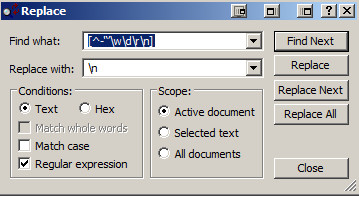
    And what you do with the above is to set Textpad (see previous post again) to replace all of them with a newline (\n) character.

    Here’s what the search and replace box in Textpad looks like for this:

    Augmented Proofreading image001


    Notice that the “Regular expression” box is checked. And then you choose “Replace All”.

    The result is to turn this:

    Once upon a night we’ll wake to the carnival of life
    The beauty of this ride ahead such an incredible high
    It’s hard to light a candle, easy to curse the dark instead
    This moment the dawn of humanity
    The last ride of the day

    into this:

    Once
    upon
    a
    night
    we’ll
    wake
    to
    the
    carnival
    of
    life
    The
    beauty
    of
    this
    ride
    ahead
    such
    an
    incredible
    high
    It’s
    hard
    to
    light
    a
    candle

    easy
    to
    curse
    the
    dark
    instead
    This
    moment
    the
    dawn
    of
    humanity
    The
    last
    ride
    of
    the
    day


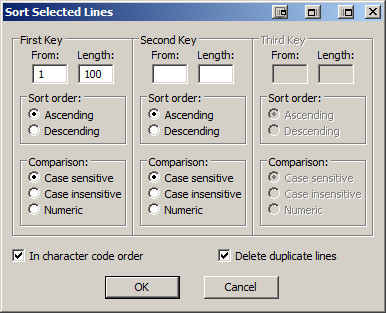
    For a book, this means what you have as a multi-thousand line long document and LOTS of repeated words. The next step is to lose the repetitions by sorting the list. For TextPad,  you’ll find Tools->Sort on the menu bar, and I generally set the sort up as the following:

    Augmented Proofreading image002

    This is a case-sensitive sort and “Delete duplicate lines”, of course, gets rid of all the duplications of words like “a”, “an”, and “the”.

    For the above text, you get:

    It’s
    Once
    The
    This
    a
    ahead
    an
    beauty
    candle
    carnival
    curse
    dark
    dawn
    day
    easy
    hard
    high
    humanity
    incredible
    instead
    last
    life
    light
    moment
    night
    of
    ride
    such
    the
    this
    to
    upon
    wake
    we’ll

    34 unique words.

    And here’s the payoff for all this funky text munging: Run a spelling checker over this, and it will find typos, of course, but it will also generally complain about most names, which aren’t generally kept in spelling checker dictionaries, and it will also show you words and their variants, nestled fairly closely together. Here’s an example from one of my projects:

    Swiss-born
    Take
    Talking
    Tallmadge
    Tallmadge’s
    Tarelton
    Tarleton
    Tarleton’s
    Tavern
    Tecumseh
    Tell
    Ten
    Thames

    The spelling checker landed on Tallmadge and its possessive form, but do you notice the “Tarelton” on the list? That’s the time for the Aha!, and you can fix the “Tarelton” form. The same thing applies to possessive variants and any other variant form you find.

    As with the last post, I’ll be peeking in on the comments and answering any questions that come up.

    Share
  • Why capture zing if you don’t use most of it?

    I agree that the ability to develop and finish a story is more important, and rare, than coming up with or capturing random ideas, especially since “ideas” can be something as small as a two word sentence from your daughter or the colors on some weird bug that you found hiding out in a teacup in your cupboard. Finding one of those is like finding one brick for a 50,000 brick house. Big whoop.

    I also agree that ideas captured in a journal or file of some sort is NOT the only way to start developing a story. Getting a prompt or story parameters, writing to specifications, is obviously a perfect spot to begin as well (e.g. get me a SF story no longer than 6,000 words by Dec 15th that includes a bug). It is, if you think about it, just another type of starter idea. Going from image to story parameters or from parameters to story images–I don’t think the order matters. They’re both aspects of the story that need to be eventually developed. And we all know that stories can start from seeds of all types–character, image, line, issue, setting, problem, technology, AND parameters. What makes a prompt for a real gig powerful is that it pushes you farther down the path from one brick to house. It does this because a huge part of getting a story written depends on making decisions, getting specific. And on getting the motivation to buckle down and finish the thing.

    I’m also going to bet that for all writers MOST of the elements (dialog, plot, character, setting) of any story are generated during the pre-draft planning (including research) and drafting–during the actual writing. Not by continually ransacking idea files like some people do their closets, trying to find pants, shirts, and shoes that will make an outfit. Like most anything else, we generate things (ideas in this case) only when they’re needed.

    It’s true we have to care about and believe in what we’re writing. But I don’t think how any story gets started is significant. Partially because no matter how big the initial idea, it’s still small compared to everything else that must be generated. But more importantly because I think just starting is the key, whether that’s motivated by shot of zing or a deadline or whatever. I say this because I’ve found that zing strikes me more when I’m on the move working.

    So if the vast majority of captured ideas are never used, why observe and capture at all?

    Here are my personal reasons.

    1) Because when I fail to consume new sights, people, ideas, and experiences, I tend to keep using the same things over and over in stories–lines, descriptions, plot turns, etc. Doing this actually helps me see new possibilities and go beyond my current ken.

    2) While I forget most of what goes into the file, I don’t forget everything. When I’m working, the context of the story often evokes memories of some of these things I’ve captured.

    3) Because when I’m on the lookout, I tend to see more. And current idea captures are a great source for random juxtaposition for the current project. I’m writing a story, go on a walk, and see in the snow a raccoon splayed out spead eagle on the side of the road like it’s been sacrificed, its belly torn open, the cavity completely hollow, four thin, almost translucent, ribs rising to the sky. There is some blood, but not much, and where it has fallen the snow is Valentine pink. There’s nothing else around the animal but a multitude of bird tracks and a few dark strings of disconnected and frozen gut. Because this signals story idea to me, I stop and pause to get more details. I write them up, look a bit closer, sketch it. And the impossible to imagine random detail goes into the current story to work its magic.

    4) Because being on the lookout just brings more zest to my life. The universe offers up a small wonder or dread to me, and if I’m trying to be alert, I’m more apt to see it, cherish it, if only for a moment, and go my way rejoicing.

    Share