A simple calculator for how much home you can afford

It’s March. Spring is here in most places. And this is when the house hunting season starts to get rolling. I used to moonlight as a realtor. I started from nothing, ran my own little gig, and did very well. Then I got a book contract, and there was no way I could do three jobs. But I learned a lot.

One of the things I learned is that home buyers very frequently have a very hard time staying within their budget.

They set a number, start looking in their price range, then peek at the homes in a higher price range, and of course those homes look better. Why wouldn’t they? They’re more expensive! And, geez, they have such nice faucets and cool counters and a shower with five heads so you can wash your body from every imaginable angle, and suddenly many of my buyers would refuse to see cheaper homes. Because they just had to have the ultrawash shower.

Or a dent in a wall that’s officially called an alcove.

Or a super deluxe gas heater fireplace that runs on banana peelings and saves gerbils.

Or whatever.

It’s called house craze. It’s a temporary thing. It passes as soon as you get in the house and start making the payments.

And then you wake up and realize you have a hot tub and you hate hot tubs! What in the world were you thinking?!

Well, you had house craze.

The unfortunate side effect of buying too much house is that the mortgage eats up so much of the take-home pay that it makes everything else exceedingly tight. Or impossible.

You don’t have room to pay off debts. Don’t have room to invest much, or at all. Don’t have room to have fun vacations. Don’t have room for anything except the fricken-ricken, blankity-blank, #$%!* house!

This condition is called being house poor.

So house craze leads to being house poor.

Which leads to second jobs and stress and often more debt. You may also end up in a roadside ditch. The situation below occurs with more than just with cable companies.

The lender will tell you that you can lend up to 36% of your take-home pay!

Your eyes go wide, and you being to think that maybe you can afford two ultrawash showers. But just slow down and think for a second–the lender is the one SELLING you the loan.

Right…

Don’t listen to the lenders.

Listen to common sense.

My advice is the same as Dave Ramsey’s:

  1. Don’t buy a house until you’re out of debt and have saved enough to pay 10% of the purchase price of the house.
  2. When you’re at that point, get a 15-year, fixed-rate mortgage with a monthly payment that’s no more than 25% of your take-home pay.

So that’s my advice. You’re free to do with it what you wish. Just know that being house poor sucks.

And all that to introduce the calculator which will tell you exactly how much home you can afford. It takes 10 seconds to fill in.

Here it is: How much home can I afford?

Download it and be happy.

Share

Similar Posts

  • 24 Hours in Ancient Rome

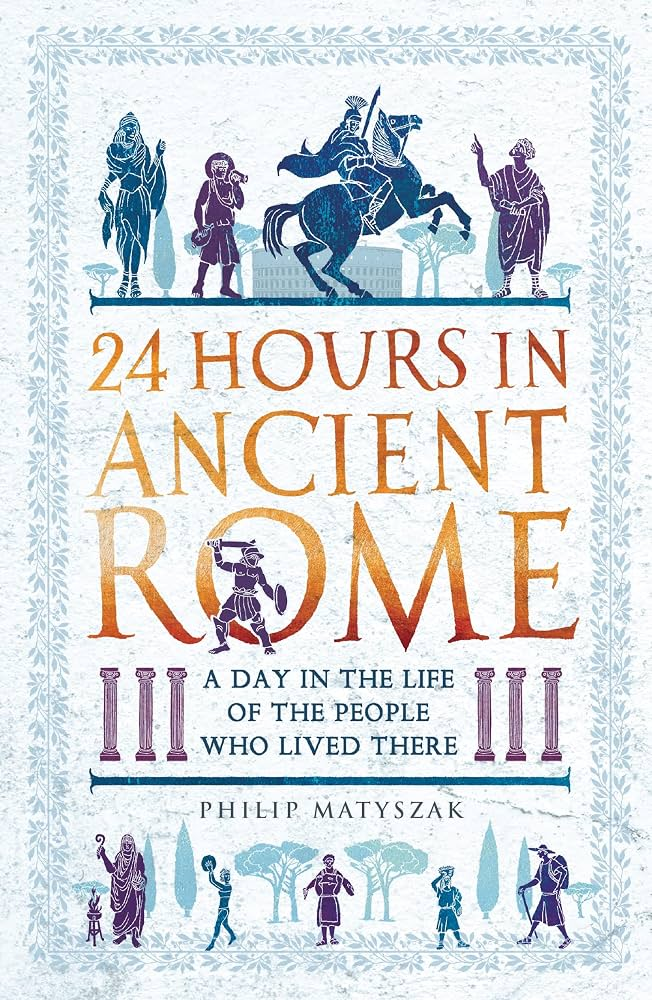
    One of the best tricks for building fantasy worlds is to start with real history. Tolkien did it. George R.R. Martin did it. I do it too. In The Drovers, I draw, in part, on the cultures around the Black Sea. 

    This is why I read a lot of “daily life” books. And I found one that is unlike anything else I’ve read. 

    It’s called 24 Hours in Ancient Rome by Philip Matyszak. 

    Instead of dry lists of facts, it gives you twenty-four stories — one for each hour of the day — told through the eyes of Romans: a watchman, a baker, a carter, a senator, a slave girl, a mother with a sick child, and plenty more. 

    Each short chapter drops you right into their lives. I couldn’t put it down. By the end, I felt like I’d actually walked the streets of Rome. And I kept telling my family, “Did you know this? Did you know that?” 

    If you love history, or if you’ve ever wondered what daily life in Rome really felt like, I think you’ll enjoy this one. 

    A big thanks to those who responded to the last email with castle recommendations: John E, John D, Nikki, Tom, and Robert. Skipton, Bamburgh, Mad King Ludwig’s places, Carnarvon, Carcassonne, and many more, including some in Japan if I ever get over there. I now have a terrific list, and want to visit as many of these as I can. 

    And thanks to those who sent me their first names and told me how much they enjoy the books. (We luvs to hear that, Precious.) 

    I will also say this: there are some fascinating people on this newsletter list. Of course, when I sit down with anyone, I find they’re fascinating in their own way. I’m honored to have you here. 

    Here’s to books that make the past feel like an adventure—and the present feel richer for it. 

    Sincerely, 

    —John 

    Share
  • |

    All you need is a little beating and robbery

    Mrs. Brown, my wife, teaches language arts for the 7th and 8th grades as well as reading comprehension. She’s big on reading. She wants to provide every opportunity for kids to not only get good at it, but also learn to love it.

    And so her walls are lined with bookshelves full of awesome books teens love. She reads the first chapters of books to her classes to let them sample various stories. She features their book reports. She has them paste the covers of the books they’ve read on pages displayed around the classroom. And the school’s awesome librarian supports with her own programs.

    The 7th and 8th grade students at Rich Middle School are marinated in a big celebration of reading.

    In Mrs. Brown’s class, it’s fairly straight forward to get an A on reading, which is a huge part of your grade—all you’ve got to do is read.

    But how much reading do they need to do? How do you track it? And what books should they read?

    Check this out.

    First, she tests each student to see what his or her reading speed is.

    Next, she takes the number of hours they’re supposed to be reading each week for homework (I think it’s 2 or 2.5), then does the math to get a feasible reading word count for the trimester for each student. She may adjust it a bit, depending on the student’s ability.

    Third, she presents that number to the student, and the two of them set a word count goal for the trimester. Talk about an individualized goal.

    If you want to get an A in reading, all you have to do is reach that word count goal.

    How do you know how many words a book has?

    The Accelerated Reader program provides that information.

    But how does she know that they’ve read the books?

    She uses the Accelerated Reader tests. And if there isn’t one, the student can write a report.

    And what books do the students read?

    Any dang book they like.

    I love this. The kids get to select their own books and just read, read, read.

    Another part of this is that she pings each student once a week to ask them what book they’re reading, what page they’re on, and what they think of the book. This weekly check-in provides the more frequent accountability students of that age need.

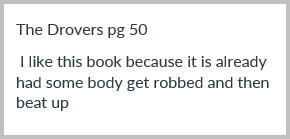
    Yesterday, she received this report from one of her 8th grade boys who is reading Prey, the first book in The Drovers series.

    Oh, yeah.

    I’ll take that any day (grin).

    Rock on, budding reader.

    Share
  • A Response to John Scalzi

    The best way to change someone’s mind: use the skills you learned writing fiction.

    John Scalzi recently wrote a post about White Privilege.  You know: the idea that Straight White Males (SWMs) have all the cards stacked in their favor.  It’s called “Straight White Male: The Lowest Difficulty Setting There Is.” I assume he wrote it to help SWMs have more sympathy for those who aren’t SWM.

    It’s a noble cause.  Not as noble as true love, but that’s so rare–not one couple in a century has a chance at true love (at least when you live in Guilder).

    The problem is that Scalzi’s post is a great 101 on how To NOT Win Friends and Influence People.  Actually, that’s not right.  He will win new friends and increase his influence among those who are like-minded.  But if he was hoping to win over those who didn’t already see things his way, I don’t think he’s going to be very successful.

    His posts generated hundreds of comments. When you look at the comments, you’ll see that the vast majority of them are folks arguing Scalzi’s side with smug condescension and other folks arguing points against Scalzi with an equal lack of tact.

    In short, it’s a classic online bring-your-guns-to-the-party event.

    Alas.

    Except I must admit such events can be a lot of fun if you’re on the side with greater numbers.  Furthermore, there is sometimes a tremendous pleasure to be had in being provocative.  Sometimes we simply must publish something with teeth in it.  And maybe that’s what Scalzi was trying to do. 

    But if not, here’s where Scalzi’s post went admirably wrong.  And it has everything to do with principles that underlie influence as well as writing fiction.  You see, when you’re writing fiction and you want someone to root for your character, you do not turn to the reader and insult him. Insults don’t bring readers into your world.

    Equally as important, telling, or demanding someone feel a certain way towards someone else, will fail every time you try it. You cannot demand (or whine) that a reader must feel sympathy and admiration for the character.  Why?  Because emotions don’t respond to demands.  They just don’t.  It’s like trying to freeze water by seasoning it with pepper. 

    The advice “Show, don’t tell” works in real life as well as it works in fiction.

    Emotions are automatic.  If someone presents the right stimulus, we WILL feel the desired emotion in response.  We don’t experience a sympathetic change of heart when someone gets in our face and demands we feel sympathy.  We do feel that change when we see the antecedents which prompt the emotional response in us.  Show me.  Make me believe.  And the response is automatic.  

    This is what happened with Uncle Tom’s Cabin and the movie Ghandi and the TV series Roots and the more recent movie Believe in Me and the novel Les Miserables and thousands of others.  It’s what happens every day when someone in one group meets someone in another group they feel some distrust for and begins to build a friendship. 

    Show the antecedents, help folks identify, and you’ll move millions.  Get up and rant at someone, and all you’ll get is the bird.  And applause from the true believers.

    Scalzi claims that if you feel offended by his post then you’re hypersensitive because all he was doing is pointing out the facts.  Um, no.  Jim Hines is trying to establish potential facts.  You could try to verify those.  You could try to separate out causation from correlation.  But Scalzi is not doing that. He’s telling all SWM that they are playing on the kiddy version of the life video game.  Your life is so easy.  Everything is rigged for you.  You’re playing the baby version.  And because of that everyone else’s life is so much harder.

    No, he didn’t say those words exactly. But there is this thing call connotation. There is this thing called tone.  And no matter how hard you try, you’re can’t separate the non-verbal communication from the message. 

    Everyone knows that some people have it harder in life and some have it easier. Like, duh.  I think we all learn that when we showed up to the first grade.  So what’s the point of telling all the SWM’s reading his blog that they are playing the dweeb version of life, the one with training wheels?

    Furthermore, instead of helping all of us pampered SWMs identify with our brothers and sisters, he tries to erect more boundaries that would push us apart by giving all of us another way to discriminate and another reason to be resentful.

    Lowly, pampered SWMs at the bottom.  Gays, people of color, and women farther up. 

    So now we’re going to go around with a My Life’s Harder Than Yours number?  The opinions of those with low numbers will have less weight.  How could they have anything as worthwhile to say when their life has been so easy?  Those with higher numbers will have more weight. 

    A whole new group calculus will have to be developed and standardized.  And it will have to go beyond which shade of brown your skin is (yes, White people really are just a lighter shade of brown), your gender, and sexual orientation.  Because those who are handicapped, by birth or by accident have it really rough too.  We’d have to figure out if they had it more or less rough that someone who was gay, and would that change if that gay person lived in San Francisco versus Laramie, Wyoming?  A geographical element!  And what about those with idiot parents who teach their kids to take meth and don’t get them to school or beat them in alcoholic rages or who are never around?  I wonder what score that would bring.  And what about the kids who grow up with grandpa molesting them?  And what about the short, the fat, the plain?  What about those with glasses?  Those who are runty bully targets?  Or those with a minority religion.  What about those born with AIDS? 

    Are we sure it’s a good idea to start ranking ourselves, using color, gender, and sexual preference to tag our status? 

    Wait, haven’t we already tried that?

    When someone comes up to you at a party and condescends, when they’re always one-upping you with a “you think you’ve got it hard you haven’t seen squat” line, what is your response?  Even if it is legit.  What about when they get in your face for someone else?  Does that change your default response?

    It’s the same at internet parties and gatherings.

    So.

    Lesson 1: If you want to influence someone, don’t start by insulting them and continue by talking down to them. If you want to have a good time with like-minded friends, then, by all means, skewer.

    Lesson 2: Remember “show, don’t tell” to win someone’s affection.  Present the person’s story, and the reader will feel respect, trust, sympathy, sorrow, regret, and admiration automatically (okay, you’re right, some of that depends on the reader).  Tell or demand, and none of that will occur.

    Lesson 3: Don’t raise barriers between two groups when you want members of one group to identify with members of another.

    Here’s a better way. 

    Tell me a story about a real gay black woman.  Make me love her.  Make me care.  Tell me a story about her I can sympathize with.  Just show me the woman.  Make it about her, not her group category.  Or tell me a story about a Mexican man who is just trying to provide for his children in America.  Or tell me about a sympathetic SWM who goes to Asia or Polynesia and finds the cards stacked against him.  Stories like this abound.  

    In fact, why don’t you drop the whole “SWM” business.  If you want me to identify, to experience-take (yes, that official jargon), it’s probably best not to slap SWM on me and set me in one corner and slap GBM on someone else and set them in another.  Help me identify.  Focus on how we are alike. When you do discuss the differences, magnify those things that are wonderful and unique, or eccentric and unique, or goofy and unique, or weird and unique, or whatever, but make it positive.  And when you must talk about old or continuing grievances between two groups, do so with respect, with a desire to calm, not enflame.

    Lest you think I don’t know what I’m talking about, I grew up working in a family business where employees were White, Black, Hispanic, Tongan, and Japanese.  Male, female, homosexual, heterosexual.  And we were a big family.  My father and mother held out big welcoming arms.  I have Whites and Blacks in my biological family.  I hope my daughters find great men to be their husbands.  And if they happen to also be Indian or Puerto Rican or Black or Asian or Maori or Scottish or Southern or whatever, I would think it was grand.  It’s possible I might experience some of that mild “other group” anxiety that sometimes comes when you meet someone that’s not just like you.  But I know it’s possible to get beyond that by seeing what’s common, building friendships, and celebrating and laughing at and with the differences.

    My father, God rest his soul, liked to quote Edwin Markam.  I thought it fitting.

    He drew a circle to keep me out,

    A thing of scorn, and a thing to flout.

    But love and I had the wit to win:

    We drew a circle that took him in.

    You want to laugh with the like-minded?  Draw the first kind of circle.  You want to win hearts and minds?  Draw the bigger one.

    Share
  • Pew Study on American Reading Habits

    Pew Research Center just published the results of a national study surveying reader habits. It answers questions like:

    • Do folks read ebooks more often on cell phones, e-readers, or computers?
    • How many books does each age group read per year?
    • How do readers under 30 discover books to read? 

    Lots of great stuff. You can read the full survey here: http://libraries.pewinternet.org/2012/10/23/younger-americans-reading-and-library-habits/

    Share
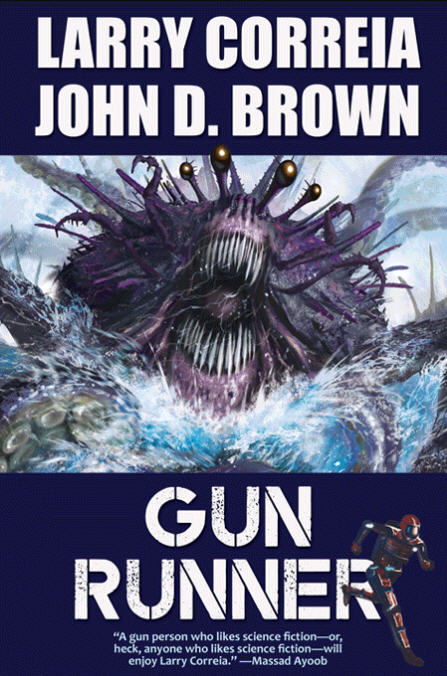
  • Gun Runner is out today!

    Gun Runner on Amazon! Order here!
    Autographed copies available from Uncle Hugo’s here!
    Podcast discussion with the authors here!

    The is 100% Brown and Correia, which means it’s action-packed, full of fun characters, and none of that navel gazing business.

    It’s about a guy named Jackson Rook who works on a crew that smuggles weapons. They’re active in a righteous cause, helping the oppressed peoples of various planets stand up for themselves against the whoresons with the money and power.

    But then Jackson learns something about the current job that turns his gut. And he begins to think they might just be working for the wrong team.

    Will he be able to set things right when just about everybody and everything on the godforsaken planet called Swindle wants to kill him or turn him back into the monster he once was?

    Read to find out.

    If you like action and science fiction, I think you’re going to love this book.

    Share
  • Good Stuff! A clear-eyed view of the Founders

    When it comes to politics, we frequently talk twice as much as we should and listen half as much as is deserved. With our mouths open so much of the time, we fail to get the facts. And this often leads us to paint things in hyperbolic black or white.

    One area where we seem to do this regularly is with the Founding Fathers. Depending on our side, we label the Founders as devils or demigods and the constitution as a wicked document or holy writ.

    Is it possible both sides are distorting the truth?

    Joseph Ellis, one of the nation’s foremost scholars of American history, suggests that we are. He has written an excellent article for the online Encyclopedia Britannica called “Founding Fathers” that points out both the amazing things the Founders achieved with the birth of this nation and some of their most egregious failures.

    I don’t know about you, but I find clarity a good thing. I think it helps us have more productive conversations. If you agree with me, I think you’ll enjoy the clarity Ellis brings to the Founders and the nation they set up. Read his article here.

    For my part, I think the Founders set up an awesome system. Not because it was perfect at birth, but because it was a system that got enough right to allow us to get where we are today. Look at how far we’ve come on so many fronts! And it got enough right to allow us as a nation to get even better in the future.

    Just consider what the Founders implemented that was in no government at that time. The ideals of individual liberty, the separation of powers, the ability for a huge swath of citizens to elect their leaders, the ability to change the constitution itself, the separation of church and state, and the engine of democratic capitalism that has lifted more people out of poverty than anything else the world has seen.

    The Framers didn’t create the Constitution in a vacuum, but nowhere in the world had anyone set anything up that went so far. There was nothing like it, no real examples to follow. And many thought it would fail, just as France’s attempt in their revolution failed just a few years later.

    As for things they got wrong. Well, they themselves soon recognized the way we elect the president and vice president didn’t work and adjusted it. Their idea that political parties wouldn’t form was wrong. Their idea of a militia for common defense didn’t work (see my writeup here). Their compromise on slavery was a festering sore that came to a head before the Union was 100 years old. Their treatment of the Indians was awful. Their reasons for excluding women and those not owning land was bone-headed.

    So, yes, they got some things wrong. Some of them held some beliefs that we find appalling today. And the nation has not implemented their stated ideals as well as we might have hoped. However, the Founders got so many things right. And what’s more, they did it as men living in the times they lived, having grown up with the beliefs and values of that time, not those of 2019!

    While we as a nation have progressed from some of their failures (thank heavens), in other ways the Founders may be are our betters. There are a great many lessons to learn from them, both from their successes and failures. One is their humility—they knew what they’d created wasn’t perfect. Let’s not imagine that we or our ideas are perfect either.

    If you’re at all interested in politics, I recommend Ellis’s article and its view of the Founders. Read it article here.

    Share