|

Writers of the Future, the Church of Scientology, and Killing Puppies

Author Jim C. Hines recently posted a thoughtful blog about connections between Writers of the Future and Scientology. There are a number of folks who have issues with Hubbard’s metaphysical claims and the church he started. Some folks claim that supporting Writers of the Future (WOTF) in any way supports the Church of Scientology (CoS) and the abuse of the young, the innocent, those who are vulnerable, and the stupid.

I won a first prize in the Writers of the Future. I received $2,000 cash for the prize and subsequent publication. I also recieved a paid trip to Cocoa Beach, Florida to workshop with the other winners and pro writers. I tell new writers to submit to the contest all the time. I do not feel I’m supporting any wickedness. Let me walk you through this. You tell me if I’m killing any puppies.

A. What underlies the continued operation of WOTF?

  1. Hubbard wanted it (I don’t know why, although he states it was to help new sff authors and illustrators).
  2. The folks who run it have a very HIGH esteem of Hubbard and so have huge motivation to make it successful.
  3. A trust was set aside, although without looking at the books we can’t know exactly if it’s an independent thing or if money is being funneled from other CoS holdings.  You do not pay many to enter the contest, so all of the money to run the contest and pay prizes etc. comes from this trust, sales of the WOTF anthologies, and perhaps other CoS holdings.
  4. It’s used for positsive PR for Hubbard’s brand name.
  5. The judges, who don’t give a fig about CoS, want to help new writers.

B. What are the effects of the contest?

  1. No documented writer conversions to CoS.
  2. No documented WOTF anthology conversions of young skulls full of mush to CoS. Someone please show me some evidence of the WOTF antho being a gateway to anything, despite the rumored statements of some Scientologists someone’s uncle overheard.
  3. No documented donations to CoS that I know of.
  4. New writers get paid a whole bunch of money, get to network, and receive instruction from pros for a week.
  5. The winners, on average, think better of Hubbard, as do their friends and family.
  6. Most winners report it was a great experience and encourage other new writers to submit.
  7. WOTF sells some anthologies and makes a little bit of cash to offset expenses. I can’t imagine they’re ever in the black, are they?
  8. WOTF tracks winners and uses those who have done well as PR shiny for . . . WOTF and the Hubbard brand name.

I was a first place winner. I had a marvelous time. This was the one held in Cocoa Beach, Florida. One night I needed to go to a convenience store to get something (tooth paste?). One of the WOTF folks drove me there. A nice woman. It was raining. It was just the two of us in the SUV.

I’m a VERY CURIOUS guy. I’ve read most of DIANETICS. I stopped by a Scientology place in Seattle to chat. I like hearing people talk about their faiths, about their lives, about whatever. If you spend any amount of time with me, you will tell me your life story. You will. It just happens.

I tried my dangest to get something out of that woman, but she was as tight as a clam sealed in four feet of concrete.

Nobody talked Scientology. Everyone involved went out of their way to avoid it. End of story. I’ve talked to many other winners. They report the same.

On the other hand, they did have a PR guy there.

Mr. PR intereviewed us about the contest and Hubbard’s works and took footage. Our one-on-one interviews were on camera. We took still photos. He asked us in our acceptance speeches to thank Hubbard by name.

He was a PR guy.

It was very clear his job was to generate PR content for WOTF and Hubbard. How do I KNOW this? Because his questions all centered around WOTF and/or Hubbard. But never CoS.

Some of the winners did not like his solicitation for a mention of Hubbard’s name. There was some reality show behind the scenes grumbling and scheming, and they did not mention Hubbard in their thanks at the awards event.

That’s fine, although it didn’t make much sense to me. Maybe they felt gratitude needs to be spontaneous, not asked for. And I can agree with them on that. At the same time, why would I take $2,000 cash for the prize and publication, and the paid hotel, and workshop, and airfare and then slap the folks who gave it to me? I was indeed grateful. So I mentioned Hubbard in my thanks (oh, look at how noble I am; somebody should saint me).

What did the contest do for me?

  1. Gave me some cash.
  2. Validated that maybe I had some chops. No, I wasn’t competing against pros. But I was competing against all those wanting to break in. I talked to Wolverton, who was a coordinating judge for many years and was the first reader, about the numbers of submissions they received. Hundreds upon hundreds each quarter. Huge boxes full. Were some drek? Of course. Who cares? Others weren’t. I won.
  3. Planted an idea in me that maybe I could do this.
  4. Gave me great connections with some pros and other authors.
  5. Allowed me to tell people I won a big international award for my writing. A little PR for my own brand. Who doesn’t want to engage in a bit of puffery now and then (and so you see, Fred, I am a little fabulous, aren’t I . . . )?

So the contest, as far as I’m concerned, is a GREAT contest for new writers.

But am I supporting CoS? And is that a bad thing?

Every time I purchase a Kraft Foods or Nabisco product, I directly fund Phillip Morris tobacco company and their efforts to hook children on smoking abroad. Some of the tomatoes I purchase in Walmart and other grocery stores are tainted by slavery that occurs today in Florida and California’s central valley with migrant workers. Some of those tomatoes end up in various restaurants like Pizza Hut or Papa Murphy’s. Every bite of chocolate you eat funds slavery in the Ivory Coast, where the vast majority of cocoa beans come from. Not a few slavers here and there, but widespread slavery and abuse. There are many situations like this.

What do you do when you like a product or service, but don’t necessarily want to lend aid to an affiliated cause?

In many situations, I don’t do much.

Alas, there goes my sainthood.

I admit that I should and should probably think more about this.  At the same time, with regards to CoS, I don’t know that it is a wicked and exploitative organization.

I’ve seen nothing that suggests they’re into crime. Or systemic abuse. Or fraud. Or that they have a vendetta against dumb people. I don’t share one iota of their faith in Hubbard or his metaphysical teachings. But I do share other values and beliefs with them. Just as I do with Catholics, Muslims, Pagans, Athiests, Communists, and Realtors.

Besides, I never did PR for them. I’ve always said I DISAGREED with their theology, which is negative PR, if you think about it. Furthermore, I’m fairly confident the contest DOES NOT funnel large amounts of money to CoS.

What can they be making after taking out the expenses of the award week for all those authors, illustrators, judges, “luminaries,” etc. that they fly in and house, all in addition to the prize and publication monies? I’m confident they make nothing at all, but actually lose money each year.

So the net net is that they get some PR for WOTF in the SFF community and some for Hubbard’s name. That’s it. That’s what I’m giving them.

But I don’t see any documented stories of that leading to any donations or conversions to CoS. Or positive PR for CoS. Which, again, I’m still not convinced is a systemically exploitative and wicked organization.

But even if it were, am I really supporting CoS when I promote WOTF?

I don’t think so. I’m not giving them cash. I’m not giving them any positive PR. It seems to me purchasing one bag of Oreos or a Lindt chocolate bar does more harm than this ever could.

I feel so much better now. I am saving the puppies.

Of course, if you disagree, please post a comment. If you have reliable documentation, not hearsay and tabloid clamor, that can add to the discussion, feel free to share it. I’m all for good data. And if you see issues with my logic, share that as well. But no wild-eyed, Chicken Little, my mother was eaten by CoS aliens rants please.

As for that Twix I just ate. . .

(sigh)

EDIT 1: I just learned the Phillip Morris spun Nabisco and Kraft off in 2007.  So that frees up my Oreo conscience, but the principle remains.

EDIT 2: Okay, so I just learned that the CoS planned and authorized crimes in Operation Snow White. What to make of that? Comments? Talk about your corporate espionage. I know there are governments and organizations around the world and in the US that engage in that all the time. But this is the first I’ve seen from a “church.”

EDIT 3: Read through the links on this post by Deirdre Saoirse Moen where she explains why she no longer supports the WOTF contest. Primarily, she just can’t stand some of the CoS practices.

Of note is the link to the court report by the Village Voice at the Debbie Cook hearing. One question I have is why all those leaders were in the Hole to begin with? Was it some routine church program? Yeah, it sounds awful, but the military puts the SEALs and Special Forces through awful things. So I’m not clear on all of that.  And why haven’t more come out to complain? The unlawful detainment aspect of these allegations is disturbing. But are they really doing this? Are these isolated experiences, or SOP? I don’t know.

There’s another one farther down that lists alleged harassment of folks posting some CoS theology documents on the internet.  I sampled the documents linked to there. Most of those are just copyright violation letters. SOP for anyone trying to protect copyright.

Looking at Operation Snow White, the Debbie Cook hearing, and the copyright violation stuff, it’s becoming fairly clear that the CoS has taken an extremely aggressive approach against some of those who speak out against them (maybe it’s over the top) and a similar approach with protecting their materials. Although I think they’ve lost the battle about their materials on the internet. 

Instead of trying to win public opinion with the truth, it seems in some cases they’ve instead attempted through various methods to try to silence detractors.

Anyone have any more links to substantive material?

EDIT 4: Here’s a letter from Joni Labaqui, a Scientologist and the person who runs the whole WOTF shooting match, to Frank Wu, who was an illustrator winner, and had posted some stuff about WOTF and CoS here: http://www.frankwu.com/illo.html (I found the letter at the bottom).

Dear Frank,

Hi! It’s Joni Labaqui here. Haven’t seen you since you blew me off at LA Con a few years ago and now I know why. I didn’t understand why you didn’t want to talk to me for very long. I loved your write-up on your site about the contest until you got into talking about Scientology. I know what you mean about feeling hurt when people put down your church. I happen to think you are NOT stupid because you are a Christian. I have many Christian friends and I respect their beliefs and even fight for them. But then you get into my religion on your site and putting out falsehoods, then I realized you didn’t have all of the info. We don’t sue people for bad mouthing our religion. The Church sues when there is slander and liable of considerable magnitude involved. Lets use an analogy here – lets say someone accused you of raping the girl next door, but you didn’t do it. Would you be upset? Lets say the parents then sued you or had you put in jail or both. Would you be upset? Would you hire an attorney? Gee, you’d be involved in a legal suit wouldn’t you? What if the father of the girl made sure you were lied about in the newspapers and on TV and he tried or succeeded in ruining your reputation? How would you feel? On top of that, lets say what really happened is you simply talked to the girl and were trying to help her and she turned around and accused you. How would you feel? And how about all those people who love to gossip? (I personally hate people who gossip as all they are doing is hurting others and they are basically low-life losers – lots of people fit into this category, I’m afraid). How would you feel?

You were actually wrong in that Scientology pays for the writers and illustrators awards. The Hubbard estate (which is not the church) makes so much money on royalties from his hundreds of published fiction it would make your head spin. You were right about the fact that every one of us who works at Author Services is a Scientologist, but the judges of the contest are not. They share the same goal that Mr. Hubbard did in starting and paying for this contest – to help the new guy, just like yourself back then when you won. So I don’t understand, a nice person like you has to even bring up the subject in your write-up. You think we are interested in “converting” any of you winners just because we have you tour the Life Exhibition? The answer from the horses mouth is NO. We are simply showing you more about his life and works so that you have the facts about the other part of his life, not the bullshit and lies that has been put out by vested interests of multi-billion dollar drug companies and the psychs that can’t stand us. Have you received tons of unwanted, unsolicited mail? The answer is no. Trust me, if we wanted to convert you, you would sure know it. Believe it or not, Mr. Hubbard in founding this contest just wanted you guys to be seen and heard because he knew how hard it is to get started. Period. Its not about Scientology. That is the simplicity of this contest. Anyone reading anything else into it has their own issues and I feel sorry for them. I guess maybe you ran into someone bad mouthing us and you listened to them. If someone badmouthed you – to this day – I wouldn’t buy it. I’d tell them to take a hike. Do you know why? Because I know you are a good person. I met you, I shared some of that joy you experienced when you won, and I was truely happy for you because I like people being happy, winning in life and doing well and winning this contest. I still like you, but I’m a bit disappointed that you felt compeled to write what you did. I don’t get it. I personally put in hundreds of hours of work to help give you the event that you won your award at, so how do you think I feel?

I hope to hear from you. Best, Joni

Share

Similar Posts

  • Indie Thoughts: Authors, We Are Not Amazon

    Sometimes I think some of us indies get this weird attachment syndrome and start thinking we’re Amazon.

    Joe Konrath recently hosted a blog-conversation with Lee Child about the whole Amazon vs. traditional publishers thing. The Passive Voice had an active discussion about it as well.  Kudos to Lee Child for yet again showing up and injecting a new perspective into the conversation. It can indeed become something of an echo chamber in the main indie blogs, which I love, but which nevertheless do still tend to sometimes echo. Having someone with his experience come engage and share his two cents was helpful.

    One thing his comments reiterated to me is that neither Amazon nor the publishers are in this as the author’s let’s-get-pinky-rings BFF.

    I’m not going to carry an ounce of water for Amazon in their fight with Hachette. I’m not going to carry an ounce for the trad publishers either.

    I think it’s helpful for all of us to try to understand the truth about the business, and spread that to other authors, but that’s very different from this knee-jerk Defender of Amazon thing that goes on, which seems so very much like Republicans and Democrats turning a blind eye to their own candidates and fixating a hyper-critical one the others.

    Case in point: here’s a link to a description of Amazon’s Gazelle Project.

    Why do indie authors care? Because we’re Amazon vendors as well.

    Look, I love what Amazon has enabled me to do. I love that Nook and Apple are helping enable it as well. But was this Gazelle Project a good thing? A bad thing? If we stand by and cheer Amazon in such tactics, are we essentially standing by and cheering as Germany takes Austria, France, and Poland? Or are we like England cheering the USA coming in with their troops and bombers?

    I’m NOT a traditional publisher. And I’m NOT Amazon, or any other retailer. Even when I contract with them. None of us are. I sometimes wonder if some of us have gotten a bit confused about this.

    Konrath says don’t worry about the tiger (Amazon) when a wolf (traditional publishers) is gnawing on your leg. But if you’re an indie writer, you have no wolf gnawing on your leg. That’s someone else’s problem. But we are indeed in bed with the tiger.

    Why haven’t we seen more posts about the Gazelle Project on the big indie blogs? Lee Child, darling of the traditional publishers, has to point me in its direction? Why haven’t we been more curious about this tiger’s behavior?

    Let’s make hay while the sun shines. The tiger seems to be fairly decent right now. He’s not perfect. For example, eBay strangely enough only charges 15% to sell via their site while Amazon charges 30%. But let’s not forget that as decent as he is, he’s still a tiger. And he’s probably not like those poor guys being made to do tricks by Ringling Brothers.

    Ringling_brothers_over_the_top_tiger

    Share
  • New creatures & mystery in wonder fiction

    I love listening to writing excuses because I get to hear three smart and funny authors discuss interesting topics that get me thinking. This week’s writing excuse was on building non-humans in SF&F.

    Here’s my take.

    An alien race, if done right, can be a huge draw to a story. For example, Brandon Sanderson’s Kandra point of view in HERO OF AGES is one of the most enjoyable parts of that book.

    However, I want to suggest that aliens (in fantasy or sf) create that draw only IF they’re kept sufficiently strange or mysterious. The minute they become common or too human, they lose their power to enchant.

    That’s one thing I like about how Tolkien did the elves and orcs–we never got the National Geographic on them. They never became common. And so I always wanted to know more. Easterlings, ents, balrogs, the orders of wizards, dragons, etc. were the same. There were tons of tales Tolkien hinted at, curioisties raised, but those desires were never sated. This is part of what drove me to other fantasy books.

    It’s the same thing that made me love mammoths and dinosaurs, bats and giant squid, and far-off places. However, once these things became common and explained, their magic departed. The curiosity generated by the wonder of things new is one of the key things science fiction and fantasy offer its readers. But I think authors can only keep it alive if they approach it in the same way a fan dancer approaches her work.

    This leads me to another point. It’s true that focusing our world building on the conflicts and story touch points can keep us on track. And we do need to produce. However, I think if we strictly limit our alien development to the central story conflicts, we might miss many opportunities for that wonder. Some of what we develop might end up complicating the plot while other parts might only enrich the experience. And I don’t think that’s bad.

    For example, one of the most poignant parts of the LOTR, of which there were many, was the tale of the ents and the entwives and Treebeard’s poem. Tolkien could have eliminated that and the story never would have been affected. But, O, how much richer the story was for that little side trail that still beckons. Or you might think of the ring Bilbo found. When Tolkien first wrote THE HOBBIT, it wasn’t THE ring of power. It was merely a ring that Gollum used. Only later, when he began to work on LOTR and was trying to figure out the main problem of the story did he work that detail into it becoming THE ring of power.

    Share
  • No Apology: Chapter 1 – The Pursuit of the Difficult

    WE MUST FACE OUR CHALLENGES OR DIMINISH

    Romney starts the chapter with a quote his dad used to recite to him: “the pursuit of the difficult makes men strong.” Romney states that over the years, he’s come to believe that this idea applies to more than individuals—it applies to businesses and nations as well.

    He maintains that America has always faced great challenges. He cites a few examples from America’s history and states that there really hasn’t been a time when we were free of challenges. It seemed, after Reagan and Bush had presided over the fall of the Soviet Union, many thought “peace and prosperity were here to stay—without threat, without sacrifice.” Of course, that proved untrue.

    America has faced great challenges in the past and faces huge challenges now. He believes we will “remain the leading nation in the world only if we face our challenges head on.” If we do not face and overcome them, we will become “the France—still a great country, but no longer the world’s leading nation.”

    The question is: what’s so bad about that?

    The answer is that some other nation or nations would fill the power vacuum. Romney poses the fundamental question: “what nation or nations would rise, and what would be the consequences for our safety, freedom, and prosperity?”

    FOUR GLOBAL STRATEGIES FOR WORLD POWER

    Romney suggests that there are a number of nations and groups who are “intent on replacing America as the world’s political, economic, and military leader.” He states that there are, in fact, “four major strategies currently being pursued to achieve world leadership.”

    The first global strategy to achieve world power is the one represented by the United States. It is a strategy based on two fundamental principles: economic freedom and political freedom. Those nations that follow this strategy have become economic powerhouses and account for more than 60% of the world’s GDP. They are also the countries who have given humankind the most freedom.

    The second global strategy is the one pursued by China. Its fundamental principles are free enterprise and authoritarian rule. He spends a couple of pages discussing how well Chinese enterprise is doing. Then he believes China is intent on becoming stronger than the United States.

    The third main global strategy is the one pursued by Russia. It’s fundamental principles are authoritarian rule and controlling energy. “By controlling people and energy, Russia aims to reassert itself as a global superpower.” He then explains how this could be possible.

    The fourth main strategy for global power is the one pursued by the violent jihadists, who count many foreign leaders in their numbers. Their strategy is based on conquest and compulsion through a variety of tactical means.

    Of these four strategies in competition today only one is founded on freedom. Romney then suggests that we can be confident that our children and grandchildren will be free ONLY IF the economic and military strength of America and the West endure. He suggests that our superpower status is not inevitable. “Three other global strategies, each pursued by at least one state or major actor, are aggressively being pursued to surpass us, and in some cases, to suppress us. The proponents of each are convinced they will succeed. And world history offers us no encouragement.”

    Because of this, he believes that “our primary objective as a nation must be to keep America strong. I am convinced that every policy, every political initiative, every new law or regulation should be evaluated in large measure by whether it makes us stronger or weaker” because “our freedom, security, and prosperity are at stake.”

    OBAMA’S DRAMATIC SHIFT IN FOREIGN POLICY

    Romney next maintains that president Obama has introduced a foreign policy that “is a rupture with some of the key assumptions that have undergirded more than six decades of American foreign policy.”

    He states that when World War 2 ended, America executed a “dramatic and profoundly meaningful shift in our relationship with the rest of the world.” Previously we had guarded our own hemisphere and attempted to stay isolated from the affairs of Europe and Asia. But we found with WW1 and WW2 that “our vital interests could not be secure in the face of threats to the cause of freedom elsewhere. At the dawn of the nuclear age, a third world war was unthinkable; it would mean the destruction of humankind.” So the president and leaders of both parties “shifted America’s foreign policy. America took on the task of anticipating, containing, and eventually defeating threats to the progress of freedom in the belief that actively protecting others was the best way to protect ourselves.”

    This new order had three main pillars:

    1. “Active involvement and participation in world affairs”
    2. “Active promotion of American and Western values including democracy, free enterprise, and human rights”
    3. “A collective security umbrella for America and her allies”

    He talks about how all the presidents, Democrat and Republican, followed this new strategy. But President Obama is engineering a dramatic shift away from it based on his own underlying attitudes.

    Obama envisions an America that arbitrates disputes rather than advocate ideals. This is one of the reasons why he apologized to countries around the globe for American arrogance, trying to placate our enemies. This is also why it seems he has undercut many allies, including Israel, Poland, and Columbia. To be an arbitrator, you need to be equidistant from both sides. Not advocating for one or the other.

    Another one of Obama’s assumptions is that “America is in a state of inevitable decline.” He, therefore, considers it futile to fight it; instead, it’s his job to help us manage our decline. Romney suggests Obama believes maintaining a dominant America is “a bad idea even if it were possible.”

    Of course, Romney fundamentally disagrees with that assessment.

    GETTING BACK ON TRACK

    Romney suggests several things we can do to get back on track:

    • Treat our allies like allies
    • Strengthen the American economy
    • Increase our defense spending
    • Remind ourselves that the most attractive thing about us is our ideas—so we should “encourage democracy where we can, give aid and comfort to those who want it, and not undermine those who already have it”

    Undergirding all of this, Romney suggests, “must be a certain conception of the goodness and greatness of America.” This “doesn’t mean America is a perfect country. We have made mistakes and committed grave offenses over the centuries.” But we should recognize that “No nation has shed more blood for more noble causes than the United States. Its beneficence and benevolence are unmatched by any nation on earth, and by any nation in history.”

    Romney concludes by saying that he believes America is “destined to remain as it has been since the birth of the Republic—the brightest hope of the world” but only IF we face our challenges head on and work to keep America strong.

    MY RANDOM COMMENTS

    First, I don’t know if I’m going to have the time to capture each chapter in such detail. We’ll see.

    Second, I found the discussion of the four strategies insightful. Particularly because it put in explained a number of questions I had about why Putin’s Russia does what it does. It also gave me insight into China, which I thought was still mostly economically socialistic.

    I found the explanation of America’s shift in foreign policy in the 20th century interesting. As well as the shift Obama has made. I think I need to understand Obama better. Does he really think this? The actions and speeches Romney cites certainly are suggestive. Has anyone seen the movie 2016? It sounds similar.

    It might appear the book will continue allocating space for attacking Obama, but I believe the six pages in this thirty-page chapter form probably the biggest appearance Obama makes in the book.

    It’s clear that Romney’s business experience, especially as a consultant, has influenced how he sees things. The whole talk of strategy and challenges and competition reminds me of Michael Porter.

    Porter is a Harvard professor and founder of Monitor, a strategy consulting firm that has been hired by corporations and countries. He is claimed to be the most cited author in business and economics. According to Wikipedia “He is generally recognized as the father of the modern strategy field, and his ideas are taught in virtually every business school in the world. His work has also re-defined thinking about competitiveness, economic development, economically distressed urban communities, environmental policy, and the role of corporations in society. . . his main academic objectives focus on how a firm or a region can build a competitive advantage and develop competitive strategy.”

    The idea that America is competing with other nations is, of course, true. But I don’t think I’ve ever heard anyone running for president claim that their central goal, the goal any president should have, is to keep America strong because of the competitive threats we face. The talk is usually all focused on this issue or that without the broader picture I found here. I found Romney’s central tenet clarifying and refreshing. The rest of the book is going to be about how to keep our competitive advantages and strength.

    Comments, observations, or issues from anyone who has read the chapter?

    Share
  • |

    Writing Update: 5/28/11 – Freewrites, Storylines, Proportion

    I finished the next chapter of my outline, which turned into three chapters. Hurray for making progress. However, I’m going to need to make more time on a weekly basis if I’m going to meet my goal.

    I’ve kept stats over the last four novels. My average is 500 words per hour during the drafting stage. That includes revising and doing quick researches etc. So sometimes I will write a smoking (for me) 800 or 900 words per hour. Sometimes I won’t finish a thing. When I’m all done it averages out to 500 words. I’m going to see if I can’t get 20 hours this next week and finish 10,000 words. 

    Addition to last week’s post

     Do you remember last week’s post about the process of making it come alive in my mind first? Orson Card illustrates this as he describes how he prepared to write a story in his essay “How One Story Can Give Birth to Another“.

    Spideysense, farmer’s faith, and freewrites

    Last week when writing chapter 7, I finished, but felt something was off.  Years ago I would have freaked about writer’s block.  I would have told myself I sucked because the chapter was glucky. But not now.  It’s a gift.  So I stopped and talked to myself in a freewrite.  I had farmers faith that if I just kept working on it, something good would result. 

    Here’s what I wrote in that freewrite. It’s an awful read for you, but it shows you just how sloppy and cryptic and freewheeling my freewrites are.

    Okay, so I’ve written the stuff below and I could tweak it, I guess. But I keep having this nagging feeling that it’s not good. It’s not a compelling villain. I think he’s creepy and evil. And, truth be told, I don’t want to make him into something other than what he is—a total thrall to the Glory and the mother. So as the “pet” of the mother, what else could he be called? I don’t know.

    I shall call you endless because you will be spared, you shall continue, whereas the rest will not. Blessing. Blessed. Grateful. What would you call a thing that did you bidding reliably? But enthralled. I am part of you, you are part of me, and so you may take my name.

    He WOULD think—I am not like them. I am GRACED by the Mother’s touch. I have taken her into myself. Or she has graced me and so I have become more than I would be otherwise. I am obedient.

    What else do you call pets or tools. Maybe that’s what she calls him. My skir master. The skir lord. My trowel. Harvester.

    He’s over the harvest. Reaper. Or he’s the one that supplies food. Supplier. Gatherer. Cook. Chef. Hunter. Provider. Butcher. Slaughter.

    So I like Endless with the whole part of him being part of her. But he could use that—”you’re just like us” “no, we are part of the XXX (what was the name I had for them?) endless. You are meat”

    Devourers, Mothers, Sublimes

    Okay, so do I go with Endless or Harvest Hope. Endless it odd, neat. What could I add to Harvest to do the same. Harvest Lord, King, Overseer, Meatman, Food provider, Feeder, Harvester, Harvest, Rancher, Collector, The Harvester. Harvest.

    I think when you’re raised, you get a new name.

    Rebellion.

    Soul collector.

    The Shepherd.

    Harvest Prime

    Bald Head

    Laughter

    Everlast

    DIVINES

    ID HIM AS THE MAIN HARVESTER

    RIGHTEOUS ANGER

    The issue was that his motive wasn’t working.  I had a feel for what I wanted him to be, and my Spideysense was telling me it wasn’t working, wasn’t interesting.  Thomas McCormack in his book calls this feeling for what you want in your story a “prelibation”.  What an odd term.  But it’s real. 

    “Prelibation.  The desire for a certain effect on the reader.  It may or may not be followed instantly by an intuition of what item of narrative will cause that effect, and it’s important to see that intuition and the prelibation it is trying to serve are not the same thing. The intuiting of the narrative that will produce the effect-wanted is the work of the imagination” (p153 The Fiction Editor, The Novel, and the Novelist)

    There’s more in his book. I recommend it highly. So, after that freewrite, I didn’t have a solution, but I’d pinpointed the issue, the prelibation. I took a break with kids into the big city. Came back and had my solution for a narrative that would do the trick.  Luckily, it was something I’d cut out of the outline. Back it went with some significant tweaks and was better than before.

    Storylines & the Size of this Presentation Phase

    For those who have read my series on suspense, at this point, the presentation of the problem for the main story and many of my sub-stories is complete.  Depending on how you categorize them, I have nine to eleven story lines (which makes it impossible to write this book in 100k words).  There’s one main story line that touches everyone—the Mokaddian threat.  Then there are other questions and issues I raise that set the reader up with the expectation for a resolution.

    1. Talen
      1. Mokad/Nashrud (external threat)
      2. Lusts (internal threat, mystery)
      3. Sugar (relationship)
    2. Legs: Vulnerability
    3. Sugar
      1. Talen (relationship)
      2. Urban (relationship)
      3. Ancestors (relationship, mystery)
      4. Mokad (external threat)
    4. Argoth
      1. Mokad (external threat)
      2. Nettle (relationship)
      3. Bone Faces (external threat)
    5. Eresh
      1. Flax (conflict relationship)
      2. The Creek Widow (relationship)

    So most of these story lines have been presented, although not all. It took about 30,000 words to finish the presentation phase. I’m estimating 170,000 words, so that a presentation phase of roughly 18%.

    There are a lot of story lines and characters to juggle. Sometimes I kick myself for having so many. Of course, I love them, despite the challenge they present. Nevertheless, I AM looking forward to writing that thriller with a limited cast.

    Share
  • |

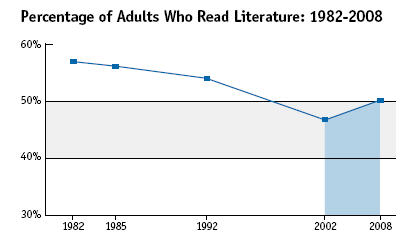
    Literary reading rates on the rise

    What great news!!!

    Washington, D.C. — For the first time in more than 25 years, American adults are reading more literature, according to a new study by the National Endowment for the Arts. Reading on the Rise documents a definitive increase in rates and numbers of American adults who read literature, with the biggest increases among young adults, ages 18-24. This new growth reverses two decades of downward trends cited previously in NEA reports such as Reading at Risk and To Read or Not To Read.

    Adults up 3.5%, young adults (ages 18-24) up by 9%. Full article here. Full report here (with nifty graphs and tables).

    They attribute it to reading programs. Perhaps. I’m sure JK Rowling phenomenon had something to do with it. Whatever the reason, it’s good to hear.

    Share
  • Indie Thoughts: 10 Things I Wish I’d Been Told

    From Russell Blake.

    I get a lot of emails from authors who are just starting out, or who are on the road but frustrated at the level of success they’ve seen thus far. I wish I had more time to correspond with everyone, but the truth is I’m usually slammed with writing/publishing related tasks, and don’t have a lot of opportunity to do more than offer a brief sentence or two.

    But the last few missives I received got me thinking about what I wish someone had explained to me before I started self-publishing in June, 2011. So here’s my top 10 list, such as it is:

    1) There are lots of talented writers out there. Lots. And it seems like everyone’s now got a book, or books, on Amazon. Being good isn’t enough to guarantee you anything but satisfaction for a job well done. It should, but it doesn’t. Don’t take it personally.

    2) There are lots of crap writers out there. Lots. And while many sink to the bottom of the swamp with nary a whimper, some sell well, and some even become bestsellers. This is because the world’s unfair and, depending upon the genre, oftentimes readers don’t care much whether they suck or not, as long as the story entertains or reaffirms some conviction or bias the readers have. These authors succeed in spite of their abilities, rather than because of them. Don’t take it personally.

    3) The internet is filled with gurus who know nothing. It’s hard to turn around without bumping into a writing or self-publishing expert. Most of them are completely full of shit, and don’t sell many books – but that doesn’t stop them from trying to get you to part with your money to hear them tell you what you need to do to sell well. Whenever you hear advice, consider the source. If it’s a million selling author, that means more than from someone whose work ranks slightly lower on Amazon than the collected love poems of Adolf Hitler in original German. Seems like everybody but me is selling seminars, courses, or how to books that promise much and deliver nothing. Must be a good business there, but I prefer labeling my fiction as such and putting in a car chase or gunfight rather than trying to trick the dim or desperate out of a few bucks.

    4) You need to be able to put out books at a decent clip. Sure, you might hit huge off one, but probably not. You’ll be building your readership the hard way, which means one reader at a time, and the more quality books you have on your virtual bookshelf the more likely one will catch someone’s eye. This doesn’t appeal to a lot of authors’ wish that they could write a book every year or two and have a nice living. Sorry. I have yet to see that happen. But it’s a seductive siren song, so lots of newbies listen to it like it’s still a viable way to go. In self-publishing, not so much.

    More at “10 Things I Wish I’d Been Told”.

    I know, I know. Stop making blog posts, John, and finish CURSE.

    Share

6 Comments

  1. John, I whole-heartedly agree with you on this. I have been submitting to WoTF for about six years. In that time I have garnered two Honorable Mentions, but nothing more, yet.

    In 2007 , I think it was, perhaps 2006, I payed my way down to LA to attend the awards celebration for that particular year, mostly to get a feel for the contest and schmooze with the likes of Kevin J Anderson and Tim Powers. It was a fantastic experience. I spent the entire evening chatting with not only the winners and judges, but also many of the guests and other attendees of the event. AT NO POINT did ANYONE even bring up Scientology in any way. Granted a few of the guests I sat next to during the ceremony seemed to be discussing something to do with Dianetics, but, even though I spoke with them for a good deal of time later, they did not broach the subject with me.

    The entire WoTF contest is focused solely on helping emerging writers to break into the business. Even the emails, snail mail, and other correspondence I get from WoTF and Galaxy Press are all about Hubbard’s writing, his stories, and his devotion to assisting young authors.

    Writers of the Future is a wonderful contest pushing a wonderful cause. Anyone who thinks otherwise is either ignorant or being pernicious.

    I fully support the WoTF contest. I will be my way into the business someday. Watch for it, 🙂

  2. If you haven’t seen documentation about Scientology’s systemic abuses, you really have been avoiding looking, frankly. I’ve got some links on my WotF-tagged posts.

    How can Galaxy Press afford to keep the anthologies in print, you might ask? Because I assure you, they benefit from the church’s own internal human trafficking to do so.

    You may not know that Scn owns their own presses, operated by Bridge Publications. There’s frankly no way, despite their claims of massive sales, they could afford to keep the anthologies in print using commercial printers, especially the older anthologies where the sales have tapered off.

    Here’s a lawsuit from a former Bridge staffer who, as a minor, severed a finger in a guillotine that had no safety guards. Minors are prohibited by federal law from operating such equipment, and Montalvo was offered no compensation.

    Meanwhile, workers at Bridge Publications? Are Sea Org, and Sea Org women are prohibited from having children and coerced into abortions. I have a post about that here.

    The camera crew for the event come from Gold Base, where the security is insane. Look at the inward-facing motion detectors, razor wire, spikes — all designed to keep people in (granted, as well as out).

    These are the working conditions for the people who actually make the bright shiny anthologies so that people can say there’s no connection. It’s not just about the surface details, that’s just gloss.

    Here’s the California penal code for human trafficking.

    d1: Scn does this with Sea Org staff. Don’t believe me? Look at the spikes in the link above.
    d2: Scn controls passports and IDs of its Sea Org staff.
    e: Scn does this with Sea Org.

    Watch the testimonies from the Human Trafficking Conference. Of these, Will Fry’s is most relevant as he was actually Sea Org at Bridge Publications.

    Look deeper. I will be.

    Until then, ponder: what social costs are you willing to pay to get a check for a few hundred or a few grand and have your story perpetually in print?

    As Nick Mamatas has pointed out, you have been recruited. Your post is proof that you are indeed doing PR for them with this post.

  3. Deirdre,

    I appreciate the comment and links. I have indeed seen the pictures of the inward facing spikes etc., read the police report filed about the person leaving (fleeing?) the compound, and read about the lawsuit that was settled out of court with the young man who lost part of his finger at Sea Org. I will read Fry’s testimony at the human trafficking conference.

    Having said that, one law suit and a police report don’t indicate systemic abuse. They just don’t. What’s needed is corroborating evidence that demonstrates widespread slavery. Perhap’s Fry’s testimony begins to provide that.

    I will admit I’m totally baffled and a bit perplexed by the practice of “the hole” with executives in CoS. But, again, are these folks really prisoners being held against their will? If so, why? And if it is a prison camp, why aren’t more of those who experienced it speaking out? Why haven’t the authorities cracked down and raided the place? Or is this something those folks have chosen to do? And what’s the whole theory behind its existence? There are just too many questions right now for me to come to any conclusion. And before I rise up in indignation, I need corroboration from trusted sources, not hearsay and internet rumor.

    I hope that makes sense.

    As for me providing WOTF positive PR, you bet. In the post above I argue that’s exactly what they get for the contest–positive PR for WOTF and Hubbard’s name as it is associated with the contest. And why wouldn’t they? It was a thoroughly POSITIVE experience. They do NOT get positive PR for the CoS. As this blog demonstrates. Nor has anyone shown me that positive WOTF PR has any effect on CoS recruitment.

    So as I find more evidence for or against, my opinion on the matter will develop. And I always welcome links to more substantive reports and testimony.

  4. For the people in The Hole, they are indeed prohibited from leaving, as are people on the Rehabilitation Project Force. Debbie Cook was kept there for seven weeks against her will (see her Nightline interview from 2/29). Others, including Heber, have been kept for years.

    I’d recommend you read any of the recent autobiographies from the ex-Sea Org people who’ve left. I was a normal staff at a relatively large Church, but those people aren’t subject to the RPF or The Hole (which are reserved for the Sea Org religious order).

    In order, I’d recommend:

    1) Marc Headley’s Blown for Good – http://blownforgood.com/
    2) Amy Scobee’s Scientology, Abuse at the Top – http://www.scobeepublishing.com/

    The best overall book is Janet Reitman’s http://www.janetreitman.com/ — which is far more accessible to someone who’s never been a Scientologist.

    I don’t really give a spit about CofS recruitment. You’re being used as a PR tool to whitewash the fact that Hubbard used to put kids in chain lockers and threw his crew overboard. If that’s what you want your name associated with, it’s your life.

  5. Deirdre,

    Thanks for the additional links. As for the allegations you mention at the end against Hubbard, again, I can’t make any conclusion without seeing everything laid out. But I will certainly read.

Comments are closed.