Calendar updates

I’ve added a number of entries to the calendar, including three conferences I plan on attending.

I know I’ll be presenting at the first two. The title and description of the League of Utah Writers presentation are:

TITLE: The Secret to Getting Story Ideas

DESCRIPTION: How to stop generating great story ideas by accident and start generating them on purpose, whenever you need them.

I don’t know what I’ll do for LTUE. I might do a repeat of the “The Secret to Getting Story Ideas,” or I might do something on how to write scenes or how genre is the key to plot. Stay tuned!

Date & Time Event Location Notes
Right now Writing Office It’s all for you, Dear Reader
2015, Summer Release of Awful Intent, a Frank Shaw novel All major online retail venues The date is not firm.
2015, Aug 28-29 League of Utah Writers Fall Conference Logan, UT League of Utah Writers
2016, Winter Release of Hard Target, a Frank Shaw novel All major online retail venues The date is not firm.
2016, Feb 11-13 Life, the Universe & Everything Provo, UT LTUE website
2016, May LDStorymakers Conference Provo, UT LDStorymakers website
2016, Summer Release of Glory: The Dark God Book 4 All major online retail venues The date is not firm.
Share

Similar Posts

  • Curse Update: Copy Edits, 2 Books

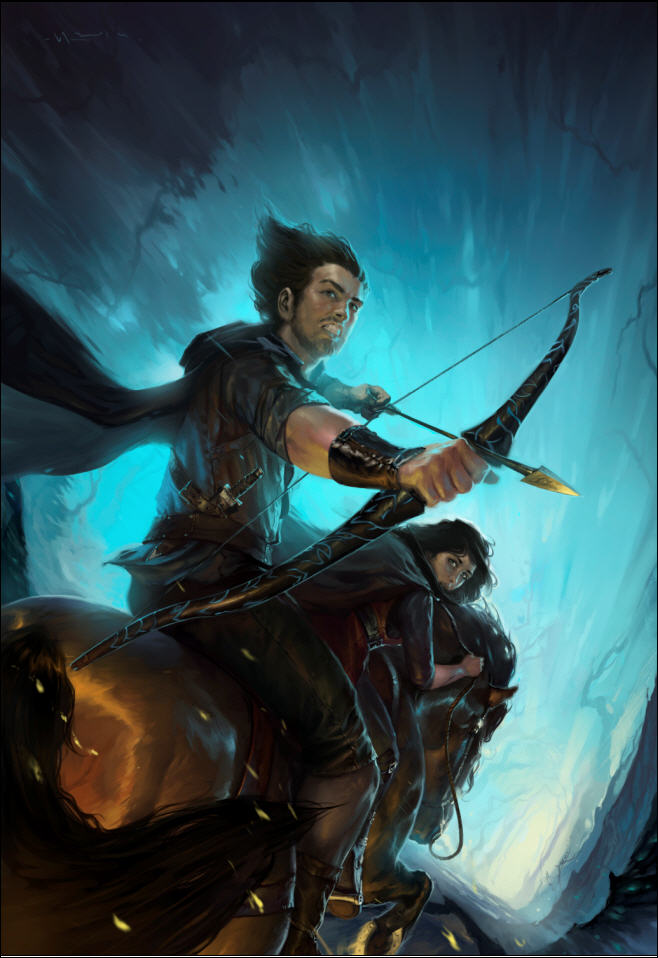
    CurseV2FinalV1My copy editor just delivered the marked up manuscript. I will be making the edits over the next few days. Once those are made, it’s time to publish.

    Ah, but publish just one book?

    Nope. It looks like this is going to be two:

    • CURSE: The Dark God Book 2
    • RAVELER: The Dark God Book 3

    Each book would be about 120k words. Novels can range from around 30-50k words like many middle grade novels (or most of the books written by Louis L’Amour) to the 50-70k length of a lot of romance novels to the 70-100k words of many thrillers to the 300-400k epic behemoths that George R.R. Martin and Sanderson have recently written.  I think most adult novels are around 100k.  I think most fantasies are in the 80-130k area, although many epics can be in the 200’s.  The bottom line is that both volumes will be chock full of story.

    This is all part of a strategy to tell the same long, big story as originally planned, but do it in quicker chunks so that the series can become viable financially more quickly, but also so readers aren’t waiting so long between books.  I have tormented those who enjoyed book 1 and wanted more far too long. I want to remedy that in the future, and more frequent installments will allow me to do this. Getting these two volumes out will help set the expectation, I think.

    So a release of CURSE in July seems more than feasible. Then we’ll release RAVELER early August. Why August? Because we need to commission a new cover illustration. The soonest the artist can have it done would be August. Stay tuned. I can’t wait to see what art Victor comes up with next.

    And if you want to get in on the new release sale for both, please sign up for the notification in the left sidebar.

    Happiness.

    Share
  • |

    You’re invited to join the novel writing workshop pilot

    I am developing an online novel writing course and am looking for folks to pilot it with me and give me feedback. I’m thinking I want to limit it to 10-12 folks.

    It’s free and will probably take two or three months to complete. If you join, your job will be to do the work. And there will be work. I’m thinking 10-15 hours of work per week. Please don’t ask to join if you don’t want to make this commitment. I only want folks who are serious and ready to give this a shot. In addition to the work, you’ll need to report your experience with the course as we go, sharing with me where you get stuck, what’s confusing, what’s helpful, what does and doesn’t advance your skill. In fact, if at some point the course just isn’t providing you any value, you are welcome to drop. That’s good feedback too.

    It’s going to be a blended format that includes self-paced work and some type of weekly online meeting. I will be guiding the class. At the very least, we’ll meet and chat at my site. I don’t know if we’ll do a live meeting or not. Still working that out.

    I struggled for many years, trying to figure this stuff out, then had a number of epiphanies during Orson Card’s boot camp and continued from there. Of course I still have lots to learn. But I want to share what I have.

    I love teaching and have been teaching in one form or another for the last 20 years. I’m currently an education program manager at a large software firm. What this is all means is that I’m trying to build a course that guides folks through a process that will help them learn to WRITE novels. Not just talk about them.

    So this is not a series of lectures with quizzes that test your ability to recall, although I will quiz you.

    It’s not a course with an end goal of teaching you what I’ve learned about the concepts and principles of plot, character, and setting, although you will need to learn that.

    This is about increasing your ability to get ideas, develop them, and then write.

    It’s about doing the work. It’s about production. It’s about finishing product. And having a good time doing it.

    If you already feel comfortable with your ability to finish novels, this is NOT the course for you.

    You can learn more about the course here by clicking The Path in the On Writing menu.

    Probably the only other thing you need to know is that the class is a PG-13’ish class. While the stories can deal with intense and adult themes, as the teacher, I’m not interested in working with stories with explicit or detailed sex or lots of language of the sort that would earn a movie rating more restrictive than PG-13.

    Remember, this is a pilot. Even though I’ve taught about writing for a number of years to various audiences, there might be some rough spots. We might find we need to change the work requirements or activities or any number of things.

    If you’re interested, click on the Contact link on the menu of my site, and shoot me an email.

    Edit 1/30/15: I’m getting a number of excellent questions about the time commitment and schedule. Let me answer them here.

    The gap I’m trying to fill

    First, you have to understand that I am not interested in talking about novels and writing novels. I’m interested in helping folks finish novels. That’s a big gap I see in most writing instruction. It’s the gap I had. There was nobody to help me move from the theory to the writing, and writing all the way to the end. So this isn’t a class about novels. It’s a class where I hope to help you learn a number of techniques for developing and finishing one. And to learn those techniques, you have to actually use them. Which means you have to develop and finish a novel 🙂

    So why 10 hours as a minimum?

    If you’re a slower writer, it’s going to take you around 50 hours to develop and write a novel of 25,000 words. That’s the size of one of Louis L’Amour’s smaller novels (which we call sometimes call “novellas” today). It’s the size of some smaller romances. A lot of indies are writing serials around this size. If you want to write a 50k book, it’s probably 100 hours, maybe more. A 75k novel? 150-200 hours. The development and first draft of a 100k novel? 200-300 hours.

    These are not exact times. Some writers are faster. But you get the picture. Writing a novel is a big project. And I’ve found that it’s just too hard to get any traction on less than 10 hours per week. When you spend much less time than that, you spend most of your time just trying to remember what the story is about. I’ve found it’s best to keep your writing engine hot, or at least warm.

    So will these 10 hours be in meetings?

    No. I don’t want to have a lot of meetings. That’s the beauty of online. We will have deadlines. But you should be able to complete you work during the times that suit you best.

    What’s the course schedule?

    I can’t give you an exact schedule. I haven’t timed everything. Figuring that out is part of what we’re doing in this course. But I do know what I want you to learn and how I hope to help you learn it. We’ll just have to see how far we get with each weekly 10-hour chunk.

    Share
  • NEWS: The Man is going all indie for the next little while

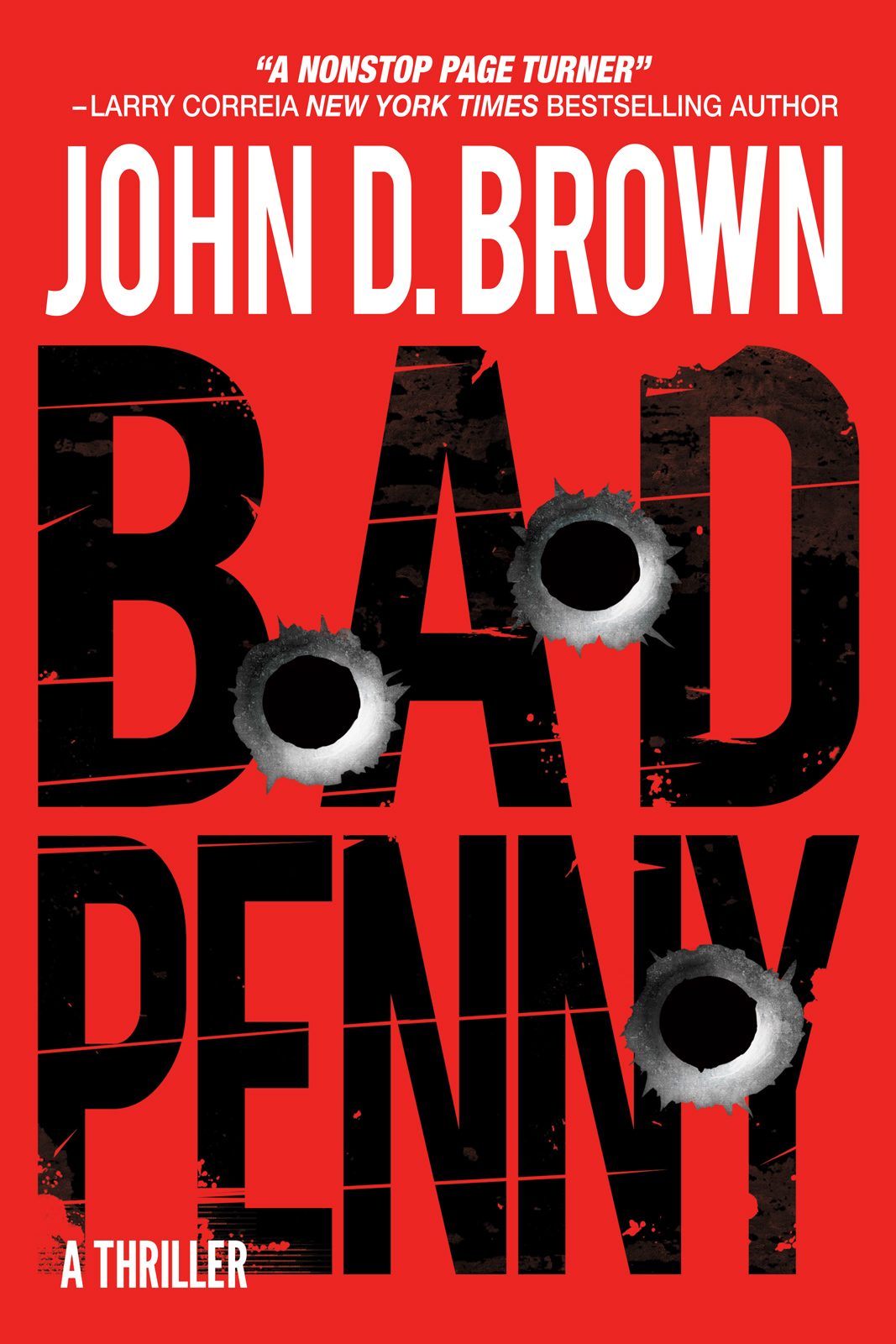
    After discussions with my agent and a few others, I’ve decided NOT to shop BAD PENNY to New York publishers. In fact, I’ve decided I’m not going to be shopping anything to NY for the next 12 – 18 months.

    My agent was certainly willing to take the property out, but given the average expected advance for thrillers ($15-20k per book; maybe up to $100k for three books) and the terms that NY currently wants, I thought that it might be worth it to try to build something on my own.

    I do not hold the illusions some do about indie publishing (I probably hold others). For example, I know quite a few authors who have published indie and are selling very low numbers each month–single digits and teens. Of course, I know others, a smaller portion, who are selling just fine.

    But then what’s the bar? How many copies do I have to sell on my own over a three to five year period to match what NY can do for me via brick and mortar?

    Let’s look at that from a revenue and a unit perspective.

    The average advance for a fantasy, according to Tobias Buckell’s survey, is about $7,000 for a new author. $12,000 for an established author. We saw the numbers I gathered for thrillers above.

    So lets see how many copies I’d have to sell indie style to earn as much as I’d get in an advance from New York.  Why not select a higher number? Well, my understanding is that most books don’t earn out their advance. That doesn’t mean the publisher doesn’t make money; just that a publisher’s profit isn’t dependent on an author earning out.

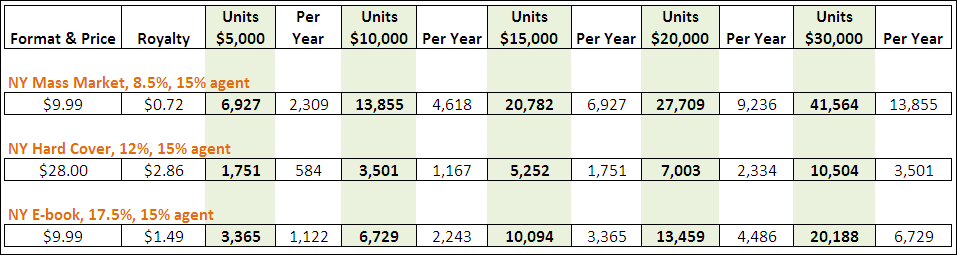
    So what are the numbers? Well, here are the numbers for NY. Down the first column you’ll see the different formats. Across the rows you’ll see how many units I’d have to sell to make the advance specified at the top. And how many units I’d have to sell if I wanted to spread the total over three years.

    IndieNYComparisonNYNumbers

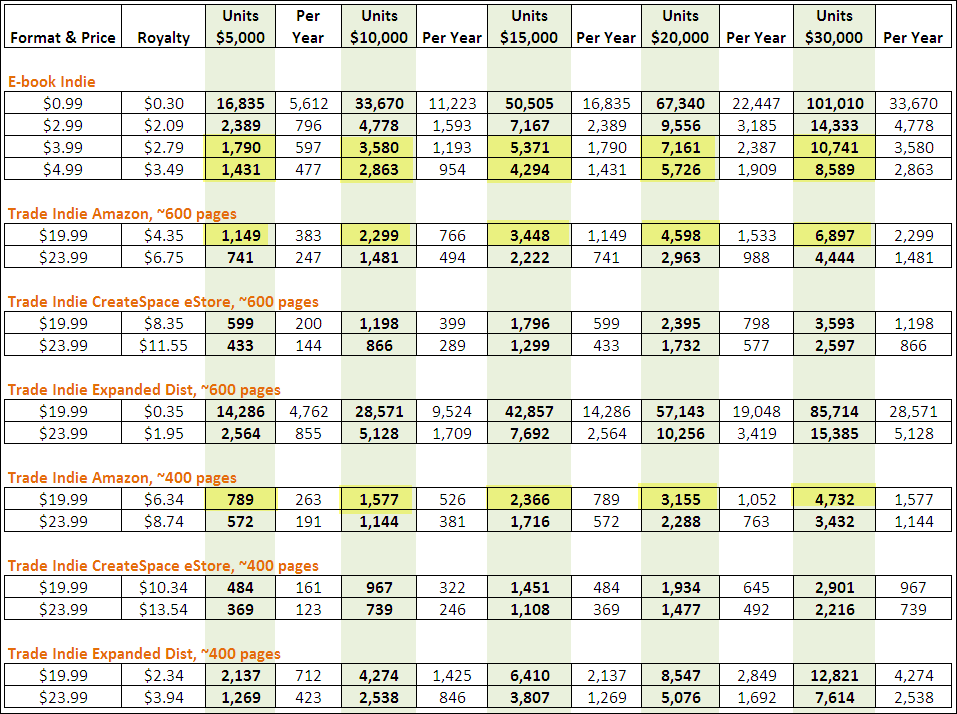
    Okay, and here’s what I’d have to sell if I went indie to make the same numbers. I put in the trade paperback format for both 600 and 400 pages because that’s about how big SERVANT and BAD PENNY are going to be.

    IndieNYComparisonIndieNumbers


    What does this tell me?

    It tells me I have to sell a heck of a lot more units with NY at a much higher price than I do indie.  It tells me that a $5,000 advance is not even close to being worth the control I lose with NY.  And if it’s true that most books don’t earn out, then it tells me the units that are being sold by NY on the average book.

    Back in 2009 I shared this: How Many Copies Do Average Authors Sell? This was from an editor at Tor Books. Seems like my numbers are in the ball park.

    It’s true that NY could get me into brick and mortar stores. But if the book gets shelved spine out in the back, how many people will discover it?

    It’s true that NY produces some spectacular hits. I looked at the USA Today bestseller list yesterday and it appears only about 10% of the books there this week are indies. But I can’t bank on becoming a NY wonder. The vast majority of NY published books DON’T make the bestseller lists.

    Finally, even if I sold BAD PENNY today, it still wouldn’t hit shelves for probably 12-18 months from now. And then it would only stay on the shelves for 12-18 weeks. Going indie, I will have it up by September. And it will stay. For years and years and years.

    There’s no guarantee of success either way. But the indie numbers look good to me. We’ll see how it goes.

    Share
  • SODG Story Edits Finished

    Click to see edits

    Wahooooooo!

    I just turned in my final story edits to Stacy and David. The due date was November 1. The 3rd actually. The book clocks in around 177,000 words.

    Wow. This last set of story edits led to some great changes. Not huge ones, but nice touches. I had to rewrite part of this battle scene, and man, oh, man I’m totally geeking out about it. We’ll see how it plays with readers.

    What’s been interesting is seeing the types of things Stacy and David have commented on in the text. It’s as if they went through asking simple logic questions. Did they have enough time actually to do this? It makes no sense that person y wasn’t there. This thing isn’t fully explained.

    And sure enough, the logic gaps were there.

    So it wasn’t the interest level of the story they seemed to be editing for as much as the details that lead to clarity and belief. Of course, that those two things must be present for the interest to come. And this is not to say they didn’t focus on parts where interest flagged. There was one comment that forced me to cut my favorite dawg scene, a whole chapter’s worth. But the bulk of the comments were focused on the “logic” of the story.

    Anyway, as of next Monday I think I’m officially into production. And back to book 2, which I’m 25,000 words into.

    Share
  • If you liked “From the Clay of His Heart” you can nominate for Hugo

    You may nominate works for the 2009 Hugo award if you either:

    • were an attending or supporting member of Denvention 3 (the 2008 World Science Fiction Convention); OR
    • are an attending or supporting member of Anticipation (the 2009 World Science Fiction Convention) before January 31, 2009

    If you liked “From the Clay of His Heart” and want to nominate it in the novelette category, all you need to do is go here and fill out this form before Saturday, February 28, 2009. You can nominate up to 5 stories in each category.

    If you want to read it, you can do so online if you have an IGMS vol 8 subscription ($2.50). If you don’t plan on subscribing to that issue, post a comment, and I’ll make sure you get a copy.

    Here are nomination numbers for last year’s awards. What this shows is that 40 nominations puts a novel on the final ballot. 17 nominations put a short story there.

    Best Novel (382 nominating ballots cast):
    65 – Brasyl by Ian McDonald
    58 – The Yiddish Policemen’s Union by Michael Chabon
    58 – Rollback by Robert J. Sawyer
    41 – The Last Colony by John Scalzi
    40 – Halting State by Charles Stross

    Best Novella (220 nominating ballots cast):
    52 – “Memorare” by Gene Wolfe
    50 – “Recovering Apollo 8” by Kristine Kathryn Rusch
    49 – “All Seated on the Ground” by Connie Willis
    39 – “The Fountain of Age” by Nancy Kress
    34 – “Stars Seen Through Stone” by Lucius Shepard

    Best Novelette (243 nominating ballots cast):
    69 – “The Merchant and the Alchemist’s Gate” by Ted Chiang
    45 – “Dark Integers” by Greg Egan
    24 – “Finisterra” by David Moles
    22 – “The Cambist and Lord Iron” Daniel Abraham

    Best Short Story (270 nominating ballots cast):
    46 – “Tideline” by Elizabeth Bear
    29 – “Last Contact” by Stephen Baster
    28 – “Distant Replay” by Mike Resnick
    25 – “A Small Room in Koboldtown” by Michael Swanwick
    17 – “Who’s Afraid of Wolf 359?” by Ken MacLeod

    Share