Indie Thoughts: Authors, We Are Not Amazon

Sometimes I think some of us indies get this weird attachment syndrome and start thinking we’re Amazon.

Joe Konrath recently hosted a blog-conversation with Lee Child about the whole Amazon vs. traditional publishers thing. The Passive Voice had an active discussion about it as well.  Kudos to Lee Child for yet again showing up and injecting a new perspective into the conversation. It can indeed become something of an echo chamber in the main indie blogs, which I love, but which nevertheless do still tend to sometimes echo. Having someone with his experience come engage and share his two cents was helpful.

One thing his comments reiterated to me is that neither Amazon nor the publishers are in this as the author’s let’s-get-pinky-rings BFF.

I’m not going to carry an ounce of water for Amazon in their fight with Hachette. I’m not going to carry an ounce for the trad publishers either.

I think it’s helpful for all of us to try to understand the truth about the business, and spread that to other authors, but that’s very different from this knee-jerk Defender of Amazon thing that goes on, which seems so very much like Republicans and Democrats turning a blind eye to their own candidates and fixating a hyper-critical one the others.

Case in point: here’s a link to a description of Amazon’s Gazelle Project.

Why do indie authors care? Because we’re Amazon vendors as well.

Look, I love what Amazon has enabled me to do. I love that Nook and Apple are helping enable it as well. But was this Gazelle Project a good thing? A bad thing? If we stand by and cheer Amazon in such tactics, are we essentially standing by and cheering as Germany takes Austria, France, and Poland? Or are we like England cheering the USA coming in with their troops and bombers?

I’m NOT a traditional publisher. And I’m NOT Amazon, or any other retailer. Even when I contract with them. None of us are. I sometimes wonder if some of us have gotten a bit confused about this.

Konrath says don’t worry about the tiger (Amazon) when a wolf (traditional publishers) is gnawing on your leg. But if you’re an indie writer, you have no wolf gnawing on your leg. That’s someone else’s problem. But we are indeed in bed with the tiger.

Why haven’t we seen more posts about the Gazelle Project on the big indie blogs? Lee Child, darling of the traditional publishers, has to point me in its direction? Why haven’t we been more curious about this tiger’s behavior?

Let’s make hay while the sun shines. The tiger seems to be fairly decent right now. He’s not perfect. For example, eBay strangely enough only charges 15% to sell via their site while Amazon charges 30%. But let’s not forget that as decent as he is, he’s still a tiger. And he’s probably not like those poor guys being made to do tricks by Ringling Brothers.

Ringling_brothers_over_the_top_tiger

Share

Similar Posts

  • Gun Runner wins Dragon Award

    I was very happy to receive news that GUN RUNNER, the novel Larry Correia and I wrote together, just won the 2021 Dragon Award for Best Military Science Fiction or Fantasy Novel.

    The Dragon Awards are a set of literary and media awards presented annually by Dragon Con in Atlanta, Georgia for excellence in various categories of science fiction, fantasy, and horror novels, movies, television, and games.

    And the cool thing is that these awards are voted on by fandom, meaning thousands and thousands of folks voted.

    Past winners have included authors such as Terry Pratchett, Brandon Sanderson, Rick Riordan, and Stephen King.

    As stated in earlier posts, the seed came from Larry’s eleven-year-old son, Joe.

    When Larry and I sat down to develop an idea for a workshop we were holding for Life, the Universe and Everything, a large annual writer’s conference in Provo, a number of years ago, Joe was listening in on the stairs.

    We settled on a genre, and then Correia asked, “Hey Joe, what’s cool?”

    Joe immediately popped up and said, “Giant robots, bandits, and murderers.”

    “We looked at each other and said, ‘Dang, that IS cool.’”

    Forty minutes later we had the key elements we needed for the story we’d use in the workshop. A number of years after that workshop, Baen Books wanted a collaboration from Larry, and that story was one of the first he thought of.

    Larry and I are both frequently asked to present at writers conferences. And one of the tips each of us shares to new authors is to loosen up and have fun. One of the keys to writing an entertaining story is to simply ask, “What’s cool?” And go from there.

    I’m thrilled and honored that those who voted selected Gun Runner for this award.

    Share
  • |

    Writers of the Future, the Church of Scientology, and Killing Puppies

    Author Jim C. Hines recently posted a thoughtful blog about connections between Writers of the Future and Scientology. There are a number of folks who have issues with Hubbard’s metaphysical claims and the church he started. Some folks claim that supporting Writers of the Future (WOTF) in any way supports the Church of Scientology (CoS) and the abuse of the young, the innocent, those who are vulnerable, and the stupid.

    I won a first prize in the Writers of the Future. I received $2,000 cash for the prize and subsequent publication. I also recieved a paid trip to Cocoa Beach, Florida to workshop with the other winners and pro writers. I tell new writers to submit to the contest all the time. I do not feel I’m supporting any wickedness. Let me walk you through this. You tell me if I’m killing any puppies.

    A. What underlies the continued operation of WOTF?

    1. Hubbard wanted it (I don’t know why, although he states it was to help new sff authors and illustrators).
    2. The folks who run it have a very HIGH esteem of Hubbard and so have huge motivation to make it successful.
    3. A trust was set aside, although without looking at the books we can’t know exactly if it’s an independent thing or if money is being funneled from other CoS holdings.  You do not pay many to enter the contest, so all of the money to run the contest and pay prizes etc. comes from this trust, sales of the WOTF anthologies, and perhaps other CoS holdings.
    4. It’s used for positsive PR for Hubbard’s brand name.
    5. The judges, who don’t give a fig about CoS, want to help new writers.

    B. What are the effects of the contest?

    1. No documented writer conversions to CoS.
    2. No documented WOTF anthology conversions of young skulls full of mush to CoS. Someone please show me some evidence of the WOTF antho being a gateway to anything, despite the rumored statements of some Scientologists someone’s uncle overheard.
    3. No documented donations to CoS that I know of.
    4. New writers get paid a whole bunch of money, get to network, and receive instruction from pros for a week.
    5. The winners, on average, think better of Hubbard, as do their friends and family.
    6. Most winners report it was a great experience and encourage other new writers to submit.
    7. WOTF sells some anthologies and makes a little bit of cash to offset expenses. I can’t imagine they’re ever in the black, are they?
    8. WOTF tracks winners and uses those who have done well as PR shiny for . . . WOTF and the Hubbard brand name.

    I was a first place winner. I had a marvelous time. This was the one held in Cocoa Beach, Florida. One night I needed to go to a convenience store to get something (tooth paste?). One of the WOTF folks drove me there. A nice woman. It was raining. It was just the two of us in the SUV.

    I’m a VERY CURIOUS guy. I’ve read most of DIANETICS. I stopped by a Scientology place in Seattle to chat. I like hearing people talk about their faiths, about their lives, about whatever. If you spend any amount of time with me, you will tell me your life story. You will. It just happens.

    I tried my dangest to get something out of that woman, but she was as tight as a clam sealed in four feet of concrete.

    Nobody talked Scientology. Everyone involved went out of their way to avoid it. End of story. I’ve talked to many other winners. They report the same.

    On the other hand, they did have a PR guy there.

    Mr. PR intereviewed us about the contest and Hubbard’s works and took footage. Our one-on-one interviews were on camera. We took still photos. He asked us in our acceptance speeches to thank Hubbard by name.

    He was a PR guy.

    It was very clear his job was to generate PR content for WOTF and Hubbard. How do I KNOW this? Because his questions all centered around WOTF and/or Hubbard. But never CoS.

    Some of the winners did not like his solicitation for a mention of Hubbard’s name. There was some reality show behind the scenes grumbling and scheming, and they did not mention Hubbard in their thanks at the awards event.

    That’s fine, although it didn’t make much sense to me. Maybe they felt gratitude needs to be spontaneous, not asked for. And I can agree with them on that. At the same time, why would I take $2,000 cash for the prize and publication, and the paid hotel, and workshop, and airfare and then slap the folks who gave it to me? I was indeed grateful. So I mentioned Hubbard in my thanks (oh, look at how noble I am; somebody should saint me).

    What did the contest do for me?

    1. Gave me some cash.
    2. Validated that maybe I had some chops. No, I wasn’t competing against pros. But I was competing against all those wanting to break in. I talked to Wolverton, who was a coordinating judge for many years and was the first reader, about the numbers of submissions they received. Hundreds upon hundreds each quarter. Huge boxes full. Were some drek? Of course. Who cares? Others weren’t. I won.
    3. Planted an idea in me that maybe I could do this.
    4. Gave me great connections with some pros and other authors.
    5. Allowed me to tell people I won a big international award for my writing. A little PR for my own brand. Who doesn’t want to engage in a bit of puffery now and then (and so you see, Fred, I am a little fabulous, aren’t I . . . )?

    So the contest, as far as I’m concerned, is a GREAT contest for new writers.

    But am I supporting CoS? And is that a bad thing?

    Every time I purchase a Kraft Foods or Nabisco product, I directly fund Phillip Morris tobacco company and their efforts to hook children on smoking abroad. Some of the tomatoes I purchase in Walmart and other grocery stores are tainted by slavery that occurs today in Florida and California’s central valley with migrant workers. Some of those tomatoes end up in various restaurants like Pizza Hut or Papa Murphy’s. Every bite of chocolate you eat funds slavery in the Ivory Coast, where the vast majority of cocoa beans come from. Not a few slavers here and there, but widespread slavery and abuse. There are many situations like this.

    What do you do when you like a product or service, but don’t necessarily want to lend aid to an affiliated cause?

    In many situations, I don’t do much.

    Alas, there goes my sainthood.

    I admit that I should and should probably think more about this.  At the same time, with regards to CoS, I don’t know that it is a wicked and exploitative organization.

    I’ve seen nothing that suggests they’re into crime. Or systemic abuse. Or fraud. Or that they have a vendetta against dumb people. I don’t share one iota of their faith in Hubbard or his metaphysical teachings. But I do share other values and beliefs with them. Just as I do with Catholics, Muslims, Pagans, Athiests, Communists, and Realtors.

    Besides, I never did PR for them. I’ve always said I DISAGREED with their theology, which is negative PR, if you think about it. Furthermore, I’m fairly confident the contest DOES NOT funnel large amounts of money to CoS.

    What can they be making after taking out the expenses of the award week for all those authors, illustrators, judges, “luminaries,” etc. that they fly in and house, all in addition to the prize and publication monies? I’m confident they make nothing at all, but actually lose money each year.

    So the net net is that they get some PR for WOTF in the SFF community and some for Hubbard’s name. That’s it. That’s what I’m giving them.

    But I don’t see any documented stories of that leading to any donations or conversions to CoS. Or positive PR for CoS. Which, again, I’m still not convinced is a systemically exploitative and wicked organization.

    But even if it were, am I really supporting CoS when I promote WOTF?

    I don’t think so. I’m not giving them cash. I’m not giving them any positive PR. It seems to me purchasing one bag of Oreos or a Lindt chocolate bar does more harm than this ever could.

    I feel so much better now. I am saving the puppies.

    Of course, if you disagree, please post a comment. If you have reliable documentation, not hearsay and tabloid clamor, that can add to the discussion, feel free to share it. I’m all for good data. And if you see issues with my logic, share that as well. But no wild-eyed, Chicken Little, my mother was eaten by CoS aliens rants please.

    As for that Twix I just ate. . .

    (sigh)

    EDIT 1: I just learned the Phillip Morris spun Nabisco and Kraft off in 2007.  So that frees up my Oreo conscience, but the principle remains.

    EDIT 2: Okay, so I just learned that the CoS planned and authorized crimes in Operation Snow White. What to make of that? Comments? Talk about your corporate espionage. I know there are governments and organizations around the world and in the US that engage in that all the time. But this is the first I’ve seen from a “church.”

    EDIT 3: Read through the links on this post by Deirdre Saoirse Moen where she explains why she no longer supports the WOTF contest. Primarily, she just can’t stand some of the CoS practices.

    Of note is the link to the court report by the Village Voice at the Debbie Cook hearing. One question I have is why all those leaders were in the Hole to begin with? Was it some routine church program? Yeah, it sounds awful, but the military puts the SEALs and Special Forces through awful things. So I’m not clear on all of that.  And why haven’t more come out to complain? The unlawful detainment aspect of these allegations is disturbing. But are they really doing this? Are these isolated experiences, or SOP? I don’t know.

    There’s another one farther down that lists alleged harassment of folks posting some CoS theology documents on the internet.  I sampled the documents linked to there. Most of those are just copyright violation letters. SOP for anyone trying to protect copyright.

    Looking at Operation Snow White, the Debbie Cook hearing, and the copyright violation stuff, it’s becoming fairly clear that the CoS has taken an extremely aggressive approach against some of those who speak out against them (maybe it’s over the top) and a similar approach with protecting their materials. Although I think they’ve lost the battle about their materials on the internet. 

    Instead of trying to win public opinion with the truth, it seems in some cases they’ve instead attempted through various methods to try to silence detractors.

    Anyone have any more links to substantive material?

    EDIT 4: Here’s a letter from Joni Labaqui, a Scientologist and the person who runs the whole WOTF shooting match, to Frank Wu, who was an illustrator winner, and had posted some stuff about WOTF and CoS here: http://www.frankwu.com/illo.html (I found the letter at the bottom).

    Dear Frank,

    Hi! It’s Joni Labaqui here. Haven’t seen you since you blew me off at LA Con a few years ago and now I know why. I didn’t understand why you didn’t want to talk to me for very long. I loved your write-up on your site about the contest until you got into talking about Scientology. I know what you mean about feeling hurt when people put down your church. I happen to think you are NOT stupid because you are a Christian. I have many Christian friends and I respect their beliefs and even fight for them. But then you get into my religion on your site and putting out falsehoods, then I realized you didn’t have all of the info. We don’t sue people for bad mouthing our religion. The Church sues when there is slander and liable of considerable magnitude involved. Lets use an analogy here – lets say someone accused you of raping the girl next door, but you didn’t do it. Would you be upset? Lets say the parents then sued you or had you put in jail or both. Would you be upset? Would you hire an attorney? Gee, you’d be involved in a legal suit wouldn’t you? What if the father of the girl made sure you were lied about in the newspapers and on TV and he tried or succeeded in ruining your reputation? How would you feel? On top of that, lets say what really happened is you simply talked to the girl and were trying to help her and she turned around and accused you. How would you feel? And how about all those people who love to gossip? (I personally hate people who gossip as all they are doing is hurting others and they are basically low-life losers – lots of people fit into this category, I’m afraid). How would you feel?

    You were actually wrong in that Scientology pays for the writers and illustrators awards. The Hubbard estate (which is not the church) makes so much money on royalties from his hundreds of published fiction it would make your head spin. You were right about the fact that every one of us who works at Author Services is a Scientologist, but the judges of the contest are not. They share the same goal that Mr. Hubbard did in starting and paying for this contest – to help the new guy, just like yourself back then when you won. So I don’t understand, a nice person like you has to even bring up the subject in your write-up. You think we are interested in “converting” any of you winners just because we have you tour the Life Exhibition? The answer from the horses mouth is NO. We are simply showing you more about his life and works so that you have the facts about the other part of his life, not the bullshit and lies that has been put out by vested interests of multi-billion dollar drug companies and the psychs that can’t stand us. Have you received tons of unwanted, unsolicited mail? The answer is no. Trust me, if we wanted to convert you, you would sure know it. Believe it or not, Mr. Hubbard in founding this contest just wanted you guys to be seen and heard because he knew how hard it is to get started. Period. Its not about Scientology. That is the simplicity of this contest. Anyone reading anything else into it has their own issues and I feel sorry for them. I guess maybe you ran into someone bad mouthing us and you listened to them. If someone badmouthed you – to this day – I wouldn’t buy it. I’d tell them to take a hike. Do you know why? Because I know you are a good person. I met you, I shared some of that joy you experienced when you won, and I was truely happy for you because I like people being happy, winning in life and doing well and winning this contest. I still like you, but I’m a bit disappointed that you felt compeled to write what you did. I don’t get it. I personally put in hundreds of hours of work to help give you the event that you won your award at, so how do you think I feel?

    I hope to hear from you. Best, Joni

    Share
  • No, You Did Not Get a Mandate

    “Mandate” is one of the stupidest words used in politics today.

    You keep using that word

    A mandate is an order, a command from the boss. A requirement.

    Some restaurant owners mandate their employees wash their hands after using the bathroom. I personally like restaurant owners who mandate that.

    States mandate that people who drive cars have car insurance. I like that mandate as well.

    But do political representatives receive mandates?

    When a politician wins an election, does he or she receive a mandate from the people?

    For example, when Obama spanked John McCain in 2008, and the Democrats swept into power, did they have a mandate from the American people to enact certain legislation?

    Obama had 52.9% of the voters behind him. McCain had 45.7% of them.

    Many Democrats at the time claimed a mandate from “the American people.” But if you know some elementary school maths, you’ll quickly recognize that 52.9% is nowhere close to 100%. Or 90%. Or even 70%.

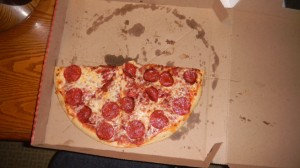
    52.9% is close to, well, 50%. That’s half. As in half a pizza. Here’s a visual for the maths-impaired.

    Half a pizza

    Clearly, 52.9% is nowhere close to “the American people” or “voters.”

    But this was lost on politicians who had the brain capacities of gerbils. They thought the elections magically evaporated the will of 45.7% of the people. They though the other half had suddenly disappeared. They thought government by and for the people meant government by and for half the people.

    Hold on, John. In the Senate, Democrats won 57 seats, Republicans 41. In the House it was 257 to 178, or 59% to 41%.

    Yeah, like I said. About half.

    But such maths were beyond them. And so they began to push through legislation that only half the country wanted. Sometimes much less than half, as in the case of Obamacare.

    They weren’t governing America. They weren’t leading America. They were leading half and oppressing the other half because they had “won the election.”

    So, my fellow Americans, should winning an election give you the right to force something onto the other half of the populace they don’t want?

    Is this what America is all about? Is that the freedom from tyranny we celebrate every fourth of July?

    The Republicans won a great victory in this year’s election, taking back the Senate and expanding their seats in the House. In the Senate, it will probably be 53 to 45. In the House, 244 to 184.

    But does this mean the American people have clearly given them a mandate to enact certain legislation? Does it mean they’re supposed to ignore the other half of the country and ram legislation down their throats they don’t agree with?

    I’m a true blue conservative. Or true red, or whatever the color is. After the last six years, I never want to have legislation rammed down my throat again. And I’ve also come to the realization that I never want to do that to the other guy.

    America hasn’t given the Republicans a mandate. Nor, as President Obama recently claimed, have they given Washington a mandate to “get stuff done.”

    Getting stuff done is exactly the problem.

    We don’t want you to get stuff done.

    We want you to get stuff done that the vast majority of us agree on!

    But, John, does that mean you want us to compromise on our principles?

    No. I don’t want to compromise. I’m not interested in going along to get along. But I’m also not interested in a representative government that fails to represent HALF of us.

    Here’s my proposal. Let’s go back and start over.

    Let’s get rid of Obamacare and put something in its place that at least 60-65% of us can agree on. Maybe 70% of us. It won’t be a liberal weed dream. It won’t be a right wing vision of glory. But whatever gets enacted will be something all of us agree are good things.

    And it will force us to win others to our way of thinking if we want to get the rest of the stuff we think is so splendid.

    But, John, what if folks can’t agree?

    Then we don’t enact. This forces us to use persuasion. It forces is to think win-win. It forces us to behave like a nation that loves freedom.

    Immigration. Do we want an American where the president acts like a tyrant and forces something down half of our throats? Or do we want to enact something 65-70% of us can agree on?

    The budget. Let’s roll back all the nonsense and get a spending plan that 65-70% of us can agree on.

    What about the 30%? I don’t want to oppress them, but 100% ain’t never gonna happen. Let’s be practical. Besides, requiring a large majority means Washington will be at least by and for most of the people. And that’s better than what we have today.

    So, do we have a mandate? If anything, I would hope the mandate would be to do stuff that represents America, not one party.

    Edit 11/10/2014

    And today I find this–an explicit example of the gerbil-brain thinking I reference above. This fine fellow is one of the architects of Obamacare, explaining that the law was written in a way to bamboozle the American voter. What we need in Washington is honest debate and persuasion. Not duplicity and lies. I’m appalled. This is the get-stuff-done-I-have-a-mandate mentality. Not the get stuff done that most of us agree on approach. These folks have completely misunderstood the purpose of government.

    Share
  • Indie Thoughts: Enticing with price

    The top two factors driving book sales both stem from having a loyal customer base. Building that base is the goal as it is in any business that depends on repeat customers. In a previous post I outlined these parts to building that base.

    1. Create a product (a book in this case) that’s likely to delight a certain set of consumers (readers).
    2. Let those consumers (readers) know about it.
    3. Make it enticing for them to give it a try.
    4. Make it easy for those who liked it to know when they can get another; and make it easy to get.
    5. Get more product (another book that’s similar to the last) out the door so your repeat customers can come back for more.

    In this post I’m going to share some thoughts on #3.

    So how do you entice someone new to give you a try? There are a lot of things I see that play into that:  a great cover, description, sample chapters, and reviews that all say quality and scream genre. But there’s another huge factor to making something enticing. And that is price. Or rather price vs. perceived value.

    I’m looking at Mark Corkers reports from Smashwords.

    I’m looking at slides 65-69. I know many of us have seen them.

    If the patterns are similar at Amazon, which sells more ebooks than anyone else, then a price of $3.99 on average will sell more than double the copies of $6.99.

    $3.99 means MORE readers who might develop some level of loyalty, MORE word of mouth, and it means MORE revenue than at other price levels.

    It means more than double the chances of getting your stuff in front on an influencer.

    More than double the chances for luck to come into play.

    And those odds grow exponentially.

    And, again, all along the way that price earns you more than if you were pricing at $6.99 or $9.99 because you sell more books.

    Of course, these are averages, which means folks are winning at prices above and below this. Furthermore, it’s not the same across genres. For example, it appears romance tends to sell better towards the lower end of the range Corker shows.  But it clearly shows that price is an important part of enticing a reader to give you a try.

    And when I look at the indies who are selling huge numbers and have built their customer base, the vast majority of them seem to have gotten there by tapping into the market forces Corker shows on these slides.

    That doesn’t mean they price all their books the same. Some are doing very well using a loss-leader/sample strategy where they offer the first book in a series for 99 cents or free. This also doesn’t mean they set their price and forget. it. They seem to do just the opposite, experimenting with different prices.  I noticed the Joe Konrath, who became a mega-seller at $2.99, raised his prices to $5.99 recently. He’s dropped them back down to $2.99 and $3.99. But he was clearly testing something. In an interview earlier this year with Simon Duringer, Russell Blake who is doing very well in the thriller category recently said this.

    Probably the most effective thing I did over the last two years other than Select, which came and went in terms of usefulness, was making the first book in my JET and my Assassin series free. That lowered the barrier to giving my work a whirl to nil, and my readership exploded from there. About a month and a half ago I stopped doing that because I saw my conversion rates were averaging about 12-13% from the first to the second book, and I questioned whether, with, say, 500 downloads a day, and seeing 60 sales of book two, it might not be more desirable to get 70 paid sales of book one, and seeing that same 60 on the conversion (because if someone pays for your first book, they’re probably going to read it, and soon, whereas if they get it free, it could take years, or more likely, never happen). So far so good.

    Clearly the folks who are doing well with this are experimenting with price to see which levels maximize revenue and loyal customers. And I think that’s the key. They are looking at what seems to be working for others, experimenting, and basing decisions on results.


    Share
  • |

    No Apology

    The Book

    Political TV ads can be fun. And annoying.

    Debates can be fun. And maddening.

    You can indeed learn things about the candidates from watching the ads and debates. But fifteen and thirty second snippets of information really don’t give you the full picture. And sometimes they actually hide the facts, producing nothing more than informational smog.

    Recently, I decided I wanted to really know what Mitt Romney thought.  What he was about.  What he hopes to accomplish if he wins the presidency. If Mitt was someone in my neighborhood, I’d go visit the man, and we’d have a chat.

    I’d ask him about his ideas and past. I’d ask him to give me examples. Because of the nature of the issues at stake and the number of them, I imagine our chat would probably last a few hours.  It might stretch over a number of evenings.

    Of course, I’d want time to consider our chat and determine where I did and didn’t agree with him. I’d want to hear what others thought. And I’d want to look into his history, his successes and failures.

    But the first step would be to go to the man himself and hear him out.

    I hate it when people put words in my mouth. I’m sure Romney, or anyone else running, hates that same thing. If I were running, I’d would hope folks would take the time to hear me out. They may ultimately disagree with me on many or a few things. But I’d hope, as they are gathering information, that they would take the time to actually go to the source and listen to what I myself had to say.

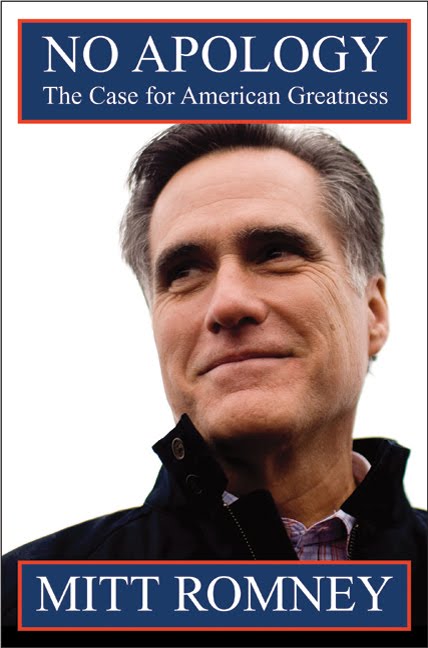
    Unfortunately, I can’t walk around the corner and knock on Mitt’s door. But he did write a book that was published in 2010, and it’s probably the next best thing to talking to Romney at his kitchen table. The book is called No Apology: The Case for American Greatness.

    I’ll admit I thought it was going to be a dry guide book explaining his position on every hot political issue. It’s not a guide book.  In fact, he leaves a number of topics out. Nor was it dry.

    I also suspected it might be a scathing attack piece on the Obama administration. It’s not that either.  Not even close. He does criticize some things where he and Obama differ, but he also commends him on a few things. Either way, Obama is a very small part of the book.

    So what IS this book?

    Romney states its purpose in the introduction: it’s “about what I believe should be our primary national objective: to keep America strong and to preserve its place as the world’s leading nation” and “the course I believe we must take to strengthen the nation in order to remain prosperous, secure, and free” (2). It’s about his ideas on how to make sure America does not falter as so many nations have, but remains wealthy, happy, and productive.

    I finished the book yesterday. I found it interesting, personable, sometimes surprising, and insightful.

    I found Mitt Romney to be a man self-deprecating humor.  He’s also a thinking man, one who likes to look at data to see what it shows. It’s clear he’s a man who does NOT think he knows everything or has a monopoly on every good idea, but he’s also a man who demands evidence.  I also saw a man who is kind.  He doesn’t talk much about his 14 years of service as a lay minister in his church in this book, but you can see how those years changed him as he discusses helping the unemployed, out-of-wedlock births, and single-parent families.  Finally, I saw a man who loves, LOVES, America and is convinced she can remain the hope of the earth, but only if we do things that foster our strength.

    This book outlines what he thinks those things are.

    The book is written in a conversational and easy style with many examples from his personal experience, studies, and history. Romney’s record of accomplishments demonstrates his skills and hard work ethic. This book explains to what end he would apply that skill and work.

    If you’re planning on voting this November for the president of the United States, I think you’ll find this book very useful.  You may end up agreeing with many things he says. You may end up disagreeing with him on many points. But before you can do either, you need to understand what Romney’s position actually is.  And the first step in doing so is to fully hear the man out, in his own words, from his own lips.

    As a result, whether you end up deciding he’s your candidate or not, you WILL come away with important insights into the issues discussed.

    What’s Next

    I want you to know that I do not worship George, Ben, Tom, Adam or any of the other guys who formed our constitution and started this nation.

    They put their lives and fortunes on the line for what they believed in. And I am immensely grateful for what they did.  I enjoy tremendous freedoms because of their courage, determination, and sacrifice. Those guys, by-and-large, rock!

    But I do NOT believe that their words are scripture nor that their ideas are sacrosanct—merely to be accepted and not to be considered and questioned and disagreed with.

    Even so, these guys were gutsy and brilliant. They attempted something everyone thought would fail.  Something that HAD failed every time it had been attempted in their recorded history. But they pulled it off and changed the world.

    These guys believed in the common man. They believed that the educated common man was the best person to hold the reins of government. Thomas Jefferson thought up a rhyme to make the idea easy to remember.  He said, “If a nation expects to be ignorant and free in a state of civilization, it expects what never was and never will be.”

    I can’t argue with that.

    Of course, we’re not going to become experts on every policy issue. But we certainly can become informed on the broad principles and issues. And we can certainly become informed about the candidates.

    Because I found No Apology so useful, over the next few days I’m going to summarize Romney’s main points, chapter by chapter, here. I’ll also point out interesting ideas and facts he shares as well as share any questions, quibbles, or disagreements I have.

    I hope you find it useful. More importantly, I hope you read the book and join in the conversation.

    Share

6 Comments

  1. But was this Gazelle Project a good thing? A bad thing?

    What do you think? Was it a good thing or a bad thing, and why?

    I don’t want to read too much into your comments and would rather hear your plain, honest opinion on the Gazelle Project.

  2. This is something I’ve been thinking about for awhile. It feels like many indie authors side with Amazon on every issue just because, and many traditionally published authors side against Amazon for the same reason. They act like to agree with the other side on any one issue is a defeat. I don’t get it. I love indie because it means more books for me to read that otherwise would never be published, but at the same time I don’t like Amazon pricing rules (they should let the market decide what is the appropriate price for ebooks, not the the supreme court).

  3. James,

    Here’s what I think drives the knee-jerk response.

    #1. Group identity. Amazon is a blessed partner to many indie authors. It’s perceived as being part of the indie group, or at least as a super friendly ally. And so when the buddy gets attacked, there’s an urge to stand up and defend him.

    #2. This attachment can be stronger for those who feel like trad pub screwed or rejected them. How many indie authors who were once with trad pub feel they weren’t treated well? How many never got welcomed into the building by trad pub, but were received with open arms by Amazon?

    Of course we think about the fates of other authors in general. I don’t think there’s one motivation. But from all the comments I read and those I make myself, it seems there’s a knee-jerk defense of Amazon. And I think simple group dynamics are driving a large part of it.

  4. Mike,

    I don’t know if it’s good, bad, or neutral. That’s why I think it would benefit from a lot of discussion.

    On the one hand, it’s a bit troubling to hear Amazon characterizing its vendors/partners that way. Why wouldn’t they view us indies the same way?

    On the other, is KDP a major feature of Amazon’s attempt to take-down the wounded gazelles and this all about courting authors?

    Has Amazon done this elsewhere?

    And what can authors do now to make hay, but minimize the risk should Amazon turn on them?

    I think these lines of questioning are so much more fruitful than pages and pages and pages about Hachette.

    Personally, I hope Hachette wins because I think the higher prices make it easier for indies to compete.

  5. I’m a huge fan of Douglass Preston (and his co-author Lincoln Child), and upon reading his petition I found myself agreeing with the spirit of it. That being said, I firmly believe that indie publishing is the future, and that it’s an exciting future that probably doesn’t include traditional publishers (at least in their current incarnation). Amazon is an engine propelling that exciting future forward, and part of me is rooting for them.

    Reading Lee Child’s post on the subject, I think Amazon is probably behaving in a way that is unprofessional. Using their platform to punish publishers that don’t agree to more favorable terms (though it’s no doubt their right to do it) feels icky. Hachette should call their bluff and walk. I have no doubt they would/will use the same tactics on indie authors when the need arises.

  6. But it’s hard to walk when something like 40% of your revenue is tied up there 🙂 Where are they going to find those sales?

    At the same time, if Amazon doesn’t carry folks like James Patterson, that will ding them. Their model depends on being THE place to find what you’re looking for.

    I am very interested to see where this goes. In the meantime, I gotta make me some hay.

Comments are closed.